
 Search

Siemens is investing in Skeleton Technologies through a strategic financing round that values the energy-storage company above $1 billion, adding supercapacitor-based power buffering to its data-center electrical portfolio. The October 14 announcement includes an exclusive global partnership for Siemens to sell and scale Skeleton’s products in the data-center market. Skeleton described the financing as a nine-digit round without disclosing the precise amount. Siemens said the transactions remain subject to customary completion formalities.
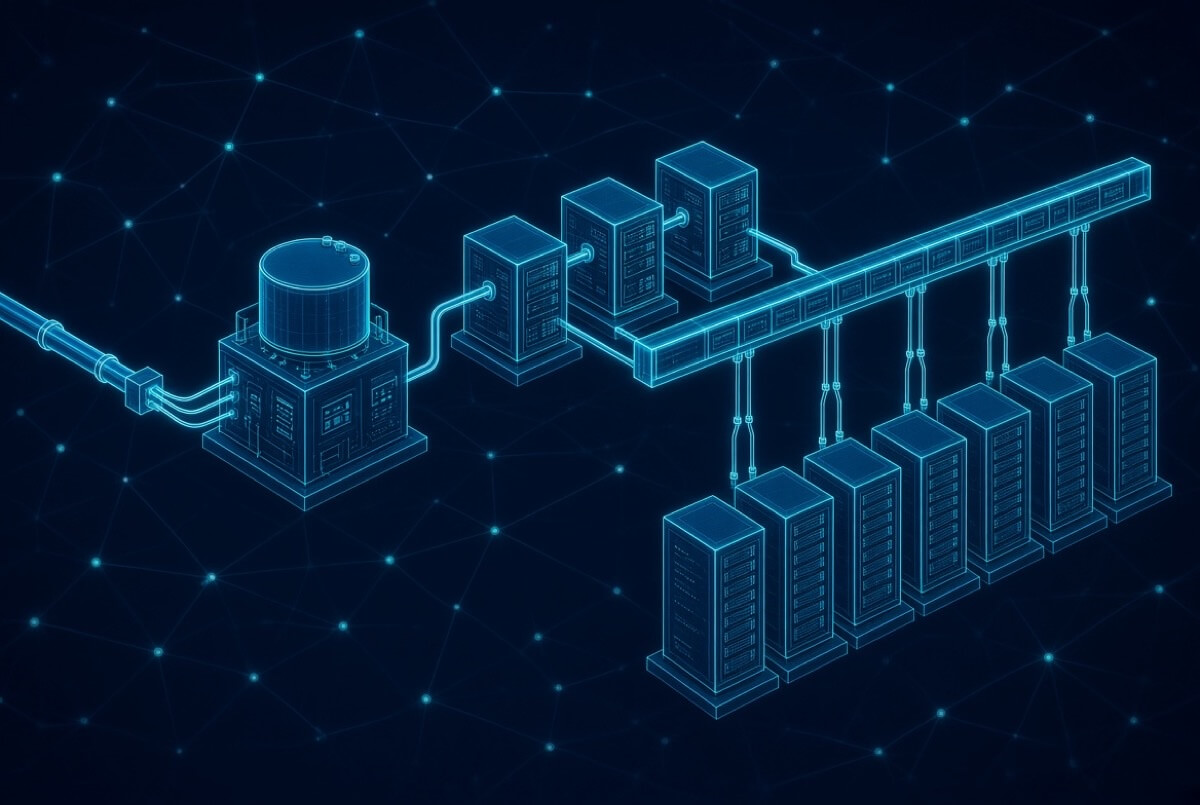
The technology targets rapid changes in GPU electricity demand. Synchronized AI workloads can produce millisecond load transitions that accumulate into megawatt-scale swings across a cluster. Skeleton combines supercapacitor cells, power electronics and controls to buffer those changes. Its GrapheneGPU systems discharge during compute peaks and recharge during lower-load periods, smoothing the demand presented to upstream electrical equipment. Siemens intends to incorporate the technology into existing AC installations and retrofit projects while supporting the transition toward 800 VDC infrastructure.
Skeleton plans more than $200 million in operational expansion and Silicon Valley R&D, alongside proposed U.S. cell manufacturing. The objective is a domestic supply chain extending from cells to complete systems. Skeleton also claims up to 40% energy savings and double-digit GPU-performance improvements; its announcement does not provide the test conditions needed to apply those figures to a specific deployment.
| Siemens + Skeleton — AI Power Buffering | |
| • Valuation | Above $1 billion |
| • Partnership | Exclusive Siemens sales and scaling rights in data centers |
| • Technology | Supercapacitors, power electronics and controls for GPU load smoothing |
| • U.S. expansion | More than $200 million planned for scale-up and Silicon Valley R&D; domestic cell production proposed |
| • Deployment path | AC retrofits and emerging 800 VDC architectures |
“The race to scale AI is increasingly becoming a race for power,” said Peter Koerte, Siemens Managing Board member and President of Smart Infrastructure.
Analysis
Siemens has been expanding the manufacturing base behind its AI infrastructure portfolio. In August, it committed more than $200 million to new electrical-equipment facilities in Pendergrass, Georgia, and Grand Prairie, Texas, with more than 1,500 jobs planned. Those investments address production capacity for electrical distribution equipment. Skeleton adds technology for managing the changing load that equipment must serve.
The investment also complements Siemens’ August partnership with Reinhausen to develop a solid-state transformer accepting grid voltages up to 36 kV and delivering 800 VDC. Together, these initiatives suggest a portfolio spanning incoming power conversion, electrical distribution and fast energy buffering near computing equipment. That architectural connection is an editorial assessment; the announcements do not establish a single jointly qualified system.
Power smoothing addresses the difference between a cluster’s instantaneous demand and the load its upstream infrastructure must accommodate. Skeleton’s product documentation describes charging during lower GPU activity and supplying power during compute bursts. The practical benefit will depend on workload behavior, storage sizing, controls and facility constraints. Customer deployment results and measured performance under disclosed conditions will therefore be useful next milestones.
| Company Profile — Skeleton Technologies | |
| Status | Private company |
| Headquarters | Tallinn, Estonia |
| Leadership | Taavi Madiberk — CEO and co-founder |
| Founded | 2009, in Tartu, Estonia |
| Core technology | Curved Graphene supercapacitors and integrated power systems |
| Products | GrapheneGPU • GrapheneUPS • GrapheneBBU |
| European footprint | Engineering in Estonia; manufacturing operations in Germany and Finland |
| Coverage | AI infrastructure • power quality • energy storage • grid stability |

-
 C114 Communication Network
 -
 Communication Home
