
 Search

Amd.com
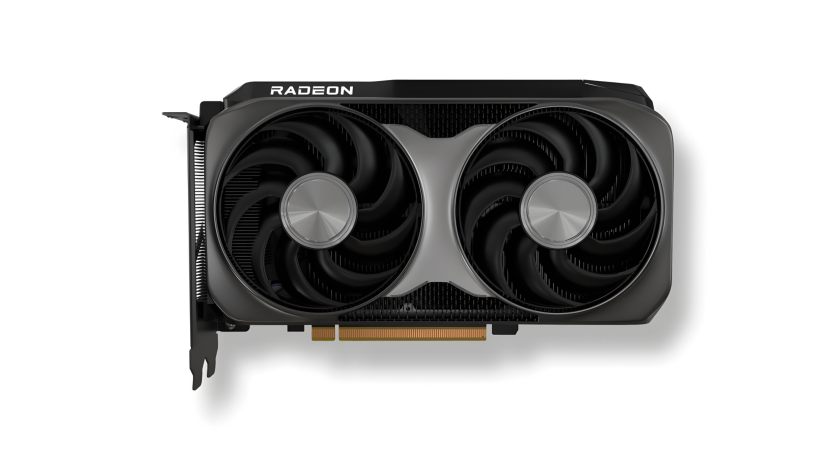
AMD has officially added the Radeon RX 9050 to its Radeon RX 9000 desktop GPU lineup, priced at $279 USD and targeting Asia-Pacific, Japan, and Latin American markets at launch per AMD's official product page. If you are shopping for a pre-built system with an RX 9050 inside, stop and read the specifications first: an OEM-exclusive 4GB variant shares the RX 9050 name but runs on a 64-bit memory bus — delivering roughly half the memory bandwidth of the retail 8GB card AMD is benchmarking and promoting.
The retail card, available as standalone purchases from add-in board partners including ASRock, Sapphire, and PowerColor, carries 8GB of GDDR6 on a 128-bit bus delivering up to 288 GB/s of bandwidth per AMD's official specifications. Those are the numbers AMD's published benchmarks represent. The pre-built variant — currently confirmed in the CyberPowerPC Gamer Master GMA6600BST, available at Best Buy for $889.99 — contains the 4GB/64-bit model and reaches only 144 GB/s.
North American and European buyers have no firm purchase date for either variant. AMD has not announced when the standalone retail card will reach those markets per the Notebookcheck launch report. The $279 suggested retail price applies to the initial APJ and Latin America rollout.
Two Products, One Name: How to Tell the Difference
The distinction between the two RX 9050 configurations is material, not cosmetic. Both share the same Navi 44 die — 16 Compute Units, 1,024 Stream Processors, 16 Ray Accelerators, and 32 AI Accelerators — but their memory subsystems are entirely different.
The retail 8GB model uses 18 Gbps GDDR6 across a 128-bit interface, producing 288 GB/s of bandwidth. The OEM 4GB model uses the same 18 Gbps GDDR6 but across a 64-bit interface, producing 144 GB/s — identical to a card configuration AMD itself criticized in a 2020 AMD blog post that attracted widespread attention in 2022, when AMD argued that "competitive products at a similar entry-level price-point are offering up to a maximum of 4GB of VRAM, which is evidently not enough for today's games."
AMD confirmed the 4GB variant will not be sold as a standalone retail card. It was developed specifically for the CyberPowerPC system, and AMD states there are currently no plans to release it elsewhere.
How to identify which variant is in a pre-built you are considering: look for the memory size and memory interface in the system's specifications listing. A system spec sheet showing "4GB GDDR6" contains the OEM variant. A sheet showing "8GB GDDR6" or simply listing "Radeon RX 9050" without memory details warrants a call to the retailer. AMD's product page covers only the 8GB retail card.
What the RX 9050's Architecture Actually Does at 92W
The retail RX 9050 is built on AMD's Navi 44 silicon — a 199mm² die manufactured on TSMC's N4P (4nm) process node, carrying 29.7 billion transistors per the Radeon RX 9000 series specifications. The full Navi 44 die supports up to 32 Compute Units; AMD has enabled 16 of them on the RX 9050 through a process called CU harvesting, which allows AMD to ship dies that don't clear the full-specification yield threshold as lower-tier products rather than scrapping them.
Each of those 16 Compute Units is meaningfully faster than an equivalent unit from the previous RDNA 3 generation. RDNA 4's redesigned CU includes dual SIMD32 vector units, improved dynamic register allocation, dual-issue instruction capability, and dedicated AI matrix acceleration hardware capable of FP8 precision — the last of which is why the entire FSR Redstone feature suite (upscaling, ML frame generation, ray regeneration, and radiance caching) runs natively on this card.
The 32MB Infinity Cache supplements the 128-bit GDDR6 interface. Rather than relying entirely on raw off-chip memory bandwidth, RDNA 4 uses the on-chip cache as a large working-set buffer. For typical 1080p workloads, where frequently accessed texture data fits within those 32MB, the effective bandwidth is substantially higher than the 288 GB/s headline figure. AMD's memory compression enhancements in RDNA 4 further reduce the raw bandwidth demand, which is part of why the architecture achieves competitive rasterization performance despite a 128-bit bus rather than the wider buses used on higher-end cards.
At 92W typical board power — 40W less than the non-XT RX 9060's 132W — the RX 9050 draws from a single 8-pin PCIe power connector and a 450W minimum PSU per AMD's product specifications. The power reduction is a direct consequence of halving the active Compute Units: fewer shader arrays toggling means lower leakage current, more conservative voltage-frequency curves, and a smaller thermal footprint. Every board partner has announced dual-slot, dual-fan designs measuring up to 249mm (9.8 inches) in length.
The boost clock of 2,600 MHz on AMD's reference specification corresponds to 10.6 TFLOPS of FP32 compute performance. Sapphire's PULSE variant raises the factory boost to 2,760 MHz and uses Honeywell PTM7950 phase-change thermal interface material.
What FSR Redstone Means on an Entry-Level Card
Every RX 9050 — retail or OEM — carries full access to AMD's FSR Redstone suite, which bundles four machine-learning powered features exclusive to RDNA 4 hardware. FSR Upscaling (formerly FSR 4) reconstructs high-quality images from lower-resolution renders. ML-based Frame Generation inserts AI-predicted frames between rendered ones. Ray Regeneration is a neural denoiser for ray-traced content. Radiance Caching accelerates global illumination by predicting how light propagates through a scene rather than recomputing it.
The reason these features are RDNA 4-exclusive is the hardware: FSR Redstone's inference tasks require FP8-precision matrix operations, which the 32 AI Accelerators in the RX 9050 support natively per AMD's Adrenalin 26.7.1 release notes. Previous RDNA 3 hardware (Radeon RX 7000 series) handles only FP16 and INT8 matrix operations, which AMD considered insufficient quality for the full ML workloads. AMD backported FSR 4.1 upscaling to RDNA 3 using an INT8 adaptation in June 2026, but Ray Regeneration and Radiance Caching remain RDNA 4-only.
For a buyer with an older Radeon RX 6000 or RX 7000-series card, the RX 9050 represents a generational leap in supported feature access — not just the compute improvement, but the availability of ML-accelerated upscaling, frame generation, and ray-tracing denoising that the previous-generation cards cannot run in their full-quality form.
The display output suite matches what AMD offers on its flagship cards: one DisplayPort 2.1a port (supporting up to 80 Gbps, sufficient for 4K at 240Hz or 8K at 60Hz) and two HDMI 2.1b ports per AMD's official specifications. AV1 hardware encode and decode are also present, enabling high-quality video streaming and recording without CPU involvement.
Can AMD's Own Benchmarks Be Trusted Here?
AMD has published 1080p gaming performance figures on its official product page, and the test platform is disclosed in the page's footnotes per AMD's product page: a Ryzen 7 9800X3D CPU, 32GB DDR5-6000 memory, and a B650E motherboard, using driver version 26.6.2 and tested in July 2026. Those numbers: 96 FPS in Cyberpunk 2077 at medium settings, 131 FPS in Forza Horizon 6, 85 FPS in Pragmata, 60 FPS in 007: First Light, and 593 FPS in Valorant at high settings.
The platform disclosure resolves one question while raising another. The Ryzen 7 9800X3D is AMD's highest-performance gaming CPU, featuring 3D V-Cache technology that reduces game loop latency — not a representative pairing for a $279 entry-level GPU. A mid-range CPU pairing would likely produce somewhat lower results, particularly in CPU-bound scenarios. Hardware publication Club386 flagged the 60 FPS result in 007: First Light at medium settings as a concern, describing it as "an obvious red flag" given that lower settings should normally provide more headroom.
Whether FSR upscaling or frame generation was active during AMD's tests is not explicitly stated for any title in the footnote. The settings listed (DX12 Medium, DX12 Balanced) do not indicate FSR status.
What is not in dispute is that no independent review outlet has received a card: AMD has not run a review program for the RX 9050, a choice Club386 confirmed after the launch. Independent benchmarks will arrive once retail units reach press in Asia-Pacific markets — at which point the card's true standing against the Nvidia GeForce RTX 5050 will become clear.
That comparison is the crux of the buying decision. The RTX 5050 launched at a $249 MSRP; at current US market prices it has climbed to approximately $309 on Amazon, above the RX 9050's $279 SEP. The RX 9060 — a related but OEM-exclusive AMD card with 28 Compute Units — averaged 19.8% faster than the RTX 5050 in independent testing across 10 1080p benchmarks by Korean publication Technosaurus. The RX 9050, with half the Compute Units of the RX 9060 and lower clocks, is expected to land considerably closer to RTX 5050 performance parity — but the exact margin awaits independent data.
Adrenalin 26.7.1 Driver: What Else It Delivers
Alongside the hardware launch, AMD has released AMD Software: Adrenalin Edition 26.7.1 — a WHQL-certified release supporting Windows 10 and Windows 11 in 64-bit editions. The driver's build numbers are 26.10.35.01 for the Adrenalin package and 32.0.31035.1003 for the Windows Driver Store.
Beyond RX 9050 support, 26.7.1 adds game-specific optimizations for the Gears of War: E-Day Open Beta Early Access, which begins August 6, and for the open-world PvP title Out of Control Evolution. On the bug-fix side, the driver resolves model flickering and rendering failures in Maxon Cinema 4D and Blender affecting RX 7000-series and newer cards, and addresses intermittent crashes tied to AMD FSR Upscaling 4.1 on Windows 10.
Several known issues remain unresolved. AMD is still working on an intermittent driver timeout when playing Battlefield 6 on the Ryzen AI 9 HX 370 platform, and texture flickering or corruption may appear in Battlefield 6 when AMD Record and Stream is active. FSR upscaling and frame generation may also show as inactive in Battlefield 6 on RX 9000-series cards per the release notes' known issues section.
When Will North American and European Buyers Get the RX 9050?
AMD has not said. The pattern with the RX 9070 GRE — which launched as a China-exclusive on March 6, 2025, then went on global sale June 2, 2026 — suggests regional exclusives eventually broaden, but no comparable timeline has been communicated for the RX 9050. The launch is also complicated by ongoing GDDR6 memory price pressure. AMD raised the memory kit prices it charges board partners by approximately 10% in July 2026 — its second such increase in six months, with an additional 10 to 15% increase anticipated in the second half of 2026 according to supply-chain reporting. Street prices for the RX 9050 in North America and Europe, whenever the card becomes available, may exceed the $279 SEP as a result.
The GDDR memory shortage is also the underlying force behind the 4GB OEM variant's existence. VRAM now accounts for more than 80% of the bill of materials on some high-end GPUs, according to TrendForce reporting cited across the industry, and the AI data center boom is consuming GDDR and HBM capacity faster than manufacturers can expand it. An entry-level card designed around 4GB rather than 8GB reduces the memory cost per unit — at the expense of the buyer in a pre-built system who doesn't look closely enough at the spec sheet.
Key Specifications: AMD Radeon RX 9050 (Retail 8GB)
| Specification | Value |
|---|---|
Architecture | RDNA 4 (Navi 44) |
Manufacturing Process | TSMC N4P (4nm) |
Compute Units | 16 (of 32 on full Navi 44 die) |
Stream Processors | 1,024 |
Ray Accelerators | 16 |
AI Accelerators | 32 |
Infinity Cache | 32MB |
Game Clock | 1,920 MHz |
Boost Clock | 2,600 MHz |
FP32 Performance | 10.6 TFLOPS |
Memory | 8GB GDDR6 at 18 Gbps |
Memory Bus | 128-bit |
Memory Bandwidth | 288 GB/s |
Typical Board Power | 92W |
Power Connector | 1x 8-pin |
Minimum PSU | 450W |
Display Outputs | 1x DisplayPort 2.1a, 2x HDMI 2.1b |
Launch Price (SEP) | $279 USD |
Initial Markets | Asia-Pacific, Japan, Latin America |
OEM-Only 4GB Variant (not for standalone sale): Same Compute Unit count; 4GB GDDR6 on a 64-bit memory bus; approximately 144 GB/s bandwidth; available only inside CyberPowerPC pre-built systems such as the Gamer Master GMA6600BST ($889.99 at Best Buy).
Frequently Asked Questions
What is the difference between the RX 9050 4GB and the RX 9050 8GB?
They share the same GPU core — 16 Compute Units, 1,024 stream processors, and the same clock speeds — but their memory configurations are completely different. The retail 8GB model uses a 128-bit memory bus delivering 288 GB/s of bandwidth. The OEM-only 4GB model uses a 64-bit memory bus delivering 144 GB/s, approximately half the throughput. The 4GB variant is not sold as a standalone card and is currently found only inside CyberPowerPC pre-built desktops sold at Best Buy. Before buying any system listed as including an RX 9050, verify the memory size and bus width in the full specifications.
How does the RX 9050 compare to the Nvidia RTX 5050?
Independent benchmarks of the retail RX 9050 are not yet available — AMD did not provide cards to reviewers ahead of today's launch. AMD's own 1080p benchmark figures (96 FPS in Cyberpunk 2077, 60 FPS in 007: First Light, both at medium settings) are self-reported and conducted on a high-end Ryzen 7 9800X3D platform. For context, the RX 9060 — a related AMD card with 28 Compute Units rather than the RX 9050's 16 — averaged 19.8% faster than the RTX 5050 in independent testing. The RX 9050, with nearly half the RX 9060's compute count, is expected to land much closer to RTX 5050 parity. The RTX 5050 launched at $249 MSRP; current US street prices sit around $309. The RX 9050's $279 SEP applies only to its initial launch markets (Asia-Pacific and Latin America) and may differ when North American availability is confirmed.
When will the AMD RX 9050 be available to buy in the US?
AMD has not announced a North American or European availability date. Today's launch is limited to Asia-Pacific, Japan, and Latin America. The precedent from the Radeon RX 9070 GRE — which was a regional exclusive for months before going on global sale — suggests broader availability will follow, but no timeline has been communicated. When the card does reach the US, ongoing GDDR6 memory price increases may push street prices above the $279 SEP.
Is the RX 9050 a good upgrade from older budget cards?
For the retail 8GB model: yes, particularly for buyers replacing Radeon RX 5000, RX 6000, or even early RX 7000-series cards. The full RDNA 4 FSR Redstone feature set — including ML-powered upscaling, AI frame generation, and ray-tracing denoising — arrives on the RX 9050 at 92W, making it compatible with older systems that cannot accommodate the 132W or higher draw of the RX 9060 series. The connectivity spec (DisplayPort 2.1a, HDMI 2.1b) also matches AMD's flagship cards. The key caveat is that independent performance validation does not yet exist, and the 60 FPS result in 007: First Light at 1080p medium on AMD's own test bench raises questions about headroom as games grow more demanding.

-
 C114 Communication Network
 -
 Communication Home
