
 Search

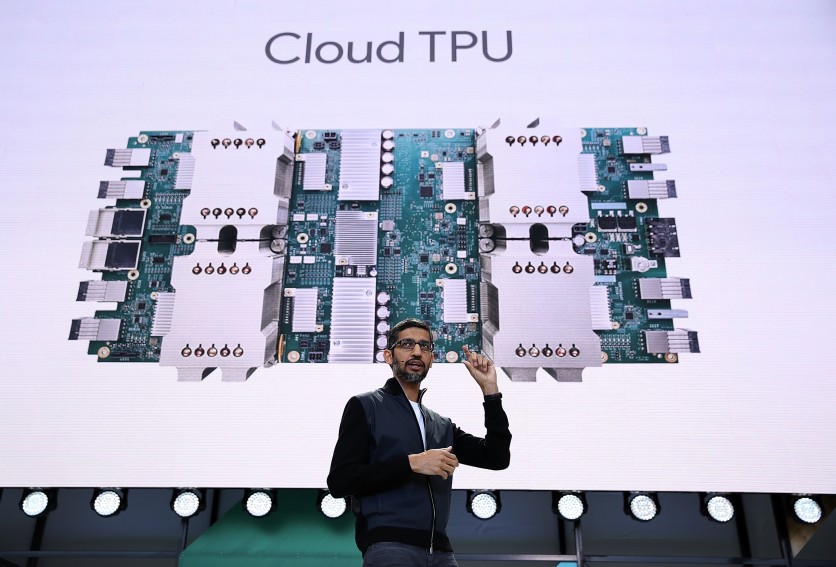
Google CEO Sundar Pichai delivers the keynote address at the Google I/O 2017 Conference at Shoreline Amphitheater on May 17, 2017 in Mountain View, California, showcasing Cloud TPU developed by Google. Getty Images/Justin Sullivan
Google is building a server chip that does something no production AI accelerator has done before: it embeds the structural blueprint of its Gemini model directly into the circuitry, bypassing the general-purpose flexibility that makes chips like TPUs useful for many things but efficient at none in particular. The project, known internally as "Frozen v2," sent Alphabet's stock climbing as much as 3.7% intraday on Monday before closing the session up 1.51%, while touching off pointed debate about whether Google's flagship model has stabilized enough to make that kind of architectural commitment in silicon.
Engineers working on the project project the chip could deliver between six and ten times the token output per watt compared with Google's latest generation of Tensor Processing Units, according to SiliconAngle's analysis of the reporting. That figure, if it holds, would represent one of the largest single-generation efficiency leaps in AI inference hardware. It would also, if Google's architectural bet proves correct, reshape the economics of running large language models at scale across the entire industry.
Google has not officially confirmed the project. The 2028 deployment target is a reported goal, and the efficiency figures are projections from engineers familiar with the design, not independently benchmarked results.
Why General-Purpose Chips Waste Energy Running Gemini
Every chip in a modern AI data center — Nvidia's H100, Google's own TPU 8i, Amazon's Trainium 3 — is built to run any model you load onto it. That flexibility is the product. But flexibility has a hidden tax.
When a general-purpose accelerator runs an AI model, it must constantly make runtime decisions: which arithmetic units to activate, how to schedule memory fetches, how to route data between its thousands of parallel cores. Those decisions mirror the model's architecture — its number of attention heads, its feed-forward layer dimensions, its normalization structure. But because the chip doesn't know in advance that it will only ever run Gemini, it must compute those decisions fresh for every inference request.
The deeper cost is data movement. Modern AI inference is not primarily a compute problem; it is a data movement problem. Off-chip memory accesses — when a chip must fetch model data from external storage rather than holding it locally — consume roughly two orders of magnitude more energy than the arithmetic operations they support. A large language model with billions of parameters cannot fit on a chip's small cache, which means constant shuttling between the chip and external memory. Faster chips don't fix this. More chips don't fix this. The only real fix is to move less data.
Frozen v2 attacks both problems at once. By hardwiring Gemini's architectural structure into the chip's circuitry itself, the hardware no longer needs to compute its own scheduling at runtime — the correct routing is physically built in. Multiple sequential computational steps that a standard chip would execute as separate memory-touching operations can instead be fused into a single hardware primitive: the chip performs the entire compound operation in one pass, writes only the final result, and never moves the intermediate values at all. This technique — operator fusion — is already used in software on conventional chips, but Frozen v2 bakes it into the silicon permanently.
The second mechanism is potentially more dramatic: because the chip is designed entirely around Gemini's specific architecture, it could theoretically be equipped with just enough on-chip memory to host the entire model, eliminating off-chip data movement for inference almost entirely. That would change the energy math from "200 times more expensive per fetch" to "essentially zero fetches."
Architecture vs. Weights: The Distinction That Makes Frozen v2 Possible
The project has a predecessor, and understanding why that predecessor was abandoned explains everything about what makes this version different.
The original "Frozen" initiative, led by Google DeepMind Chief Scientist Jeff Dean, proposed something far more extreme: burning Gemini's specific trained numerical parameters — its weights — directly into the chip's circuitry. Weights are the billions of numbers produced by training that determine how the model actually processes language. Bake them in, and you get a chip that runs one specific snapshot of Gemini with extraordinary efficiency. You also get a chip that becomes obsolete the moment Google releases the next version of Gemini.
That approach was set aside. A chip tied to a single trained model version would have a commercial lifespan measured in months, not years. The non-recurring engineering costs of a custom ASIC — which can run into the millions of dollars even before fabrication — cannot be amortized against that timeline.
Frozen v2 draws a critical distinction. A neural network's architecture and its weights are different things. The architecture is the blueprint: how many transformer blocks, how many attention heads per block, what the hidden dimension sizes are, how the feed-forward layers connect, what normalization approach is used. These structural choices change rarely — typically only when a lab fundamentally rethinks its model design. The weights are the numbers that fill that blueprint after training, and they change with every model update.
By hardwiring the architecture rather than the weights, Frozen v2 locks in Gemini's structural shape — which Google controls and evolves deliberately — while leaving the weights updateable. A future Gemini release, trained on more data or with new capabilities, can run on the same Frozen v2 hardware as long as Google keeps the underlying architectural structure intact. How much of the architecture will actually be hardcoded has not yet been determined by engineers still working on the design.
Compute Crisis: The Problem That Made Frozen v2 Urgent
Google is not pursuing this design as an academic exercise. It is pursuing it because running out of compute is costing the company measurable revenue.
"We are compute constrained in the near term," Alphabet chief executive Sundar Pichai said on the company's first-quarter 2026 earnings call. "Our cloud revenue would have been higher if we were able to meet the demand." Google Cloud's order backlog roughly doubled in a single quarter to approximately $462 billion in signed but undelivered contracts — demand the company cannot currently fulfill. The Gemini API alone was handling 85 billion requests per month as of January 2026, up 142% from ten months earlier.
The crunch has external symptoms. In around March 2026, Google told Meta it could not provide the full volume of Gemini capacity Meta wanted to purchase, forcing Meta to tell employees to conserve their AI processing allowances. Google agreed in June 2026 to pay SpaceX $920 million per month for access to roughly 110,000 Nvidia GPUs as interim bridge capacity for its Gemini Enterprise platform — a company spending more than $180 billion on its own infrastructure this year was still renting nearly a billion dollars of someone else's compute monthly.
The crunch has internal symptoms too. Bloomberg reported in May 2026 that researchers inside Google DeepMind were queuing for access to the same Tensor Processing Units the company was selling to Anthropic and Meta. The Anthropic deal alone covers up to one million TPUs worth up to $40 billion. At least one senior DeepMind contributor, Ioannis Antonoglou, departed for compute-rich startups amid the squeeze. A broader talent exodus followed: in a single week in June 2026, Noam Shazeer — who co-led the Gemini models and co-authored the 2017 paper that introduced the transformer architecture — announced he was joining OpenAI, and John Jumper, who shared the 2024 Nobel Prize in Chemistry for AlphaFold, announced he was joining Anthropic.
A chip that serves Gemini inference at six to ten times the efficiency of a standard TPU would not merely reduce energy costs. It would multiply the effective inference capacity of every data center Google already operates, without requiring new power connections, new physical space, or new chip manufacturing slots.
Not a Replacement, and Not for Sale
Google has been explicit in describing the boundaries of this project.
Frozen v2 is not a successor to the TPU line. Google's current generation consists of the TPU 8t, purpose-built for training, and the TPU 8i, purpose-built for inference — both announced at Google Cloud Next in April 2026. The TPU 8i alone claimed an 80% improvement in performance per dollar for inference workloads compared with its predecessor — a figure from Google's own benchmarking that has not been independently verified by third-party auditors. Frozen v2 is a parallel track built for a narrower job: running Gemini-family models during inference, specifically, nothing else.
Because its architecture is hardwired for Gemini, Frozen v2 almost certainly will not become a commercial product available to Google Cloud customers. Google's TPUs are leased to customers including Anthropic and Meta. A chip physically incapable of running other customers' models cannot be offered on a shared infrastructure basis.
Production volumes are expected to fall well short of TPU levels. Google currently views the project as an exploratory exercise, not a planned mass rollout.
The chip also carries an implicit timeline constraint beyond the 2028 deployment target. It will only continue to function as intended for future Gemini versions if Google maintains the same underlying model architecture — specifically, if the transformer paradigm that has defined large language model design since 2017 remains the structural foundation of Gemini. If Gemini underwent a major architectural shift — moving to a state-space model architecture, a hybrid transformer-alternative design, or some post-transformer paradigm not yet named — the hardwired elements could become obsolete regardless of how well the weights are updated.
Google Is Betting the Transformer Era Has Found Its Shape
This is the wager beneath the engineering.
The chip industry has spent years resisting exactly this kind of model-specific commitment. General-purpose accelerators dominate AI infrastructure precisely because no one could guarantee what model architectures would look like in three years. Nvidia's GPUs sell partly on the promise that they will run whatever comes next, not just what exists today. Amazon's Trainium, Microsoft's Maia, and Meta's MTIA are all more specialized than GPUs but remain architecturally neutral enough to accommodate multiple model families.
Frozen v2 is something different. By committing Gemini's architectural structure to silicon, Google is making an implicit claim: that the transformer-based architecture Gemini uses has stabilized enough — at a structural level — that locking it into hardware carries less risk than the efficiency gains are worth.
That bet is not obviously wrong. Transformer architecture has dominated large language model design since the 2017 "Attention Is All You Need" paper. Despite enormous variation in training approaches, scale, and capability, the fundamental structural choices — multi-head self-attention, feed-forward layers, residual connections, normalization before or after — have proven remarkably durable. The scaling hypothesis that larger transformers predictably become more capable has held across multiple generations. If Google's internal read is that those structural choices are set for the foreseeable future, hardwiring them is a rational bet.
The parallel to Apple's silicon strategy is instructive. Apple's M-series chips are co-designed with the software they run, achieving efficiency gains that general-purpose chips cannot match. The M chips are not programmable in the way Nvidia GPUs are; they are optimized for the workloads Apple knows will run on them. Frozen v2 takes that philosophy to a further extreme, because instead of designing for a class of workloads, it designs for one specific model family's architectural structure.
What This Means for the Broader AI Chip Market
The announcement did not immediately threaten Nvidia's position — Frozen v2 is years from deployment, capped at limited production volumes, and confined to Google's internal Gemini workloads. Custom AI chip development by hyperscalers has been reshaping, but not replacing, demand for third-party AI accelerators.
The signal is harder to dismiss than the immediate competitive math.
If Frozen v2's projected efficiency gains prove out in production — if hardwired architecture and reduced data movement actually deliver something close to ten times the tokens per watt — every major hyperscaler watching the results will face the same question: is our flagship model's architecture stable enough to do this too? Amazon's Trainium line is optimized for ML workloads generally; a chip optimized specifically for Titan or its successors would be a different product. Microsoft's Maia chips are designed for broad Azure AI workloads; a Phi-specific or Copilot-specific successor would require the same architectural stability bet.
The economics of AI inference change if even a fraction of production moves to model-specific silicon. Inference already represents roughly two-thirds of all AI compute spend, and that proportion will only grow as deployed AI products scale. Efficiency gains of this magnitude, applied to workloads that run billions of times per day, compound into enormous cost and power savings — and into pricing advantages against competitors still running general-purpose hardware.
For now, the chip remains unconfirmed, years from production, and contingent on architectural commitments Google has not yet publicly detailed. But Frozen v2 represents the clearest statement yet from the company that started the TPU era: the model-as-chip may be the next phase of AI infrastructure.
Alphabet reports Q2 2026 earnings on Wednesday. Whether Google confirms the project — and what it chooses to disclose about the architecture and timeline — will be the first real test of how seriously the company wants the market to take this bet.
Frequently Asked Questions
What is Google's Frozen v2 chip and how is it different from a TPU?
Google's TPUs are general-purpose AI accelerators — they run any model you load onto them, but must compute the model's architectural requirements from scratch on every inference request. Frozen v2 hardwires parts of Gemini's architectural structure directly into the chip's circuitry, eliminating that runtime overhead. The practical result is that the chip should need to perform fewer calculations and move less data through memory for every response it generates. The projected efficiency gain is six to ten times the token output per watt compared with Google's current TPU generation — but that is an engineer projection, not a benchmarked result, and Google has not officially confirmed the project exists.
Will Frozen v2 replace Google's TPU chips?
No. Google has signaled internally that Frozen v2 is a parallel track, not a successor. The TPU 8t and TPU 8i — announced at Google Cloud Next in April 2026 — remain the current training and inference chips, respectively. Frozen v2 is purpose-built for Gemini inference only, is expected to enter production well below TPU scale, and probably cannot be offered as a commercial product to Google Cloud customers, because a chip hardwired for Gemini cannot run other customers' models.
What happens to Frozen v2 if Google changes Gemini's architecture?
This is the central risk of the project. Frozen v2's efficiency gains come from physically building Gemini's structural choices into the silicon. If Google redesigns Gemini around a fundamentally different architectural paradigm — a state-space model like Mamba, a hybrid architecture, or a post-transformer design not yet established — the hardwired elements would no longer match the model's actual structure, and the chip could become partially or entirely obsolete. The bet Frozen v2 represents is that the transformer architecture at the core of Gemini has stabilized enough that this risk is worth taking. How much of Gemini's architecture will actually be hardcoded, and which elements are most likely to remain stable, has reportedly not yet been finalized by Google's engineers.
When will Frozen v2 be available, and who can use it?
Deployment is targeted as early as 2028, though that date is a reported goal, not a confirmed commitment. Frozen v2 is currently treated internally as an exploratory project, and Google has no reported plans to manufacture it at the scale of its TPU fleet. Because the chip's design is specific to Gemini, it is unlikely to be made available to outside Google Cloud customers — making it an internal efficiency tool rather than a new AI hardware product. Alphabet reports Q2 2026 earnings on Wednesday, July 22, and may confirm or provide further details about the project at that time.

-
 C114 Communication Network
 -
 Communication Home
