
 Search

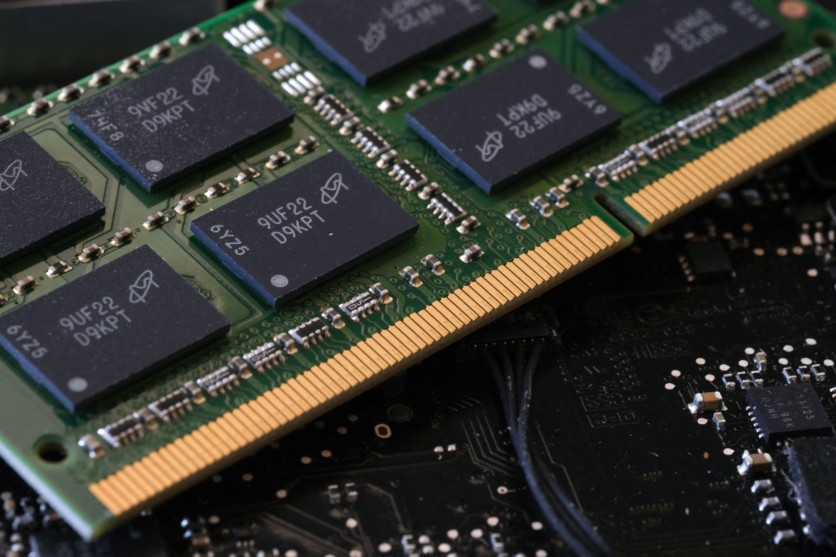
This illustration photo shows a stick of RAM (random-access memory) resting on an open laptop in Los Angeles, February 4, 2022. CHRIS DELMAS/Getty Images
A group of U.S. consumers and small businesses has filed an antitrust class-action lawsuit against the three dominant memory-chip makers — Samsung Electronics, SK hynix, and Micron — alleging they conspired to keep DRAM artificially scarce and inflate prices. The companies have not yet responded in court, and the allegations remain unproven.
At its core, the case turns the central ambiguity of the AI-era memory shortage into a legal question: is the squeeze on conventional memory a coordinated scheme, or simply three rational companies independently chasing the same fat margin? That distinction — not the eye-watering prices everyone can already see — is what the lawsuit will ultimately rise or fall on.
What the Lawsuit Claims
The suit was filed June 25 in the U.S. District Court for the Northern District of California, where 17 plaintiffs — 14 individuals and three small PC-building and distribution firms — accuse the three of abusing their roughly 90% market share, according to Tom's Hardware and other outlets including Yahoo Finance. Docketed as Garciaguirre v. Samsung Electronics and assigned to Judge Noel Wise, the complaint invokes Section 1 of the Sherman Act, the federal law against agreements that restrain trade.
At the heart of the complaint is the claim that the companies used the industry's shift to high-bandwidth memory (HBM) — the chips that feed AI data centers — as a pretext to wind down production of legacy formats like DDR3 and DDR4, restricting conventional DRAM supply and driving prices up roughly 700% over four years. The plaintiffs cite Apple's recent price increases on MacBooks and iPads as evidence of the downstream harm to consumers, and are seeking an end to what they call a coordinated production squeeze plus triple damages under U.S. antitrust law. All of this is the plaintiffs' account; none of it has been tested in court.
Why This Kind of Case Is Hard to Win
The reason the outcome is far from obvious lies in what antitrust law actually forbids. Section 1 of the Sherman Act does not bar a company from cutting output or raising prices; it bars competitors from agreeing to do so together. In a market with only three big suppliers, all three can watch one another and independently reach the same conclusion — that shifting factory capacity toward high-margin AI memory beats making cheap commodity chips — and end up moving in near-lockstep without ever colluding. Economists call that "conscious parallelism," and courts have repeatedly held it is not, on its own, illegal.
So showing that all three makers cut DDR3 and DDR4 output and that prices soared is not enough; the plaintiffs must produce evidence of an actual agreement. That is the bar the lawsuit has to clear, and proving coordination — as opposed to parallel but independent decisions to chase the most profitable product — is typically the hardest part of such cases.
History That Cuts Both Ways
The complaint leans on the past to argue a pattern, and the history is genuinely double-edged. On one side, this would not be the first time: Samsung and Hynix (SK hynix's predecessor) pleaded guilty to a U.S. Department of Justice case over DRAM price-fixing between roughly 1999 and 2002, paying $300 million and $185 million respectively as part of more than $700 million in industry fines, with prison terms for several executives. Notably, Micron — a defendant now — was a cooperator in that earlier investigation and avoided a fine.
On the other side sits a precedent pointing the opposite way. A similar consumer class action brought by the law firm Hagens Berman in 2018 made comparable claims about parallel production cuts; a district court dismissed it in 2020, and the Ninth Circuit upheld that dismissal in 2022, ruling the conduct was "more likely explained by lawful, unchoreographed free-market behavior" than by an illegal agreement. The new complaint's wager is that the industry-wide pivot to HBM supplies the missing link the earlier case lacked — a shared, identifiable reason the cuts happened in concert. Whether that clears the bar is exactly what a court will now have to weigh.
What the Companies Say, and the Market Backdrop
The defendants have publicly maintained they operate independently and are simply redirecting capacity — by some estimates around 80% — toward higher-margin HBM in response to unprecedented AI demand, which they argue is ordinary business judgment rather than collusion, and they have pointed to new fabs and production lines as evidence they are expanding supply rather than choking it.
That demand is real and broad. Memory and storage costs have pushed Microsoft to raise Xbox prices and led Valve to abandon its sub-$1,000 Steam Machine target, which launched instead at $1,049. Investment bank Jefferies expects DRAM prices to climb another 40–50% in the third quarter and 30–40% in the fourth, with little relief before 2028 — a forecast, not a certainty. None of that backdrop resolves the legal question. Whether the same facts amount to a conspiracy or to three companies independently following the money is what the case will have to settle, and the filing itself settles nothing.
Frequently Asked Questions
Who is suing the memory chipmakers?
A group of 17 plaintiffs — 14 individual consumers and three small PC-building and distribution businesses — filed the class-action lawsuit on June 25, 2026, in the U.S. District Court for the Northern District of California. The case, Garciaguirre v. Samsung Electronics, names Samsung, SK hynix, and Micron as defendants and seeks to represent a broader class of consumers and businesses that bought products containing conventional DRAM during the price surge. The companies have not yet responded in court, and the allegations are unproven.
Why are DRAM prices so high?
Both sides agree on the immediate mechanism, if not its legality: the three makers have shifted manufacturing capacity toward high-bandwidth memory (HBM) for AI data centers, which earns far higher margins than the conventional DRAM used in PCs and phones, leaving less capacity for consumer memory. The plaintiffs allege this was a coordinated, artificial restriction of supply; the companies say it is an independent, rational response to enormous AI demand. Prices for conventional DRAM have risen sharply — the complaint cites roughly 700% over four years — and analysts expect further increases through 2026 and 2027.
Did Samsung and SK hynix price-fix before?
Yes. Samsung and Hynix (SK hynix's predecessor) pleaded guilty in the mid-2000s to a U.S. Department of Justice case over DRAM price-fixing that took place between roughly 1999 and 2002, paying $300 million and $185 million respectively, part of more than $700 million in total industry fines, with prison terms for several executives. Micron, also a defendant in the new suit, cooperated with that earlier investigation and avoided a fine. The plaintiffs cite this history as evidence of a pattern, though a more recent 2018 case making similar claims was dismissed.
Is the memory shortage illegal?
That is precisely what has not been determined. U.S. antitrust law does not prohibit companies from independently cutting output or raising prices; it prohibits competitors from agreeing to do so together. Because three suppliers in a concentrated market can independently make similar decisions — known as "conscious parallelism" — without coordinating, the plaintiffs must prove an actual agreement, which courts have historically found difficult. A similar 2018 lawsuit was dismissed for that reason, a ruling upheld on appeal in 2022. The new case will have to overcome that precedent, and no court has ruled on its claims.

-
 C114 Communication Network
 -
 Communication Home
