
 Search

Tatamotors.com
Tata Motors will officially unveil the Sierra EV on Tuesday, June 30, 2026, revealing pricing, full specifications, and booking details for one of India's most anticipated electric vehicles. The launch marks the first production-ready debut of a born-electric mid-size SUV built on Tata's Acti.ev+ platform — the same dedicated EV architecture that underpins the Harrier EV — and arrives with two significant hardware firsts for this price bracket: confirmed all-wheel drive and Vehicle-to-Load (V2L) bidirectional charging, both priced to enter the market under ₹25 lakh.
The Sierra EV slots between the Curvv EV and the Harrier EV in Tata's electric lineup, targeting the segment defined by rivals including the Hyundai Creta Electric, Mahindra BE 6, and Maruti e Vitara. It is Tata's seventh electric vehicle and the company's second entry in the mid-size SUV class after the Curvv EV coupe-SUV. Bookings are expected to open in July 2026, with retail deliveries following through the July–September window.
Acti.ev+ Platform: Four Layers, One Architecture
The Sierra EV does not share a platform with any existing Tata ICE vehicle. It rides on the Acti.ev+ (Advanced Connected Tech-Intelligent Electric Vehicle Plus) architecture — an evolution of the base Acti.ev platform, differentiated by its dual-motor quad-wheel drive capability, larger frunk, and high-voltage centrally stacked battery design.
Tata's Chief Product Officer Anand Kulkarni has described the Acti.ev+ as a four-layer skateboard architecture: a powertrain layer, a chassis layer, an electrical and electronic (E&E) layer, and a cloud layer. The skateboard design places the battery pack entirely flat under the floor, eliminating the transmission tunnel, lowering the vehicle's center of gravity, and enabling a flat cabin floor that Tata says improves both interior volume and crash safety. The chassis uses ultra-high-strength steel, and the platform is designed to achieve a five-star Bharat NCAP safety rating — the same standard the ICE Sierra achieved in March 2026.
The key distinction between Acti.ev+ and the platform under the ICE Harrier is significant. The original Harrier was built on the Omega Arc, a localized version of Land Rover's D8 architecture tailored for diesel powertrains and structural rigidity — not for EVs. That platform could not support a flat floor or large battery packs. The Sierra EV, like the Harrier EV before it, abandons that ICE legacy entirely in favor of a purpose-built electric architecture. Tata calls vehicles built on Acti.ev+ "born EVs" to distinguish them from earlier models like the Nexon EV, which began as ICE vehicles converted to electric drivetrains.
TiDAL: How the Software-Defined Vehicle Works
The electrical and electronic layer of the Acti.ev+ platform runs TiDAL (Tata Intelligent Digital Architecture Layer), Tata's implementation of a software-defined vehicle (SDV) stack. According to Autocar Professional, TiDAL runs 500 million lines of code and uses a cockpit domain controller to consolidate infotainment, ADAS, and vehicle system management under a single compute architecture — replacing the patchwork of 70–100 separate electronic control units that characterize traditional vehicles.
In practical terms, TiDAL is what makes over-the-air (OTA) software updates possible, along with features already demonstrated in the Harrier EV: a 540-degree surround-view camera system, DrivePay (a UPI-based in-car payment function), auto-park assist, a summon mode for extracting the vehicle from tight spaces, and low-speed terrain assist. A buyer who understands SDV architecture will recognize what this means: the Sierra EV's feature set is not fixed at purchase. Software updates can add capabilities post-delivery without a workshop visit.
The cabin will likely feature a triple-screen setup — a 10.25-inch digital driver's cluster, a 12.3-inch central infotainment touchscreen, and a 12.3-inch co-passenger entertainment display — on higher trims, with a dual-screen configuration and head-up display expected on lower variants. Additional confirmed features include dual-zone climate control, Level 2+ ADAS (autonomous emergency braking, adaptive cruise control, lane assist, and blind spot monitoring), a 360-degree camera system, powered and ventilated front seats, a panoramic sunroof, and a JBL audio system on top-spec trims.
Battery, Range, and Drivetrain
Two battery configurations are expected: a 65 kWh pack paired with a rear-wheel drive single-motor setup, and a 75 kWh pack with the QWD (Quad Wheel Drive) dual-motor all-wheel drive layout. The battery chemistry is lithium iron phosphate (LFP), supplied by Octillion — Tata Group's own battery subsidiary — using cylindrical cells with liquid cooling. LFP chemistry offers greater thermal stability than the nickel-manganese-cobalt (NMC) chemistry found in some competitor vehicles, a relevant consideration in India's temperature range.
The dual-motor QWD configuration uses an induction motor at the front axle and a permanent magnet motor at the rear — the same architecture as the Harrier EV, which Autocar Professional confirmed delivers intelligent torque distribution with a 7–8% efficiency advantage over fixed-split AWD systems.
Since the Sierra EV's body is lighter than the Harrier EV's, Autocar India notes that its ARAI-certified claimed range could approach or exceed the Harrier EV's 627 km figure on the 75 kWh RWD variant. Realistic real-world range is estimated at 400–450 km under typical Indian driving conditions. The platform supports up to 100 kW DC fast charging — sufficient to add approximately 100 km of range in roughly 10–15 minutes at a compatible charging station.
V2L and V2V: Bidirectional Charging at the Mid-Market Price Point
One of the Sierra EV's most technically significant features is also its most practically relevant in the Indian context. The vehicle will support Vehicle-to-Load (V2L) and Vehicle-to-Vehicle (V2V) bidirectional charging — capabilities that until now have appeared primarily on premium global EVs priced well above ₹25 lakh, such as the Hyundai Ioniq 5, Kia EV6, and Ford F-150 Lightning.
V2L works through a built-in DC-to-AC inverter in the Acti.ev+ platform. When the Sierra EV is parked, the inverter converts the battery's high-voltage DC power to standard AC output — typically up to approximately 3.6 kW — allowing owners to run appliances, power tools, portable electronics, or camping equipment directly from the vehicle's battery. V2V extends this capability to charging another electric vehicle, using the Sierra EV as a mobile charging source.
In India, where grid reliability varies significantly across states and between urban and rural settings, V2L changes the Sierra EV's value proposition from a mode of transport to a mobile power platform. The India Smart Grid Forum ran a pilot in 2024–25 using Tata Nexon EVs to demonstrate bidirectional grid feedback, confirming that the underlying hardware and software architecture for this capability is proven in Tata's platform ecosystem. At ₹20–25 lakh, making V2L accessible to a mid-market Indian buyer represents a genuine price-point milestone for the technology.
Competitive Context: What Buyers Are Deciding Between Now
The Sierra EV's primary competitors are priced and specified as follows, based on current market data: the Hyundai Creta Electric starts from ₹18.03 lakh and offers up to 465 km ARAI-certified range; the Mahindra BE 6 is priced from ₹18.90 lakh with its INGLO-platform born-EV architecture; the Maruti Suzuki e Vitara entered the market in early 2026 with 49 kWh and 61 kWh battery options.
The Mahindra comparison is the most direct technical rivalry. The BE 6 is also a born-EV, built on the INGLO platform, and targets the same aspirational mid-size buyer. Where the BE 6 emphasizes sportier styling and a more aggressive power delivery, the Sierra EV is expected to lean on interior space, platform maturity (shared with the proven Harrier EV), and the V2L/V2V capability that the BE 6 does not offer. The competition is also about market timing: Tata remained India's largest EV manufacturer in May 2026 with approximately 39% market share, but Mahindra's rapid rise — driven by the BE 6 and XEV 9e — has compressed Tata's lead from the historic highs above 70% seen in FY2024. The Sierra EV is among Tata's most direct responses to that competitive pressure.
Design: What Changes From the ICE Sierra
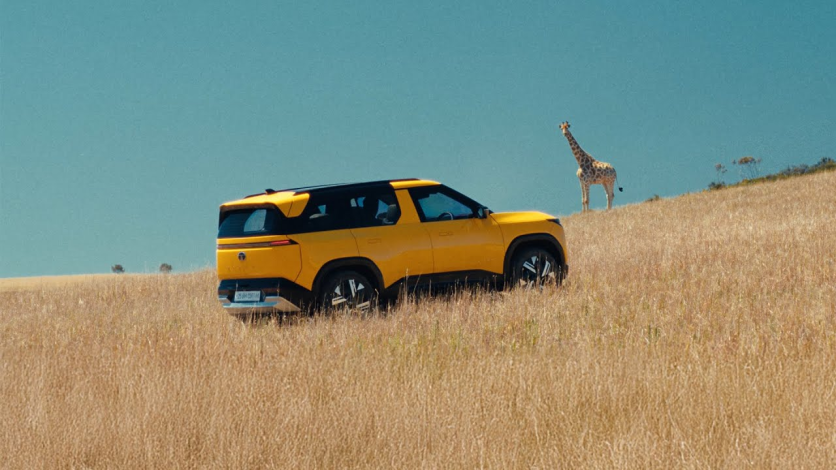
The Sierra EV retains the ICE model's signature panoramic rear glass windows, clamshell tailgate, upright stance, functional roof rails, and flush door handles. EV-specific changes include a closed-off body-colored front grille, revised aerodynamic bumpers, aero-optimized alloy wheels, and Sierra.EV badging on the tailgate. The result is visually coherent with the ICE Sierra while being unambiguously distinguishable as the electric variant. Color options confirmed include White, Red, Black, and Yellow, with specific shades restricted to certain trim levels.
How the Sierra EV Positions an Indian Automotive Icon
The original Tata Sierra, introduced in 1991, was one of India's first lifestyle SUVs — notable primarily for its large wraparound rear glass, which remains a design signature of both the modern ICE revival and the EV variant. The ICE Sierra, which relaunched in January 2026, received a five-star BNCAP safety rating in March 2026, confirming the platform's structural capability before the EV version inherits it. The EV follows six prior Tata electric vehicles: the Tiago EV, Tigor EV, Nexon EV, Punch EV, Curvv EV, and Harrier EV.
Frequently Asked Questions
What is the expected price of the Tata Sierra EV in India?
Official pricing will be announced at the June 30, 2026 launch event. Multiple automotive sources estimate the ex-showroom price range at ₹18 lakh to ₹25 lakh, positioning the Sierra EV between the Curvv EV (from ₹16.99 lakh) and the Harrier EV (from ₹21.49 lakh). The lower end is expected to cover the 65 kWh rear-wheel drive variants; the ₹25 lakh ceiling corresponds to the 75 kWh all-wheel drive QWD trim. Bookings are expected to open in July 2026.
What battery and charging options does the Tata Sierra EV offer?
The Sierra EV is expected to come with two battery configurations: a 65 kWh lithium iron phosphate (LFP) pack with a single rear motor in rear-wheel drive, and a 75 kWh LFP pack with a dual-motor QWD all-wheel drive layout. Both packs use Octillion cylindrical cells with liquid cooling. The platform supports up to 100 kW DC fast charging, which adds roughly 100 km of range in approximately 10–15 minutes. ARAI-claimed range on the 75 kWh variant is expected to approach or exceed 600 km, with realistic real-world range estimated at 400–450 km.
Does the Tata Sierra EV come with all-wheel drive?
Yes. Tata confirmed all-wheel drive through official teasers released on June 21, 2026. The system — branded QWD (Quad Wheel Drive) — uses an induction motor at the front and a permanent magnet motor at the rear, the same architecture as the Harrier EV. AWD is expected to be available on the top-spec 75 kWh variants. The ICE Sierra does not currently offer AWD, making the EV variant the first Sierra in India's history to offer four-wheel traction.
Is the Tata Sierra EV worth waiting for over a Mahindra BE 6 or Hyundai Creta Electric?
The decision depends on what a buyer prioritizes. The Sierra EV is the only vehicle in this price bracket confirmed to offer both AWD and V2L bidirectional charging. Its Acti.ev+ platform and TiDAL software architecture are proven through the Harrier EV, which supports OTA updates and a growing feature set that can be updated post-purchase. The BE 6 offers a sportier profile and a slightly lower entry price; the Creta Electric offers Hyundai's well-established service network and 465 km ARAI range in a familiar package. Buyers willing to wait until July for deliveries — and who value the mobile power platform use case that V2L enables — have a strong reason to consider the Sierra EV. Those who need a vehicle immediately should evaluate the alternatives currently on sale.

-
 C114 Communication Network
 -
 Communication Home
