
 Search

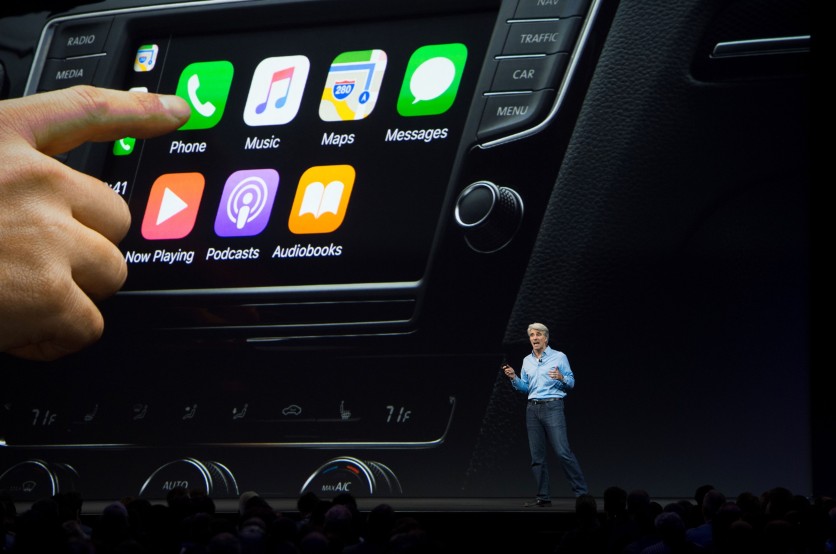
Apple's Senior Vice President of Software Engineering Craig Federighi speaks about CarPlay on stage during Apple's World Wide Developers Conference in San Jose, California on June 05, 2017. / AFP PHOTO / Josh Edelson JOSH EDELSON//Getty images
Siri's rebuilt intelligence has arrived in the car, and a week of real-world driving through the iOS 27 developer beta confirms the upgrade is real — with limits that will matter to anyone who expects a truly capable co-pilot behind the wheel. Context memory works. Live traffic data does not. Third-party app integration hasn't arrived yet. For iPhone 15 Pro owners and above, this is the most meaningful CarPlay upgrade in the platform's 12-year history — if you understand what it can and can't do today.
Read more: iOS 27 Beta 2: Write with Siri Replaces Writing Tools as RCS Gets Inline Replies
What Siri AI Actually Did Behind the Wheel
Tom's Guide senior editor John Velasco spent a week running the rebuilt assistant through its paces on his daily commute, using the iOS 27 developer beta on an iPhone 17 Pro. His most striking finding wasn't about raw intelligence — it was about memory.
Velasco dictated notes about a test vehicle while driving, returned several minutes later to add details, and found that Siri remembered precisely which note to update. When he retrieved it later, the assistant had organized his comments into a titled, bulleted list without being asked. That kind of unprompted structure — carrying conversational context across a gap of several minutes and applying it intelligently — is something the old Siri could not do.
The improvement extends to multi-step requests that previously required either separate voice commands or direct phone interaction. When Velasco asked it to pull up music from a prior day and then navigate to a destination, the assistant connected the two requests without being redirected. The practical upside for drivers is real: fewer taps, fewer interruptions, and less of the assistant's characteristic habit of treating every request as if it arrived from a stranger.
Siri's delivery also changed. It sounds more human than before — tonal inflections shift with context, and the flat robotic cadence that characterized prior versions is largely gone. In a car environment where voice is the only safe interface, that qualitative shift carries weight. A clunky assistant gets abandoned; a fluid one becomes part of how you drive.
Conversations are saved in a new dedicated Siri app and sync across devices through iCloud. Exchanges started in the car — marked with a car icon — can be picked up on an iPad or Mac after arrival.
How Siri AI Decides Whether to Stay on Your iPhone
The most important technical correction to the original article narrative: Siri AI is not a purely on-device system, and that distinction matters for CarPlay.
Apple built the system around three inference tiers. The first runs an approximately 3 billion parameter model directly on the iPhone's Neural Engine, using 2-bit quantization to fit a capable language model within the memory and power constraints of mobile silicon. Simple requests — setting timers, playing music, sending a message — never leave the device. The second tier routes more complex queries to Apple's Private Cloud Compute infrastructure, which runs on Apple Silicon servers and is designed so requests are processed without being stored or accessible to Apple. The third tier hands the most demanding reasoning tasks to a custom Google Gemini model licensed by Apple.
A system orchestrator evaluates each request and routes it to the appropriate tier invisibly to the user. The practical implication for drivers: the on-device tier can operate without an internet connection, which is genuinely useful in tunnels, rural stretches, or poor-signal zones. But the more capable responses — those requiring real reasoning, personal-context synthesis across multiple apps, or web knowledge — depend on connectivity, routing your query beyond the phone. CarPlay's most useful scenarios — synthesizing traffic from messages, researching nearby businesses, answering follow-up questions requiring web knowledge — fall into the cloud tiers, not the offline one.
The Neural Engine itself is the hardware that makes the on-device tier possible at all. Introduced in Apple's A11 Bionic chip in 2017 and present in every A-series and M-series processor since, it is a dedicated silicon block optimized for the matrix multiply-accumulate operations that power neural networks — separate from the CPU and GPU and far more energy-efficient for AI workloads. The iPhone 15 Pro and newer models carry enough Neural Engine throughput and memory bandwidth to run the base tier of Siri AI in real time, which is why Siri AI is gated to that hardware tier.
Where It Fell Short
Velasco's week of driving also exposed the current ceiling. When he asked Siri AI to check live traffic conditions on a congested highway, the assistant couldn't access real-time traffic data — a significant gap for a driving assistant. He found a workaround by asking it to search news and social media for road closure information, and eventually learned about a four-truck crash that had caused the congestion. That's a functional workaround, not a feature.
Two additional limitations surfaced. He couldn't interrupt Siri AI while it was mid-response — a friction point the tester attributed to the cabin's ambient noise interfering with wake-word detection. And when he asked the assistant to choose between multiple recommendations it had surfaced, it declined to pick one and restated the options instead.
Third-party app integration is the structural gap. Velasco cited placing a voice order through a fast-food app while driving as the natural next capability — one Siri AI cannot yet deliver. Apple's native apps — Maps, Music, Notes, Messages — benefit substantially from the upgrade. Everything else depends on developer adoption of a new conversation mode API that iOS 27 opens to any CarPlay app. That API makes it theoretically possible for an app to accept a full voice order and submit it — but "theoretically possible" and "works today" are still two different things.
What Else Arrived in CarPlay With iOS 27
The Siri AI upgrade is the headline, but iOS 27 also brings several long-overdue CarPlay improvements that don't require an iPhone 15 Pro.
The Now Playing interface now includes an audio scrubber — a touch slider to jump to any point in a podcast or song, something users have requested for years. A persistent audio MiniPlayer lets playback controls stay visible while using other CarPlay apps, available to any developer building media apps. Wireless CarPlay reliability is also being improved through better Bluetooth and Wi-Fi handling, with Apple aiming to reduce the connection dropouts that have frustrated users.
Apple Maps gains natural language route search tied to the Siri AI rollout, eventually enabling requests such as "navigate to the restaurant Nicole recommended last week," with the assistant pulling context from messages and notes. That capability was shown as a concept at WWDC 2026 and will develop over subsequent betas.
Read more: iOS 27 Hidden Features: Beta Reveals Alarm Volume Sliders, AirPods Custom EQ, Full-Page Widgets
CarPlay Video Is Coming, With Caveats
iOS 27 also formally opens video streaming as a supported CarPlay app category. The mechanism is AirPlay, the same wireless protocol used by Apple TV and HomePod — running over Wi-Fi and requiring explicit certification from automakers through Apple's MFi Program. No automaker has publicly committed to support as of this writing. When a compatible vehicle does support it, video plays only while parked — safety restrictions cut the feed when the car is put in drive and switch supported apps to audio-only playback.
The Apple TV app is the likely first-party launch app, surfaced in developer simulator testing, though Apple has not formally confirmed it as a shipping product. Third-party streaming apps that already support AirPlay video require no code changes to work through the AirPlay path; the native CarPlay browsing path requires developers to adopt a new API.
Who Gets Siri AI, and When
iOS 27 is currently in developer beta, with the second developer beta available now through the Apple Developer Program. A public beta is expected in mid-July, with the full release scheduled for September alongside new iPhones.
Siri AI in CarPlay requires an iPhone 15 Pro or newer — the hardware tier where the Neural Engine and memory bandwidth meet the demands of running the on-device inference model. iOS 27 itself runs on any iPhone that supported iOS 26, including the iPhone 11 and iPhone SE (second generation and later), so the CarPlay improvements that don't require Siri AI — audio scrubbing, the MiniPlayer, wireless reliability improvements — reach a much wider user base.
One logistical note: users may need to join a waitlist for the new Siri AI experience. Some beta testers have reported remaining on "Siri Classic" after installing iOS 27 until a waitlist slot opens.
Siri AI is not available to iPhone or iPad users in the European Union at launch, where Apple and EU regulators have not reached agreement on implementation under the Digital Markets Act. It is also unavailable in China pending regulatory approval. Mac and Apple Vision Pro users in the EU can access Siri AI when set to a supported language.
For iPhone 15 Pro or newer owners who drive regularly, iOS 27 is worth a second look — but wait for the public beta before installing on a daily driver.
Frequently Asked Questions
Does Siri AI in CarPlay work without an internet connection?
Partially. Simple requests — playing music, setting a reminder, sending a message — run on an approximately 3 billion parameter model stored directly on the iPhone's Neural Engine, with no network needed. More complex requests, including those requiring web knowledge or multi-app context synthesis, are routed to Apple's Private Cloud Compute infrastructure or a licensed Google Gemini model, both of which require connectivity. In practice, the most useful CarPlay scenarios — traffic research, web-sourced recommendations, reasoning across personal data — fall into the cloud tiers.
Which iPhones support Siri AI in CarPlay?
Siri AI in CarPlay requires an iPhone 15 Pro, iPhone 15 Pro Max, or any iPhone 16 or iPhone 17 model. The constraint is hardware: those devices carry the Neural Engine throughput and memory bandwidth needed to run on-device AI inference in real time. Standard iOS 27 CarPlay features — audio scrubbing, the MiniPlayer, wireless reliability improvements — work on any compatible iPhone running iOS 27.
What are the biggest remaining gaps in Siri AI CarPlay?
Three stand out from real-world testing. First, Siri AI cannot access live traffic data directly, requiring workarounds like searching news or social media. Second, third-party app integration is still limited — placing a voice order through a restaurant app, for example, remains outside its current reach. Third, the assistant cannot be interrupted mid-response in a car environment, likely because cabin ambient noise interferes with wake-word detection.
When does iOS 27 CarPlay come out for everyone?
The full public release of iOS 27 is scheduled for September 2026, alongside new iPhones. A public beta is expected in mid-July for users who want early access. Siri AI itself will roll out as a separate beta later this year for supported devices set to English, meaning some users may get iOS 27 without the new Siri experience immediately.

-
 C114 Communication Network
 -
 Communication Home
