
 Search

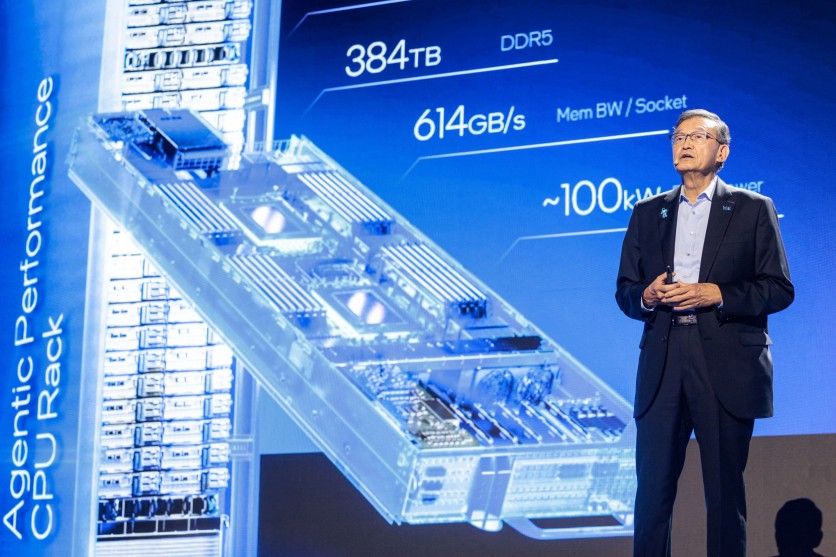
Intel CEO Lip-Bu Tan speaks during a keynote presentation at Computex in Taipei on June 2, 2026. CHENG Yu-chen/Getty Images
Intel has recruited Seok-Hee Lee, the former CEO of SK hynix and battery maker SK On, as executive vice president of Intel Foundry — a high-profile hire aimed at making advanced packaging a pillar of its contract-manufacturing turnaround as AI elevates the importance of how chips are stitched together.
Intel announced the appointment Thursday, effective June 18, with Lee reporting directly to CEO Lip-Bu Tan and overseeing advanced packaging, system integration, and back-end, or post-fabrication, technology development and manufacturing. For Lee it is a homecoming: he spent about a decade at Intel from 2000 to 2010, working on process integration from the 130nm to 32nm nodes and earning three Intel Achievement Awards, before leading SK hynix — where he played a central role in acquiring Intel's own NAND business in 2020 — and then SK On. He had stepped down from SK On in late May, reportedly citing health reasons, only to return to the industry three weeks later.
Why Packaging Became a Battleground
For decades, chip progress came from shrinking transistors. As that slows and a single large die runs into size and yield limits, makers increasingly build a system from several specialized "chiplets" — logic, memory, input/output — and the value shifts to how tightly those pieces are connected. That is what advanced packaging does, and it is why Tan is carving it out as a dedicated business: in AI systems, packaging has become a key lever for performance, power efficiency, and the heterogeneous integration of different components into one high-performance package.
Intel's toolkit here is well regarded. Its EMIB technology embeds a small silicon bridge in the substrate to link chips side by side at high bandwidth, an alternative to the interposer-based approach TSMC uses; EMIB-T adds vertical connections for power and signal delivery, and HBI bonds dies together at very fine pitches for denser integration. "Advanced packaging and system integration are becoming defining capabilities for next-generation computing systems," Tan said, crediting Lee with the ability to scale technologies such as EMIB-T and HBI to high volume.
The Real Target Is Yield
The sharper logic of the hire, as Korean analysts read it, is not just the marquee name but the specific problem Lee is meant to fix. At SK On he was credited with stabilizing the manufacturing processes and yields of large battery plants, and advanced packaging — bonding many expensive dies into one package without defects, at volume — is exactly where Intel's back end has struggled. In other words, Intel is importing a proven yield-and-operations executive to attack the bottleneck that stands between its packaging technology and the high-volume orders it needs.
Lee's arrival comes with a reorganization. Naga Chandrasekaran, who continues to report to Tan, will now concentrate on front-end work — accelerating volume production of the Intel 18A and 14A nodes and future processes — along with design support, customer engagement, and business operations, while Lee takes the back end. Longtime executive Navid Shahriari is retiring after 37 years.
Read more: TSMC Arizona Fab Posts $514M Year-One Profit: Q1 2026 Earnings Surpass Full 2025 Figure
A Flurry of Foundry Moves, and a Korea Angle
The hire lands amid a burst of activity at Intel Foundry under Tan. In April, Intel recruited Samsung foundry veteran Shawn Han and landed Tesla as the first major customer for its next-generation 14A process, due to ramp in 2029. On the same day as Lee's appointment, the Trump administration announced that Apple had agreed to work with Intel on U.S. chip design and manufacturing, and Google has reportedly booked Intel to package more than three million of its TPUs in 2028 — though that last deal's scope is disputed, with JPMorgan suggesting the chips themselves may still be fabricated by TSMC and Intel handling only the packaging.
Lee's SK hynix pedigree adds another angle. Analysts see it as potentially strengthening Intel's ties to SK hynix in the high-bandwidth memory supply chain now dominated by TSMC and SK hynix — a reading with a concrete basis, since SK hynix is already reported to be testing Intel's EMIB packaging for HBM integration — while introducing a fresh competitive variable for Samsung's foundry, which has benefited from spillover demand amid the industry's advanced-capacity crunch.
"With demand for system-level integration accelerating across AI and high-performance computing, Intel holds a unique position to lead in advanced packaging," Lee said, adding that he was glad to return and would work to strengthen Intel's technology and manufacturing while deepening customer support.
The momentum is real, but so are the caveats: Intel still trails TSMC on advanced-node yields, several of the marquee engagements are early-stage rather than committed volume, and the headline customer figures point to 2028 and 2029. What Lee changes is the seniority and operational focus Intel is now putting behind the part of chipmaking that used to be an afterthought.
Read more: Chip Supply Shifts From TSMC: Google's Reported Intel TPU Order Lifts Foundry, but Doubts Remain
Frequently Asked Questions
Who is Seok-Hee Lee?
Seok-Hee Lee is a semiconductor veteran who has now joined Intel as executive vice president of Intel Foundry, leading advanced packaging and back-end manufacturing. He previously spent about a decade at Intel (2000–2010), then led memory maker SK hynix — where he helped acquire Intel's NAND business in 2020 — and most recently battery maker SK On. He holds a materials-science degree from Seoul National University and an engineering doctorate from Stanford.
What is advanced packaging in chips?
Advanced packaging is the set of techniques for connecting multiple chips, or chiplets, into a single high-performance package, rather than relying on one large monolithic chip. As traditional transistor scaling slows, packaging has become a major way to boost performance and power efficiency, especially for AI systems that combine logic, memory, and other components. It is now considered a competitive battleground among Intel, TSMC, and Samsung.
What is Intel's EMIB technology?
EMIB (embedded multi-die interconnect bridge) is Intel's method of placing a small silicon bridge inside a package's substrate to connect two chips side by side at high bandwidth, instead of using a large silicon interposer as in some rival approaches. Intel is extending it with EMIB-T, which adds vertical power and signal connections, and pairs it with HBI, a fine-pitch die-bonding technique, to pack components more densely.
Why does Lee's hire matter for SK hynix and Samsung?
Analysts suggest Lee's SK hynix background could deepen cooperation between Intel and SK hynix in the high-bandwidth memory supply chain — SK hynix is already reported to be testing Intel's EMIB packaging — which would give Intel a foothold in a market dominated by TSMC and SK hynix. The same dynamic could introduce a new competitive challenge for Samsung's foundry. These are analyst interpretations, not confirmed commercial agreements.

-
 C114 Communication Network
 -
 Communication Home
