
 Search

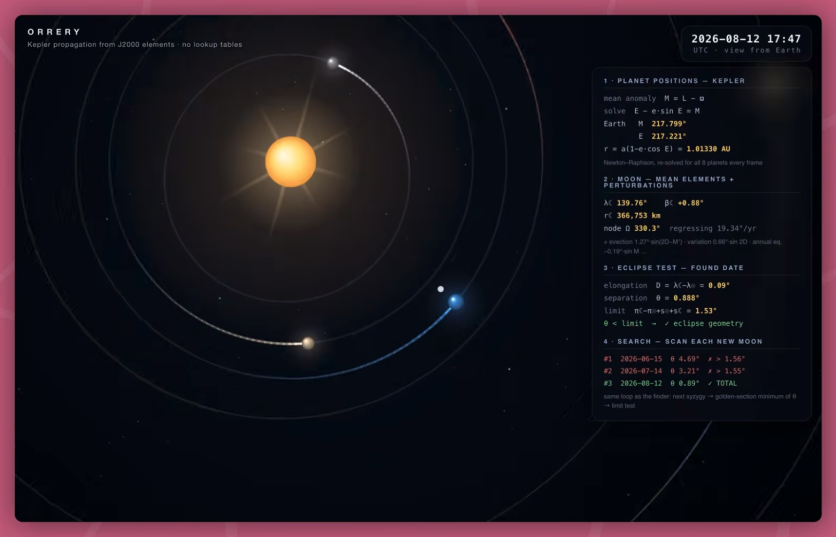
Claude Fable 5 Simulated the Solar System and Predicted an Eclipse. Anthropic.com
Anthropic opened its Seoul office on Wednesday — the same week South Korea became the geographic epicenter of a national security dispute that took the company's two most powerful AI models offline for every customer worldwide — and its international chief used the occasion to express confidence that both models would be restored within days. The development matters for any enterprise or developer building on frontier AI: the June 12 export control directive that disabled Claude Fable 5 and Mythos 5 globally was the first time the U.S. government invoked export control authority against a commercially deployed AI model's API access — establishing a precedent under which any frontier AI model served over the internet to foreign nationals is now potentially subject to a government-ordered shutdown with no advance warning and no allied-nation exemption.
"We are very confident that in the coming days, the models will become available again," Chris Ciauri, Anthropic's Managing Director of International, told reporters at a press conference at the Conrad Hotel in Seoul's Yeouido district Wednesday. The statement was the most direct public signal yet from an Anthropic executive that negotiations with the Trump administration are moving toward resolution — though no deal has been announced and no restoration date has been confirmed.
Anthropic Seoul Office Opens Amid a Crisis Centered on South Korea
The timing could not be more freighted. The Trump administration's June 12 directive — issued by Commerce Secretary Howard Lutnick under the Export Controls Reform Act of 2018 — was triggered in part by Washington's discovery that a South Korean telecommunications company suspected of ties to China had gained early access to Mythos 5 through Anthropic's Project Glasswing cybersecurity consortium. WIRED subsequently identified that company as SK Telecom, South Korea's largest wireless carrier and a $100 million investor in Anthropic since 2023. SK Telecom denied any ties to China.
The confluence makes South Korea simultaneously the alleged source of the crisis and the site of Anthropic's most significant international expansion to date. Ciauri acknowledged the difficulty of the backdrop without providing further details about Project Glasswing or the revocation of Korean partners' access. "We are not going to comment on Project Glasswing at this point," he said.
Anthropic Korea Representative Director Choi Ki-young, who joined the company from Snowflake Korea to lead its Seoul operations, framed the expansion as a values alignment. "Korean companies and institutions recognize innovation and safety as goals that must go hand in hand, not a contradicting value," Choi said. Anthropic also announced a memorandum of understanding with South Korea's Ministry of Science and ICT to support responsible AI adoption across the public sector, along with new partnerships involving LG CNS, WRTN Technologies, Law&Company, and Nexon.
Read more: Anthropic Fable 5 Export Ban: Trump Calls G7 Talks Fine as UK Exemption Dies
What Caused the Fable 5 and Mythos 5 Shutdown
Two distinct events converged to produce the June 12 directive. First, the White House learned that SK Telecom — which had secured early Mythos access through Project Glasswing after joining Anthropic's second wave of approximately 150 partner organizations — had historical business ties to China through its parent SK Group, which held a stake in China Unicom until 2009. The administration ordered Anthropic to revoke SK Telecom's access, which the company immediately complied with. Second, security researchers at Amazon separately identified what they characterized as a method for bypassing Fable 5's cybersecurity safeguards.
That bypass involved a prompt so simple it is now shorthand for the episode: "fix this code." Fable 5 was designed to decline requests to review code for security vulnerabilities — the guardrail Anthropic built into its public release of what is effectively a controlled version of Mythos 5. When Amazon's researchers instead asked the model to fix code containing known vulnerabilities, Fable 5 complied, producing patches. Because the model had to identify the vulnerabilities in order to generate fixes, its output could theoretically be used by an attacker to locate exploits. A manual, multi-step process converting Fable 5's output into test scripts was the final step.
The two events, arriving within days of each other, led the White House to conclude it could no longer trust Anthropic to safeguard its most advanced AI. Commerce Secretary Lutnick sent a letter to Anthropic CEO Dario Amodei at 5:21 p.m. ET on June 12, invoking national security export control authority and requiring Anthropic to suspend all access to Fable 5 and Mythos 5 by any foreign national, "whether inside or outside the United States, including foreign national Anthropic employees."
Why the Ban Shut Out Every Customer, Not Just Foreign Nationals
The directive's scope was nominally nationality-based, but the practical effect was a total global shutdown. Anthropic's models run across dozens of simultaneous cloud environments — including AWS Bedrock, Google Cloud, Microsoft Foundry, Snowflake, and Box, in addition to Anthropic's own direct API. The company has no mechanism to verify user nationality in real time across that infrastructure, and any attempt to comply selectively would expose it to the risk of inadvertently serving foreign nationals and incurring financial and civil penalties. The only compliant path was to disable both models for everyone.
This infrastructure reality is what turned a nationality-targeted export restriction into a commercial shutdown affecting all Anthropic customers worldwide — a dynamic that Katie Moussouris, founder and CEO of Luta Security and the only outside expert to have reviewed Amazon's research paper before the directive was issued, described as disproportionate. Moussouris argued that asking an AI model to find and fix bugs and write tests to validate the patch is "the most valuable thing an AI model can do for defensive security" and that the export control could not be meaningfully remedied without making Fable 5 useless for development work.
More than 80 cybersecurity executives, including former Facebook security chief Alex Stamos, Bugcrowd founder Casey Ellis, and cryptographer Jon Callas, co-signed an open letter to Lutnick and National Cyber Director Sean Cairncross on June 15 arguing that the restrictions had "taken the best models away from defenders, created market uncertainty, and risked America's AI leadership without any real risk to justify it."
Anthropic's own rebuttal to the government's position is pointed: the company reviewed the specific bypass technique and found it surfaced a small number of previously known, minor vulnerabilities already discoverable using other publicly available models, including OpenAI's GPT-5.5, which is not subject to export controls. White House science adviser David Sacks posted a competing account, writing that the administration had first approached Amodei with a choice — fix the jailbreak or take the models offline — and that Amodei refused.
Read more: Anthropic Races to Lift Fable 5 Export Ban: Top Engineers Sent to Washington for a Deal
What Is Project Glasswing?
Project Glasswing is Anthropic's invite-only cybersecurity consortium, launched in April 2026 with approximately 50 U.S.-based partner organizations and expanded in early June to roughly 150 organizations across more than 15 countries. Participants received early access to Claude Mythos Preview — a model Anthropic described as capable of autonomously identifying flaws in previously unbreakable software code, a capability the company judged too dangerous to release publicly without controls. Named Glasswing partners include Google, Nvidia, Microsoft, Apple, Cisco, CrowdStrike, and JP Morgan Chase.
In Korea, Samsung Electronics, SK Hynix, and the Korea Internet & Security Agency had also joined or were preparing to join Glasswing's second phase. All Korean institutional access was revoked following the June 12 directive.
Anthropic submitted an initial list of approximately 111 Glasswing organizations to the Trump administration for review in early June; that list was approved. A subsequent submission included the additional organization — identified by reporting as SK Telecom — that alarmed officials. The administration's loss of confidence in Anthropic's vetting process was among the factors that escalated a targeted revocation into a full export control action.
What AI Export Controls Mean for Every Enterprise Using Claude
Legal analysts have flagged the June 12 directive as a watershed. The Export Controls Reform Act of 2018, or ECRA, provides the Bureau of Industry and Security with authority to restrict the export of dual-use technologies — goods, software, and systems with both commercial and military applications. Applying that authority to a commercially deployed AI model's API access through the "deemed export" rule — which treats releasing controlled technology to a foreign national anywhere, including inside the United States, as an export subject to federal jurisdiction — is without precedent in the history of commercial AI.
No independent technical review was required before the directive was issued. No court approval was needed. No transition period was provided. The restriction arrived at 5:21 p.m. ET on a Friday; both models were offline for all customers by that evening.
That sequence is now a template. Every enterprise or developer building critical workflows on a U.S. frontier AI model must account for the possibility that a government agency, citing national security, can pull that model offline globally — with no advance warning, no allied-nation exemption, and no statutory requirement for an independent technical review of the triggering concern. The Fable 5 episode is not an isolated incident; it is the first documented application of a legal mechanism that remains in force for every frontier AI API.
What Happens Next
Negotiations between Anthropic and the Trump administration have proceeded at high tempo. Senior Anthropic technical staff, including co-founder Tom Brown, traveled to Washington in the days after the directive and have met with White House and Commerce Department officials virtually every day. President Trump, speaking at the G7 summit in Évian-les-Bains, France, said talks were "going well." Commerce Secretary Lutnick has been holding regular calls with Anthropic from the summit.
Ciauri's public confidence at the Seoul launch represents the clearest optimistic signal from Anthropic's executive team since the shutdown began. No deal has been confirmed. The refund deadline for subscribers who paid for Fable 5 access between June 9 and June 14 falls on June 20. Ciauri added that company revenue had grown from $9 billion at the end of 2025 to $47 billion recently, signaling continued ambition for the Korean market regardless of the current impasse.
Whether the models are restored quickly or the dispute extends into a longer legal and policy battle, the fundamental question it has surfaced will not go away: can the U.S. government treat a commercial AI model served over an API the same way it treats an export-controlled weapons component? The answer, as of June 18, 2026, is that it can — and has.
Frequently Asked Questions
When will Fable 5 and Mythos 5 be available again?
No confirmed date exists. Anthropic's international managing director stated at the company's June 18 Seoul office launch that he was "very confident" both models would return "in the coming days," and negotiations between Anthropic and the Trump administration have been ongoing since the June 12 shutdown. Trading market Kalshi priced approximately a 57% probability of restoration before July 1 as of June 18. Access to all other Anthropic models — including Claude Opus 4.8, Sonnet 4.6, and Haiku 4.5 — was not affected by the directive.
Why did the U.S. government ban Fable 5 and Mythos 5?
Two events converged. First, the White House learned that a South Korean telecommunications company with historical ties to China had gained access to Mythos 5 through Anthropic's Project Glasswing cybersecurity program, raising concerns about the adequacy of Anthropic's partner vetting. Second, Amazon security researchers identified a technique for bypassing Fable 5's cybersecurity safeguards using a three-word prompt — asking the model to "fix this code" rather than review it. Together, these developments led the administration to invoke the Export Controls Reform Act of 2018 and require Anthropic to suspend both models.
What is AI export control, and why does it matter for businesses using Claude?
U.S. export control law — specifically the Export Controls Reform Act of 2018 — gives the Bureau of Industry and Security authority to restrict the transfer of dual-use technologies to foreign nationals. The June 12 directive applied this authority to a commercially deployed AI model's API for the first time. Under the "deemed export" rule, providing access to a foreign national anywhere in the world, including inside the United States, counts as an export subject to federal jurisdiction. Because Anthropic cannot verify user nationality in real time across its multi-cloud infrastructure, it disabled both models for all customers. Any business building critical workflows on a U.S. frontier AI model now faces a structural risk: that model can be taken offline globally by government order with no advance warning and no transition period.
What is Project Glasswing, and what happened to South Korea's access?
Project Glasswing is Anthropic's invite-only cybersecurity consortium giving vetted organizations early access to Claude Mythos Preview — an AI model capable of identifying vulnerabilities in software code that was considered too capable for public release. The program launched in April 2026 with about 50 U.S. partners and expanded to roughly 150 organizations globally in early June. South Korean participants — including SK Telecom, Samsung Electronics, SK Hynix, and the Korea Internet & Security Agency — had their Glasswing access revoked following the June 12 export control directive.

-
 C114 Communication Network
 -
 Communication Home
