
 Search

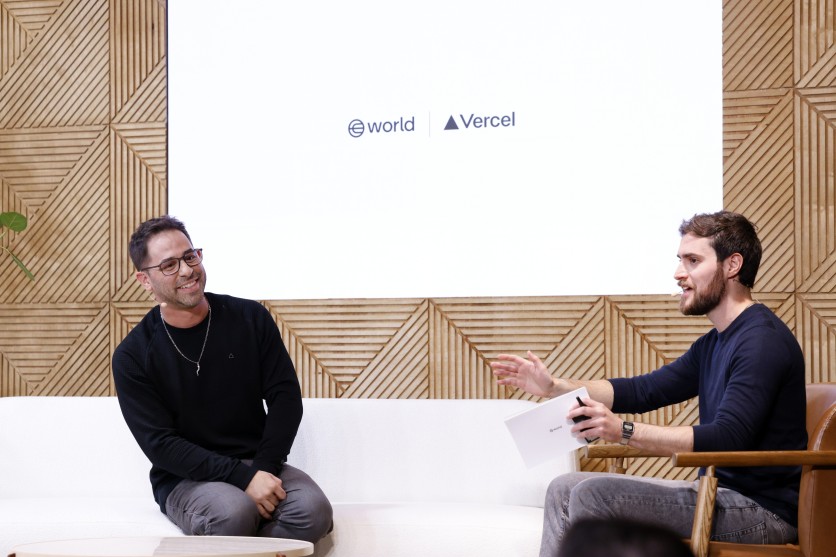
Tom Occhino, Engineering, Product, and Design at Vercel and Tiago Sada, Chief Product Officer, Tools for Humanity speak onstage as Sam Altman and Alex Blania Present Lift Off, a World Event at The Midway SF on April 17, 2026 in San Francisco, California. Kimberly White/Getty Images
Vercel — the company that ended years of React deployment hand-rolling with Next.js — launched Eve on June 17 at its Ship 26 conference in London, staking the same bet on the agentic AI era: that the framework owning the plumbing will own the category. Eve is an open-source, TypeScript-native agent framework where every AI agent is a directory of files that compiles to a durable, production-ready service on Vercel Functions — no separate hosting infrastructure required. CEO Guillermo Rauch said agents now trigger more than half of all commits on Vercel's platform, up from under three percent six months ago, and Eve is positioned as the infrastructure layer that keeps that growth from reverting to one-off plumbing.
Why Agent Frameworks Keep Failing Before They Ship
The problem Eve is solving is not novel, but it is genuine. Every team building a production AI agent — one that runs for hours, waits on human decisions, integrates with external APIs, and survives server crashes and new deployments — has to assemble the same scaffolding before the agent does anything useful: a way to checkpoint state, a sandbox for untrusted code, a gate for human approval, a pipeline for observability. Most agent frameworks supply the logic and leave all of that to the team. Vercel says every one of its own internal agents had to hand-roll those pieces, and none of it carried over from one project to the next.
Eve is its answer. The framework ships with six production capabilities included by default: durable execution, sandboxed compute, human-in-the-loop approvals, subagents, OpenTelemetry tracing, and a built-in evals system. The licensing is Apache 2.0, and the current version at launch is eve@0.11.4, available now through npx eve@latest init. The framework is currently in public beta, and Vercel says the APIs and behavior may change before general availability.
Read more: Vercel Terms Classify Third-Party AI Tools as Electronic Agents: Billing Falls on Developer
How Durable Execution Works in Eve
The most significant engineering decision in Eve is how it handles durable execution. In distributed systems, the problem is familiar: an agent calls an external API at step two of a ten-step workflow, the server crashes at step three, and without explicit checkpointing the entire job restarts — or silently fails. Eve addresses this by building on Vercel's open-source Workflow SDK, which persists the agent session as an event log and replays it deterministically to reconstruct state. The effect is that a session mid-conversation can survive a crash, a cold start, or a full deployment of a new version of the agent. A session in flight when a developer pushes an update finishes on the version it started on.
The sandboxed compute layer works through an adapter pattern. On Vercel's platform, agent-generated code runs in Vercel Sandbox — an isolated VM that runs shell commands, scripts, and file operations in a separate security context from the agent harness. Locally, the same adapter runs on Docker, microsandbox, or plain bash. The model never sees the URL or credentials for any external service: Vercel Connect brokers all OAuth tokens and API keys, so an agent connecting to Slack, Snowflake, or Salesforce never holds those credentials directly. Model requests route through Vercel's AI Gateway, which handles provider fallbacks transparently across OpenAI, Anthropic, Google Gemini, and open-weight models.
Human-in-the-loop approval works at the tool level. A single flag on any tool definition causes the agent to pause at that action, wait indefinitely without consuming compute, and resume from the exact checkpoint once approval arrives. Approvals surface as native UI elements in whichever channel the user is already in — buttons in Slack, for example — rather than requiring a separate approval interface.
The Directory Contract: How Eve Defines an Agent
An Eve agent is a directory of files, and the directory structure is the API. At minimum, an agent requires two files: agent/agent.ts for the model configuration and agent/instructions.md for the system prompt written in plain English. From there, capabilities are added by file convention: a TypeScript file in agent/tools/ becomes a tool the model can call, where the filename is the tool name and no registration is needed; a Markdown file in agent/skills/ becomes a contextual playbook the agent loads only when relevant; a file in agent/channels/ connects the agent to Slack, Discord, Teams, Telegram, Twilio, GitHub, or Linear with no webhook plumbing required.
The session API is standard HTTP. Creating a session posts to /eve/v1/session and returns a continuation token and session ID; lifecycle events stream as NDJSON from /eve/v1/session/
Inside Vercel's Own Agent Fleet
Vercel runs more than 100 agents internally on Eve today, and it published the architectures of six to illustrate the framework's range. The most-used is d0, a data-analysis agent that any Vercel employee can query in Slack to pull answers from the company's data warehouse. It handles more than 30,000 questions a month and enforces data permissions automatically — the agent cannot surface a table the querying employee could not already access.
The Lead Agent is an autonomous sales development representative that works inbound leads the moment they arrive, follows up without human prompting, and reportedly costs about $5,000 a year to run while returning 32 times that figure, with one engineer maintaining it part-time. Vertex, a support agent, resolves 92 percent of incoming tickets without escalation. Athena, a sales cockpit built by Vercel's RevOps team without engineering involvement, answers pipeline and forecast questions from Snowflake and Salesforce in plain language — it was assembled in six weeks. At the top of the fleet sits V, a routing agent that receives every inbound Slack message and directs it to the appropriate specialist agent, making a fleet of hundreds of agents feel, to the user, like a single system.
Read more: Vercel Labs' Zero Compiler Speaks JSON to AI Agents: Closing the Human-Translation Gap in Agentic Coding Loops
What Eve Does Not Give You: The Platform Dependency
The framework's most significant tradeoff is the one it does not advertise. Eve's production capabilities — durable execution via Vercel Workflow, sandboxed compute via Vercel Sandbox, model routing via AI Gateway, credential brokering via Vercel Connect, observability in the Agent Runs dashboard — are each built on Vercel's platform. Independent analysts reviewing the launch noted that porting Eve to a non-Vercel runtime requires replacing each of these adapters, a task the framework's adapter pattern technically permits but does not make frictionless. This is the same dynamic developers already documented with Next.js, where features like Incremental Static Regeneration and Edge Middleware work seamlessly on Vercel but require significant rebuilding on other hosts.
The distinction matters for teams evaluating Eve against platform-neutral alternatives. Mastra, a Y Combinator-backed TypeScript framework that reached version 1.0 in January 2026, is designed to run on any host. LangGraph (Python-first) and Inngest AgentKit (TypeScript) offer durable execution without platform coupling. The major cloud providers — Amazon Bedrock AgentCore, Google Vertex AI Agent Engine, Microsoft Agent Framework — offer managed agent runtimes that accept frameworks from any vendor. Eve's advantage, as independent analysts have phrased it, is distribution rather than technical novelty: Vercel serves more than six million developers, and a fraction of that base adopting Eve for agentic workloads represents a substantial addressable market without requiring a single new customer acquisition.
How Does Vercel Eve Compare to LangChain and Other Agent Frameworks?
LangChain's LangGraph is the most established agent framework and is Python-first; it supports durable execution and has LangSmith for production observability, but requires teams to manage their own hosting infrastructure. Eve is TypeScript-native and integrates deployment as a first-class concern — the tradeoff is platform coupling to Vercel. For TypeScript teams already on Vercel, Eve eliminates the operational work that has historically prevented agent prototypes from reaching production. For teams on other platforms or in other languages, the existing frameworks may offer more flexibility at the cost of more setup work.
Frequently Asked Questions
What is Vercel Eve and how does it work?
Eve is an open-source, TypeScript-native agent framework released by Vercel in public beta on June 17, 2026. An Eve agent is a directory of files: instructions.md sets the system prompt, TypeScript files in agent/tools/ define callable tools, and Markdown files in agent/skills/ serve as on-demand playbooks. When deployed, Eve compiles this directory into a service running on Vercel Functions, with durable execution (session state persisted and replayed via Vercel Workflow), sandboxed compute (Vercel Sandbox), and OpenTelemetry observability included by default. The framework is model-agnostic — it routes requests through Vercel's AI Gateway and supports any model provider without changing orchestration logic.
What does durable execution mean for AI agents?
Durable execution means an agent's session state is checkpointed at every step, so the session can survive crashes, cold starts, and new deployments without losing work. In Eve, this is implemented through Vercel's open-source Workflow SDK: each step of a conversation or task is written to an event log and deterministically replayed to reconstruct state on resumption. For agents that wait on external APIs, run for hours, or pause for human approval, this eliminates the need to write manual retry logic, idempotency handling, or compensating transactions.
Is Vercel Eve free and open source?
The Eve framework is open source under the Apache 2.0 license and is free to use. The production infrastructure it depends on — Vercel Workflow for durable execution, Vercel Sandbox for isolated compute, AI Gateway for model routing, and the Agent Runs observability dashboard — runs on Vercel's platform, which requires a Vercel account and falls under Vercel's standard pricing tiers for compute and usage. The framework can run locally using Docker, microsandbox, or bash as sandbox backends, without a Vercel account.
Does Eve create platform lock-in the way Next.js did?
Intentionally or not, the pattern is familiar. Next.js is MIT-licensed and technically deployable anywhere, but features like Incremental Static Regeneration and Edge Middleware require Vercel-specific infrastructure to function fully, creating documented migration friction. Eve follows the same structure: the Apache 2.0 license permits porting, but each production feature — durable execution, sandboxed compute, credential brokering — requires a Vercel platform equivalent to replace. Teams comfortable building on Vercel's ecosystem gain a substantial reduction in setup work; teams that need platform neutrality should evaluate Mastra, LangGraph, or Inngest AgentKit before committing.

-
 C114 Communication Network
 -
 Communication Home
