
 Search

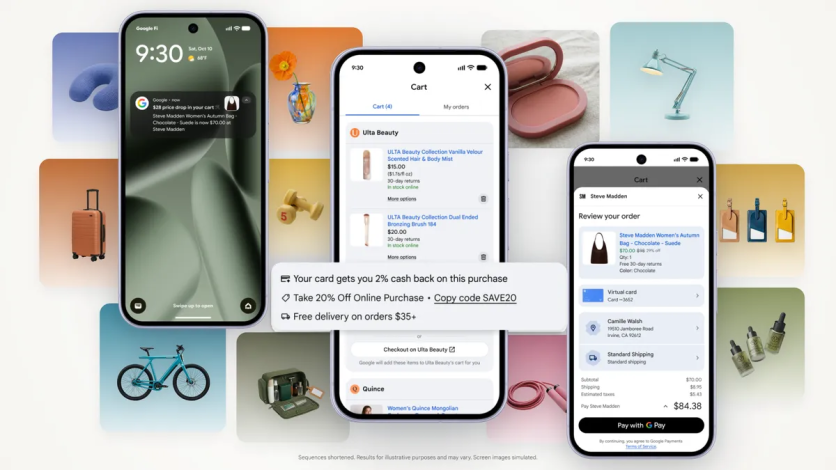
Google is now tackling that problem with a new product it's been building all year.
Online shopping has never been short on tools designed to make it easier, but most of them still require users to manage multiple tabs, multiple wishlists, and multiple carts spread across different stores.
Google Launches the Universal Cart AI Shopping Tool
Google has officially launched Universal Cart in the United States, rolling the new AI-powered shopping tool out across Google Search and the Gemini app. The feature was first announced during Google I/O 2026 in May and has now reached its broader US audience ahead of the holiday shopping season.
Universal Cart is described by Google as an intelligent shopping cart and a central hub for all shopping activity that takes place across Google's family of products. Rather than maintaining separate carts or wishlists on different websites, users can now add products from various retailers into a single, unified cart that follows them as they browse.
"People shop across Google more than a billion times a day, powered by advanced AI and the Shopping Graph, the world's most comprehensive catalog of over 60 billion product listings," Google said in its announcement. "As agentic technology advances, shopping has the opportunity to become even more powerful, intelligent and fun."
The tool is available now across Google Search and the Gemini app, with support for YouTube and Gmail set to follow at a later date. Participating merchants at launch include Nike, Sephora, Target, Ulta Beauty, Walmart, Wayfair, and several Shopify merchants including Fenty and Steve Madden.
Gemini Powers the Universal Cart AI Shopping Tool
The intelligence behind Universal Cart comes directly from Google's Gemini models, which run in the background from the moment a product is added to the cart. As soon as an item is saved, Gemini begins tracking it for price drops, pulling price history data, and sending notifications when a previously out-of-stock product becomes available again.
The AI reasoning built into the cart can also anticipate problems before they arise. One specific example Google highlighted at I/O was the ability for the cart to identify incompatible PC components across multiple retailers and flag the issue proactively, even when the user has not asked for that kind of analysis, CNET reported.
Universal Cart is also integrated with Google Wallet, which means it can analyze which credit or debit card in a user's wallet offers the best perks or cashback for a particular purchase, and suggest the optimal payment method accordingly. It will also surface relevant promo codes directly from within the cart interface, reducing the need for users to search for discount codes separately.
When it comes to completing a purchase, two options are available. Users can check out securely using Google Pay directly within the cart for participating retailers, or they can transfer their items to the merchant's own website to complete the transaction there. In either case, Google says the merchant remains the seller of record, and order confirmations and customer support come directly from the retailer.
The underlying infrastructure connecting these pieces together is what Google calls the Universal Commerce Protocol, a common framework that allows AI agents to communicate with retail and payment systems in a standardized way. Alongside the Universal Cart launch, Google also announced the Agent Payments Protocol, or AP2, which will eventually allow AI agents like Gemini Spark to complete purchases on a user's behalf within predefined spending and brand limits. That feature is set to roll out in the coming months.
Google Universal Cart: Available in the US Only
The Universal Cart rollout is currently limited to users in the United States across Google Search and the Gemini app. Google has not announced a specific timeline for international availability, though the company previewed the product at Google I/O as a foundational piece of its broader push into agentic commerce, suggesting wider availability is planned as the service matures.
The cart is built on top of Google's Shopping Graph, a dataset the company describes as the world's most comprehensive product catalog with more than 60 billion continuously refreshed product listings. That scale means the cart's background price-tracking and inventory monitoring tools are pulling from one of the largest real-time product databases in existence.
Google has also positioned the Universal Cart explicitly as a holiday shopping tool, framing the October launch as timed to help users manage their gift lists and purchases across the busiest retail season of the year.
Frequently Asked Questions
What Are AI Shopping Assistants?
AI shopping assistants are tools that use artificial intelligence to help users find, evaluate, and purchase products more efficiently. Rather than simply returning a list of search results, these tools can understand natural language requests, compare products across multiple retailers, track price histories, identify relevant discounts, and even make purchase recommendations based on a user's past behavior or stated preferences.
Some AI shopping assistants, like the one powering Google's Universal Cart, operate in the background without requiring constant input, monitoring a saved product list for price changes or stock updates and alerting users when conditions change in their favor. At a more advanced level, some AI systems are being designed to complete purchases autonomously on a user's behalf, within limits set by the user in advance. Google's Agent Payments Protocol, which is launching soon with Gemini Spark, is an example of this more autonomous tier of AI commerce capability.
Are AI Shopping Assistants Helpful?
AI shopping assistants address a genuine friction point in online shopping: the fragmented and time-consuming nature of comparing prices, tracking deals, and managing product lists across dozens of retailer websites. By consolidating that activity into a single interface, tools like Google's Universal Cart reduce the number of steps a shopper has to take between discovering a product and buying it.
The proactive features, such as automatic price drop alerts and notification when an out-of-stock item returns, offer value that most traditional shopping tools do not provide without extra setup. The integration with Google Wallet adds another layer of utility by helping users make smarter payment decisions without having to manually compare card benefits.
That said, the practical benefits depend heavily on how many retailers participate in the ecosystem and how reliably the AI surfaces accurate and timely deal information.
What Are Google Universal Cart's Perks?
Google Universal Cart's core perks center on four areas: organization, price intelligence, savings discovery, and streamlined checkout. On the organization side, users can save products from multiple retailers into a single cart rather than managing separate browser tabs, screenshots, or retailer-specific wishlists.
Items saved to the cart are synced across Google products, so users can pick up their shopping session wherever they left off. On the price intelligence side, the cart monitors every saved item continuously and sends alerts about price drops or restocks automatically.
For savings discovery, the cart surfaces promo codes and analyzes Google Wallet card benefits to help users choose the most advantageous way to pay at checkout. On the checkout side, users can complete purchases either through Google Pay without leaving the cart or by transferring their items directly to a retailer's own site, with all order confirmations and support coming from the merchant directly.

-
 C114 Communication Network
 -
 Communication Home
