
 Search

Ilt.fraunhofer.de
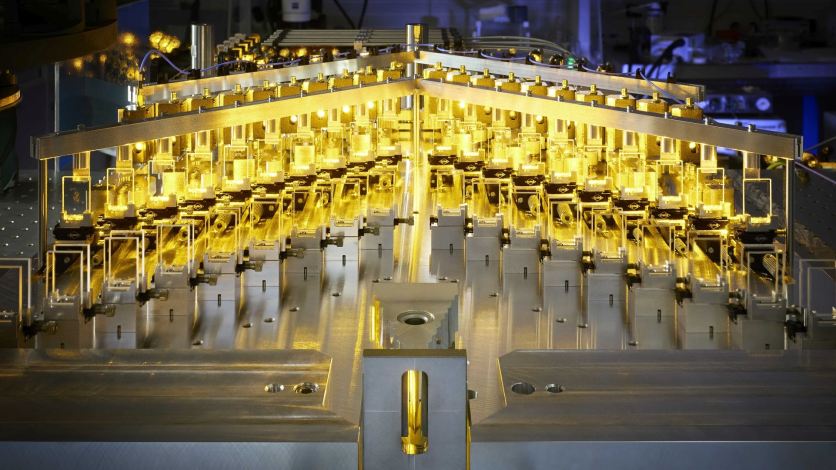
Germany's Fraunhofer Institute for Laser Technology delivered a milestone this week that sits at the intersection of precision optics and quantum hardware: a fully assembled, commissioned laser platform capable of generating 2,000 individually controllable optical tweezers — each holding a single strontium atom in place to within 100 nanometers — crammed into a footprint of one square meter, installed at the University of Stuttgart with no post-delivery realignment required. The system is now operating as the tweezer backbone of a Rydberg-atom quantum computer under construction at Stuttgart's 5th Institute of Physics.
The development matters because it makes visible something the race toward quantum advantage has so far kept backstage: engineering integration, not just qubit physics, is now an independent bottleneck determining which neutral-atom quantum computers can actually scale. Fraunhofer ILT's achievement demonstrates that the industrial laser optics layer — beam multiplexing, custom mirror fabrication, hexapod alignment at sub-micrometer tolerances — can be built, packaged, shipped, and commissioned at the precision quantum hardware demands. That is a different kind of proof than a physics result.
How Optical Tweezers Work in a Quantum Computer
The operating principle is deceptively elegant: a tightly focused laser beam exerts a picoNewton-scale attractive force on nearby atoms. Move the focus, and the atom follows. Arrange thousands of these focal points in a precise grid, and you have a programmable lattice of qubit sites, each occupied by a single atom that can be individually addressed, manipulated, and read out.
Arthur Ashkin pioneered the physics of optical trapping in the 1970s and demonstrated the single-beam gradient force trap — now called optical tweezers — in 1986, work that earned him a share of the 2018 Nobel Prize in Physics. Steven Chu, whose 1997 Nobel Prize recognized separately his work on laser cooling and trapping of atoms, contributed to the broader toolkit of atomic manipulation that neutral-atom quantum computing draws from. The convergence of these techniques with high-speed laser electronics and vacuum engineering has transformed optical tweezers from a biophysics tool into the load-bearing structure of a quantum computing platform.
In the Stuttgart system, the tweezer array is not just a static holder. During computation, the 20×100 grid of focal points can be dynamically rearranged — atoms moved to new positions mid-circuit — so that qubits that need to interact can be brought into proximity for a gate operation and then separated again. This reconfigurability gives neutral-atom computers something superconducting chips lack: any-to-all connectivity that is set by software rather than by the physical wiring of a chip.
What 2,000 Tweezers Actually Requires
Fraunhofer ILT's engineering task was to take four input laser beams carrying a combined 20 watts and turn them into 2,000 independently steerable output beams of equal power, arranged in a 20×100 grid with adjacent spots separated by exactly 3.5 micrometers, landing at each position to within less than 100 nanometers. The platform needed to fit in a single square meter to meet the Stuttgart quantum computer's design constraints, and it needed to work correctly on arrival without further tuning.
The splitting happens in two stages. Each of the four input beams first passes through a cascade of beam-splitter cubes — five stages in which 20 percent of the light is diverted at a 90-degree angle while 80 percent continues forward, yielding 20 parallel beams of equal power per input channel. Those 20 beams then enter acousto-optic deflectors in quantum (AODs): crystals in which simultaneously-driven sound waves at 100 different frequencies create 100 distinct periodic variations in refractive index, each diffracting an incoming beam at a different angle and independently controllable in direction and power. The arithmetic: 20 beams × 100 sub-beams from the AOD = 2,000 individually addressable outputs for each input laser, and 2,000 total tweezers across all four.
Getting those 2,000 beams to land 3.5 micrometers apart inside a vacuum chamber requires an additional optical chain. A Fourier lens converts the AOD output into an intermediate spot pattern, which is then directed onto a segmented step mirror — a custom-fabricated component in which each successive step has a smaller mirror face, ultimately down to a few hundred micrometers in area. This cascade compresses the spot spacing to below 200 micrometers. Still not small enough: a final two-stage telecentric relay unit applies a 50-fold demagnification before projecting the array into the vacuum chamber.
Alignment throughout was performed using a hexapod — a platform with six independent actuators that simultaneously adjust position and angle in all three spatial dimensions. "Even minimal deviations in the alignment of the optical components would result in incorrect spacing within the array," Dr. Martin Traub, group leader for Optical Design and Diode Lasers at Fraunhofer ILT, said in the press release. "That would directly compromise computational performance, as misaligned qubits can no longer fulfill their logical function." The complete system houses more than 150 optical components. It was assembled and tested comprehensively in Aachen, and upon installation in Stuttgart it required no readjustment.
Read more: Atom Computing Runs First Multi-Round Error Correction on Neutral-Atom Quantum Chip
How a Rydberg Atom Becomes a Qubit
The Stuttgart team, led by Dr. Florian Meinert and Prof. Tilman Pfau, encodes quantum information in strontium-88 atoms using a patented approach called the fine-structure qubit, operated at what physicists call the magic wavelength of 592 nm.
The magic wavelength is a specific property of the trapping laser: at 592 nm, the differential AC Stark shift — the difference in how the trap light pushes on each of the two qubit energy levels — goes to zero. Both qubit states, and crucially the Rydberg excited state, experience exactly the same trapping force. The practical consequence is that the qubit remains stable inside the trap even while being manipulated by the gate lasers, removing a dominant source of decoherence that affects other neutral-atom designs. By contrast, at the 813 nm magic wavelength commonly used in strontium optical-lattice clocks, the Rydberg state is anti-trapped — meaning the trap actively repels the atom when it enters the excited state required for a gate operation. Stuttgart's 592 nm condition addresses this at the qubit-design level.
When two neighboring strontium atoms are illuminated to drive both simultaneously into the Rydberg state — a configuration in which the outermost electron briefly orbits so far from the nucleus that the atom expands to more than a micrometer across — the strong electromagnetic interaction between the two giant atoms prevents the second from being excited. Only one atom per pair can occupy the Rydberg state at a time. This conditional behavior is the Rydberg blockade mechanism, and it is the basis of the two-qubit controlled-phase gate: the fundamental logic operation from which all quantum algorithms are assembled.
Is Neutral-Atom Quantum Computing Catching Up to Superconducting?
The honest answer is: in qubit count and architectural flexibility, yes — in raw gate speed, not yet. And the Stuttgart/Fraunhofer milestone speaks specifically to the qubit-count question.
Most near-term quantum computing demonstrations have operated with tens to a few hundred qubits. IBM's and Google's superconducting processors have pushed past 1,000 physical qubits in recent years, establishing that scale on a single chip is achievable. Neutral-atom platforms have matched that count on a different axis: Atom Computing's Phoenix system holds roughly 1,180 physical qubits; Pasqal reached 1,000 atoms in 2024; QuEra's roadmap targets 10,000 physical atoms by the end of 2026. The Stuttgart 2,000-tweezer array, when the full processor is complete, would operate at the high end of that neutral-atom qubit counts in 2026 range.
Where neutral-atom platforms lag is gate clock speed. A Rydberg two-qubit gate runs in hundreds of nanoseconds to a few microseconds; a superconducting CZ gate completes in 20–100 nanoseconds. The tradeoff cuts both ways: neutral-atom systems operate at room temperature (no dilution refrigerator) and offer any-to-all connectivity between qubits — a structural advantage that reduces SWAP overhead in circuit compilation and is what makes the logical-qubit work at QuEra tractable. In January 2026, QuEra demonstrated 96 logical qubits from 448 physical atoms using high-rate quantum error correcting codes at a 4.7:1 physical-to-logical ratio — the best demonstrated encoding efficiency outside of trapped ions.
Gate fidelity remains the primary performance gap. The best published two-qubit Rydberg gate fidelities stand at around 99.5%, compared to 99.92% on Quantinuum's trapped-ion Helios system. Stuttgart's magic-wavelength approach, by suppressing one of the dominant decoherence mechanisms during gate operations, is a specific architectural bet that the fidelity gap can be closed at the design level rather than purely through better lasers and shielding.
Google's March 2026 announcement that it is adding neutral atoms as a second quantum hardware modality alongside its superconducting program — led from Boulder by physicist Adam Kaufman — is the clearest external signal that the modality is no longer a research curiosity. It is, as at least one industry publication put it, the moment neutral atoms moved from dark horse to workhorse.
Laser Engineering Has Become the Quantum Computing Bottleneck
"We were only able to design and successfully implement the system thanks to the extensive expertise that Fraunhofer ILT has built up over its 40-year history," Dr. Traub said. "This demonstrates just how central lasers and optics are as building blocks and enablers for the future field of quantum technology."
That observation carries more weight than institutional modesty. The principal challenge in scaling neutral-atom quantum computers is no longer confined to quantum physics: it is also a precision manufacturing and integration problem. Building a 2,000-spot tweezer array that delivers equal power to every spot, lands each spot within 100 nanometers of its target, survives shipping, and requires no post-installation adjustment is an industrial optics achievement as much as a physics one.
Dr. Bernd Jungbluth, head of Strategic Mission Quantum Technology at Fraunhofer ILT, situates the work in the context of the institute's broader quantum portfolio: quantum frequency converters for networking (contributing to a quantum link between Den Haag and Delft in the Netherlands) and ion-trap chips fabricated from quartz glass using selective laser-induced etching. The through-line is laser engineering as infrastructure — the equivalent, Jungbluth suggests, of what semiconductor lithography was to classical computing.
The Stuttgart quantum computer remains under construction. The tweezer array is one subsystem; a full Rydberg processor also requires separate laser systems for atom loading and cooling, qubit-state preparation, gate pulses, and fluorescence readout. Each is its own precision engineering challenge. But the successful delivery and commissioning of the 2,000-tweezer platform removes what was, until now, the largest unproven component.
Read more: Quantum Computing Fault Tolerance: Microsoft Majorana 2, QuiX, Japan Move Past Qubit Counts
Frequently Asked Questions
How does a neutral-atom quantum computer use optical tweezers?
Each optical tweezer is a tightly focused laser beam that traps a single atom at its focal point by exerting a picoNewton-scale gradient force. Arrays of tweezers — in the Stuttgart system, 2,000 of them arranged in a 20×100 grid — each hold one qubit atom. Because the focal points can be repositioned during computation, atoms can be moved close enough together to perform two-qubit gate operations via the Rydberg blockade interaction, then separated. This gives neutral-atom computers flexible, any-to-all connectivity that is reconfigured in software rather than hardwired into a chip.
What is the Rydberg blockade, and why does it matter for quantum gates?
When two neighboring atoms are both driven toward the high-energy Rydberg state — in which the outermost electron orbits far enough from the nucleus that the atom expands to more than a micrometer across — the electromagnetic interaction between them shifts the doubly-excited state out of resonance. Only one atom in a pair can occupy the Rydberg state at a time. This conditional behavior is the basis of the two-qubit controlled-phase gate: the system can encode a logical operation that depends on the state of one atom to control what happens to a neighboring one, which is the fundamental building block of quantum algorithms.
Why does the magic wavelength at 592 nm matter compared to other approaches?
At 592 nm, both the ground qubit states and the Rydberg excited state experience identical trapping force from the tweezer laser, because the differential AC Stark shift between those states goes to zero at that wavelength. This means the qubit remains stably confined during gate operations without the trap pulling on one state more than the other — a source of decoherence that affects other approaches. By contrast, at the 813 nm wavelength used in strontium optical-lattice clocks, the Rydberg state is actively repelled by the trap, causing atom loss during gate operations. The Stuttgart fine-structure qubit's 592 nm design addresses this at the architecture level, making it a competitive technical differentiator.
Does the 2,000-tweezer delivery mean Stuttgart has a working quantum computer?
Not yet. The optical tweezer array is the foundational subsystem — the structure that holds and positions the 2,000 qubit atoms — but a complete Rydberg quantum processor also requires separate laser systems for loading atoms from a magneto-optical trap, preparing qubits in specific initial states, running the gate pulses that drive two-photon Rydberg excitation, and reading out results via fluorescence imaging. Each of those subsystems is itself a precision engineering project. The Stuttgart computer remains under construction, and the 2,000-tweezer delivery removes what was the largest unproven component of that build.

-
 C114 Communication Network
 -
 Communication Home
