
 Search

us.amazfit.com
Every smart ring on the market right now measures roughly the same things the same way: optical sensors on the inner band read heart rate, blood oxygen, and skin temperature. It is a formula that works, and it has held since the category began. The two most wanted features — a body composition readout that doesn't require stepping on a separate scale and an ECG that can flag atrial fibrillation — remain conspicuously absent from every subscription-free ring in the market. A newly published US patent from Huami, the Chinese parent company of Amazfit and Zepp Health, describes the specific engineering solution the company believes will change that.
Patent application US 2026/0219706 A1, published by the United States Patent and Trademark Office on July 30, 2026, lays out a finger-worn wearable capable of bioelectrical impedance analysis (BIA) for body composition, a single-lead electrocardiogram (ECG), skin temperature, and electrodermal activity (EDA) measurement — all from a ring, all from the same two contact surfaces. The filing claims priority to a Chinese application first submitted in October 2023, meaning the underlying work predates the first-generation Helio Ring's commercial launch. The patent's architecture is independently described in a July 30, 2026 analysis from TuttoTech.net, which read and summarized the USPTO document on the same day of publication.
The Electrode Problem Every Ring Maker Has Avoided
Understanding what the patent actually solves requires understanding why today's rings do not do these things — and why that limitation is structural, not incidental.
Current smart rings use small optical sensor clusters to measure heart rate and SpO2. Those sensors work well: a 2025 systematic review of 107 clinical studies involving approximately 100,000 participants found that finger-based photoplethysmography (PPG) achieves a heart rate correlation of r² = 0.996 against ECG gold standard for resting measurements — a result that matches clinical pulse oximeters. What optical sensors cannot do is pass electrical current through tissue, which is what both BIA and ECG require.
BIA works by injecting a small alternating current through tissue and measuring the resulting voltage. The ratio of current to voltage gives impedance; impedance, combined with demographic inputs and validated predictive equations, estimates fat mass, lean muscle, and total body water. Standard clinical BIA analyzers use a hand-to-foot current path — the current travels across the entire body, and the resulting measurement reflects whole-body composition. A 2025 Frontiers in Sports and Active Living study on the Samsung Galaxy Watch5, which uses a wrist-to-finger BIA circuit, found the measurement provided body fat percentage estimates with precision comparable to but lower than laboratory measures when compared against dual-energy X-ray absorptiometry (DEXA), the clinical gold standard. Reducing the current path from wrist-to-finger to ring-only makes that already-modest accuracy harder to achieve.
ECG from a ring faces a similar circuit problem. An electrocardiogram requires measuring the heart's electrical activity from two points on the body at a sufficient distance to capture a meaningful waveform. On a smartwatch, users touch the watch crown with a fingertip to complete a circuit across the chest. On a ring, both electrodes are on the same finger — and a ring-only circuit, absent a reference point on the other hand or elsewhere on the body, produces a weaker signal. The Circular Ring 2, which launched in August 2025 with FDA-cleared AFib detection, addresses this by asking the user to touch the ring's outer electrode with a finger from the opposite hand, completing the circuit the way a two-point ECG requires. A 2022 European Heart Journal meta-analysis found that consumer wearable ECG achieves 94–98% sensitivity and 92–97% specificity for AFib detection compared to clinical reference standards — but only when the circuit is properly completed.
What the Huami Patent Does Differently
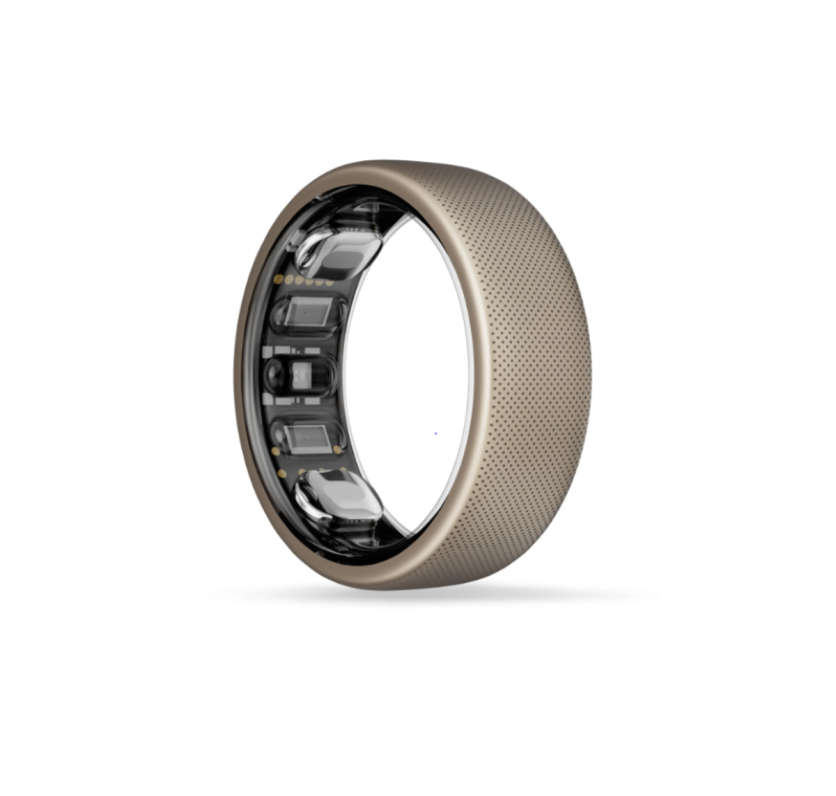
The solution Huami describes in US 2026/0219706 A1 is architectural. Instead of small sensor clusters on the inner band, the patent outlines two large curved electrodes that wrap more than two-thirds of the ring's inner circumference. That dramatically increases the surface contact area between the electrodes and the finger — which matters for both BIA signal quality and ECG capture, as TuttoTech.net's analysis of the filing confirms.
The patent describes a switching circuit that changes how the electrodes connect depending on what the ring is doing. During health sensing, the electrodes function as BIA current injectors and voltage sensors, ECG capture surfaces, and EDA skin conductance contacts. When the ring is placed in its charging case — a change from the first-generation Helio Ring's puck-style dock — the same electrodes serve as power contacts.
For body composition specifically, the patent describes two implementation modes. A simpler version uses only the ring's two internal electrodes, producing a short current path across one finger. A more capable version adds an external electrode contact — the user touches the ring's outer surface with a finger from the opposite hand, or uses a paired Amazfit smartwatch as the additional electrode — creating a longer current path across the body that more closely resembles the hand-to-foot path used by clinical analyzers. The patent also describes a multi-device mode in which the ring and a paired watch perform a coordinated multi-electrode BIA measurement.
The ECG approach follows a similar logic: the same external-contact mechanism that lengthens the BIA path would complete the ECG circuit. This is the same physical interaction the Circular Ring 2 uses — touch the ring with the opposite hand — applied to both cardiac and composition measurements from the same electrode surfaces.
EDA is the least constrained of the described measurements. The finger is one of the highest-density eccrine gland sites on the body, with approximately 400 glands per square centimeter, making it physiologically optimal for electrodermal sensing, as a 2025 systematic literature review on smart ring sensing capabilities documents. Research confirms finger EDA substantially outperforms wrist EDA, which is what most competing devices attempt to use. The first-generation Amazfit Helio Ring already includes an EDA sensor — activated via a software update in mid-2024 — so this capability is not new to the platform. The patent describes a more integrated implementation rather than a retrofitted one.
Read more: CES 2024: Introducing the Amazfit Helio Ring, an Ultra-Light Titanium Smart Ring for Optimal Athletic Performance
Where the Engineering Gets Difficult
Patents describe intent, not achievement. Several of the capabilities in US 2026/0219706 A1 are genuinely hard to deliver accurately from a ring.
BIA accuracy from a single extremity is an active area of research — and not a settled one. A 2022 study in Smart Health demonstrated a wearable ring BIA device that compared reasonably well against a conventional body fat monitor across 40 healthy volunteers. But the broader academic literature is consistent on one point: single-extremity BIA shows higher variability than whole-body or even wrist-to-finger measurements, requires well-validated population-specific prediction equations, and is sensitive to hydration status, electrode contact quality, and skin temperature at the time of measurement. A 2025 letter in NCBI from André Pontes-Silva and colleagues described BIA as "a still scientifically fragile tool for body composition assessment" — not an indictment of the technology, but a reminder that wrist-based BIA in a smartwatch already involves significant tradeoffs, and ring-based BIA involves more. Huami's patent addresses the electrode contact problem; it does not address the prediction equation problem, which is where the real accuracy work happens.
ECG from a ring also faces regulatory friction that hardware alone cannot solve. A device making medical-grade cardiac claims in the US market requires FDA 510(k) clearance. The Circular Ring 2 cleared that bar in 2025; the process typically takes 12–18 months for a new submission and requires clinical validation data beyond what a patent application contains. If Huami pursues FDA clearance for ECG on the Helio Ring 2, the regulatory timeline may extend past the hardware's readiness.
There is also the question of sensor multiplexing interference. Running a BIA current, completing an ECG circuit, and measuring EDA skin conductance from the same electrode surfaces requires careful signal isolation — the current injection for BIA cannot contaminate the EDA conductance measurement, and the ECG waveform acquisition requires a noise floor that BIA excitation might compromise. The switching circuit described in the patent addresses this at an architectural level, but whether the implementation achieves that isolation in a commercial product at an acceptable power budget and form factor is a hardware question the patent does not answer.
Helio Ring 2 Is Confirmed — But the US Market Is Not
Zepp Health executives confirmed at the company's most recent earnings call that a next-generation Helio Ring is in development and on course for release in the second half of 2026, with a September or October launch widely expected by industry analysts. No pricing, feature list, or specific launch date has been announced. The patent, which was filed in China in October 2023 and has now been published in the US system, does not confirm a product launch date — but it shows the engineering direction the company has been committed to since before the first-generation ring shipped.
The more significant complication is legal, not technical. Oura filed an ITC Section 337 complaint (Investigation No. 337-TA-1468) against Zepp Health in November 2025, asserting four patents related to smart ring form factor, internal components, and manufacturing methods. The ITC trial was scheduled for July 2026 — the same month the patent that is the subject of this article was published. Jones Day is defending Zepp Health in the ITC proceeding. In July 2026, Zepp voluntarily dismissed its own patent lawsuit against Oura, without prejudice, meaning it could refile. Oura's ITC complaint against Zepp remains active.
If Oura prevails at the ITC, the Amazfit Helio Ring could face a US import ban — the same outcome that initially blocked Ultrahuman's Ring Air from US sale in 2025 before Ultrahuman redesigned the product. The publication of US 2026/0219706 A1 at the same time as the ITC proceeding is notable: the new electrode architecture described in the patent is structurally different from the form factor and internal component arrangement that Oura's patents address. Whether Huami's new design constitutes a freedom-to-operate solution around Oura's IP position is a legal question only the ITC will answer.
Read more: Casio Ring Watch Breaks Smart Ring Convention With LCD Display and Health Sensors
Where the Helio Ring 2 Would Stand in the Market
If Huami delivers the capabilities described in the patent at the price point the first-generation ring established, the competitive picture is clear.
Samsung's Galaxy Ring has BIA through the Samsung Health app — measuring body composition via the ring's optical electrodes with an interaction similar to what Samsung Galaxy Watch5 offers — but does not have ECG. The Galaxy Watch lineup has ECG, but the Galaxy Ring does not. The Galaxy Ring 2, pushed back to early 2027 by most estimates due to its own Oura patent complications, has no confirmed spec sheet.
The Oura Ring 4 has neither BIA nor ECG, and the Oura Ring 5, announced in May 2026 with blood pressure trend detection and GLP-1 tracking tools, also does not include either feature. Oura's subscription model ($5.99 per month) remains in place.
The Circular Ring 2, launched in August 2025, has FDA-cleared ECG and AFib detection with no subscription — priced at $380 to $549 depending on finish. It does not have BIA.
A Helio Ring 2 that delivers BIA and ECG with no subscription, at a price near the current $199 street price of the Gen 1, would be the only ring in the market combining all three: body composition, cardiac monitoring, and no monthly fee. The engineering challenges above are real, and the ITC case is an active risk. Whether Huami can clear both bars by the second half of 2026 is what separates a compelling patent from a compelling product.
Amazfit's Data Is Subject to Chinese Law
Before deciding whether to adopt any Amazfit or Zepp Health device, US and international readers should understand one structural condition that no privacy policy can change.
Huami (Anhui Huami Information Technology Co., Ltd.) is a Chinese company. China's National Intelligence Law of 2017, Article 7, requires that all organizations and citizens "support, assist, and cooperate with national intelligence work." This obligation is unconditional and applies to all Chinese companies regardless of where their data centers are located, where their products are sold, or what their privacy policies say. China's Data Security Law of 2021 and Cybersecurity Law of 2017 add further provisions requiring data handlers to cooperate with government security reviews and provide access to data on demand.
Zepp Health's own privacy policy confirms that Chinese mainland users have their personal information stored in data centers in mainland China. For non-Chinese users, the policy states that data may be transferred and processed anywhere in the world. The policy does not and cannot override Article 7 obligations on the company itself.
The Amazfit Helio Ring currently collects heart rate, blood oxygen, skin temperature, electrodermal activity, sleep stages, motion data, and stress scores. The Helio Ring 2, if the patent's capabilities are delivered, would add ECG waveforms and BIA body composition data — among the most clinically sensitive biometrics a consumer device can generate. No independent security audit of the Helio Ring hardware has been published.
This is not a reason to avoid the product; it is context a reader needs before buying. Practical mitigations include reviewing what data the Zepp app uploads to Zepp's servers and adjusting sharing settings where available — but no configuration change overrides the legal framework governing Huami as a Chinese entity.
Frequently Asked Questions
Does the Amazfit Helio Ring 2 actually have ECG and body composition confirmed?
Not yet. The Huami patent published July 30, 2026, describes the engineering architecture for these capabilities — two large curved electrodes, a switching circuit, and optional external-contact measurements. Zepp Health has confirmed that a second-generation Helio Ring is targeting a release in the second half of 2026, but has not announced feature specifications, pricing, or an exact launch date. Patents describe engineering intent, not shipping products. Whether the Helio Ring 2 delivers FDA-cleared ECG, clinically validated BIA, or both depends on hardware execution and regulatory clearance that has not yet occurred.
How accurate is body composition from a smart ring compared to a body composition scale?
Less accurate, in general. Standard body composition scales that use bioelectrical impedance analysis send current through a longer path — hand-to-foot or foot-to-foot — producing a whole-body estimate. A wrist-based circuit (like Samsung Galaxy Watch5) is shorter and shows higher variability compared to clinical DEXA measurements. A ring-only circuit is shorter still. The Huami patent addresses this by describing an extended-circuit mode — touching the ring with the opposite hand or linking to a paired watch to create a longer current path — which would narrow the gap. Research on single-extremity wearable BIA consistently finds the technology useful for tracking trends over time but less reliable for absolute body composition figures than multi-point clinical analyzers.
What is the risk of buying a Chinese-made smart ring for health data?
The primary structural risk is legal, not technical. China's National Intelligence Law requires Chinese companies to cooperate with Chinese government intelligence requests regardless of where the company's servers are located or what its privacy policy says. A smart ring that collects heart rate, sleep patterns, stress responses, and — potentially — ECG waveforms and body composition data represents a substantial biometric profile. No independent security audit of the Amazfit Helio Ring hardware has been published. Readers in sensitive professions or with national security concerns should weigh this framework before adopting any Chinese-origin health wearable.
When is the Amazfit Helio Ring 2 expected to launch?
Zepp Health has confirmed H2 2026 as the target window. Independent smart ring analysts expect a September or October 2026 launch in North America and key European markets. The timeline may be affected by the active Oura ITC patent dispute against Zepp Health, which could restrict US sales of the current Helio Ring and potentially complicate the Helio Ring 2's US market entry if Oura prevails.

-
 C114 Communication Network
 -
 Communication Home
