
 Search


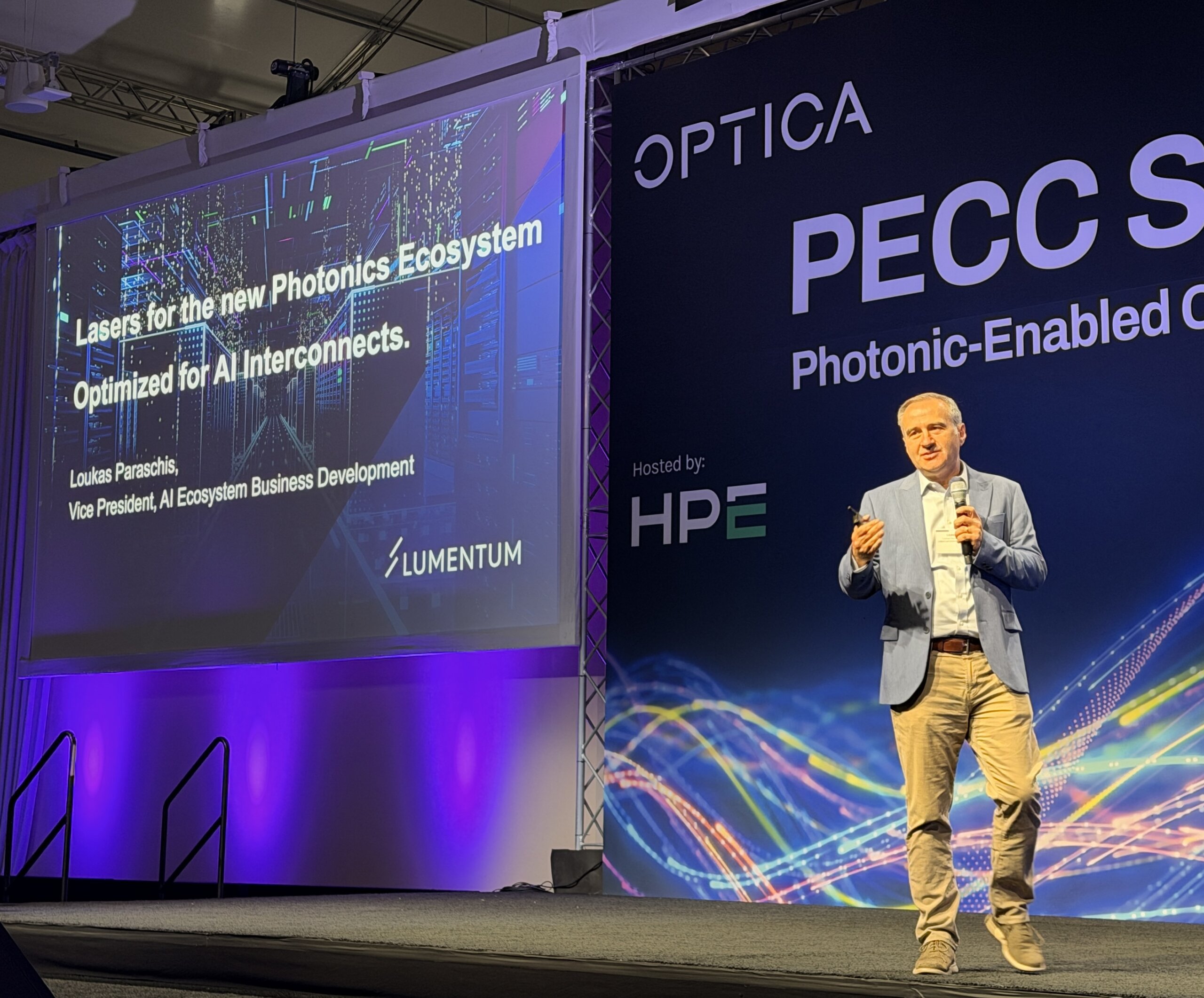
Laser power, wavelength design and placement are becoming critical architectural choices as optics moves closer to AI compute and switching silicon, according to Loukas Paraschis, Lumentum’s VP, AI Ecosystems Business Development. Speaking at Optica’s PECC Summit on October 20, Paraschis argued that the transition from copper to optics requires coordinated optimization across the entire AI cluster, including power consumption, cooling, reliability, serviceability and manufacturing capacity. His presentation positioned high-power external lasers, multiwavelength sources and VCSEL-based optical engines as complementary approaches serving different interconnect requirements.
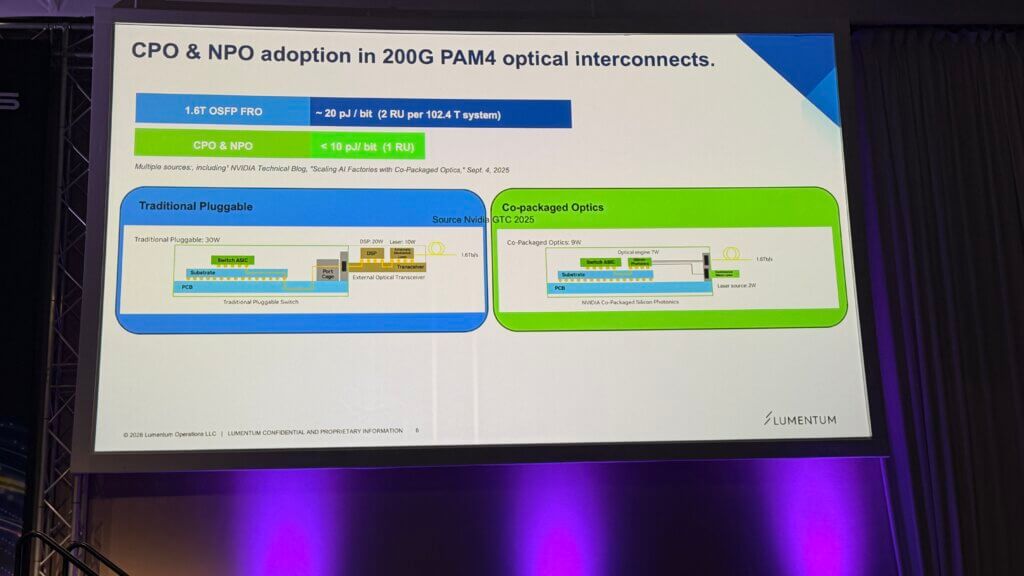
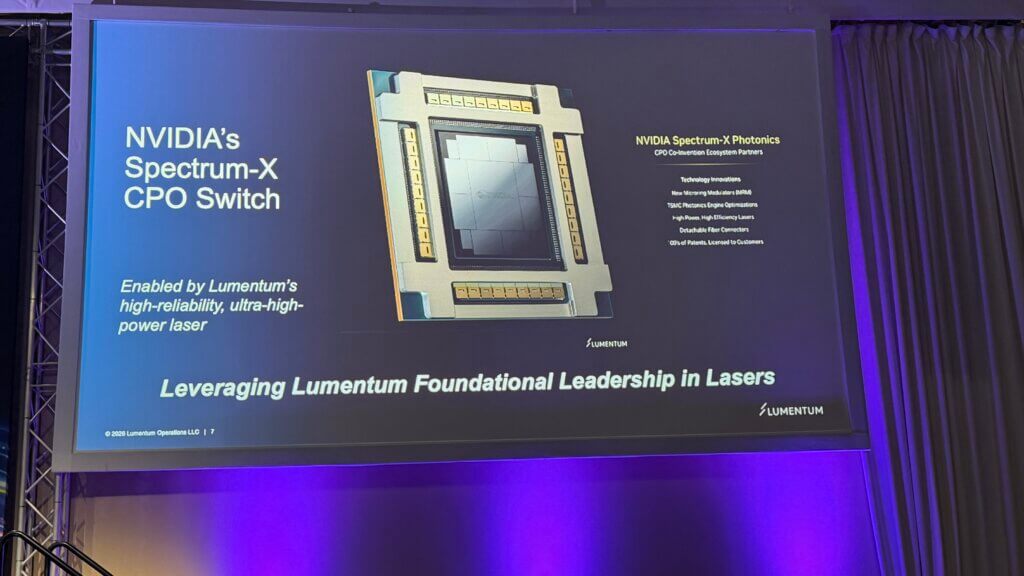
Paraschis outlined an ecosystem advancing along several paths simultaneously: 200G-per-lane optical engines with 400G-per-lane development underway; linear 800G and half-retimed 1.6T pluggables; and co-packaged optics (CPO) and near-packaged optics (NPO) that shorten electrical connections between optical engines and host silicon. His slides identified 21–26 dBm laser power levels for CPO/NPO, alongside slow-and-wide optical engines using OCI MSA architectures or 1060 nm vertical-cavity surface-emitting lasers (VCSELs) for Scale Up and Scale In. He also highlighted optical circuit switching, emerging fiber and connector technologies, optical backplanes, and coherent connectivity for Scale Across.
Lumentum’s examples illustrated both wavelength-density and optical-power scaling. A 16-channel DWDM ultra-high-power (UHP) demonstration used two ELSFP external-laser modules, distinct from the eight-wavelength OCI-oriented source shown on another slide. The presentation listed 350 mW per laser and 23–24.5 dBm per fiber for the multiwavelength platform, with wavelength control within ±25 GHz. Separately, its 1310 nm super-high-power (SHP) laser demonstration delivered more than 1 W at 25°C and more than 800 mW at 50°C, with linewidth below 100 kHz and side-mode suppression above 40 dB. Paraschis emphasized that selecting among these sources requires evaluating thermal design, failure impact, diagnostics and recovery domains, with a roadmap toward greater laser integration.
| Lumentum’s AI Interconnect Design Priorities | |
| Architecture | • CPO/NPO move optics closer to silicon; laser location remains a separate design choice. |
| Wavelength density | • 16-channel DWDM UHP demonstration: two ELSFP modules; distinct from the eight-wavelength OCI source. |
| Optical power | • 1310 nm SHP demonstration: >1 W at 25°C and >800 mW at 50°C. |
| Parallel optics | • 1060 nm VCSELs provide another path for slow-and-wide Scale Up and Scale In interconnects. |
| System priorities | • Power efficiency, thermal management, reliability, serviceability, telemetry and supply-chain maturity. |
“It’s about multidimensional trade-offs,” said Paraschis.
Analysis
Paraschis’s presentation makes the laser-distribution network part of AI system architecture. More source power can provide additional margin or support greater fan-out, but the benefit depends on splitting losses, coupling losses, connector budgets and optical-engine requirements. External sources also allow the laser’s cooling and replacement strategy to be designed separately from the compute package. Sharing a source across more engines therefore makes diagnostics and recovery boundaries important: architects must assess how many links a source failure could affect, alongside the power and packaging savings.
The different demonstrations address different constraints. DWDM increases wavelength density where fiber routing is limited; higher-power sources support larger optical budgets; and slow-and-wide VCSEL architectures distribute bandwidth across more parallel channels. These approaches can coexist across Scale Up, Scale Out and Scale Across networks. The deployment question is how their component-level benefits translate into cluster-level energy use, availability and manufacturability. The figures presented at PECC describe specific demonstrations and architectural comparisons, rather than a universal performance guarantee or a new production-availability announcement.
| Company Profile: Lumentum · NASDAQ: LITE | |
| Overview | Lumentum supplies optical and photonic components, modules and subsystems for AI and cloud data centers, telecommunications, industrial applications and sensing. |
| Headquarters | San Jose, California, USA |
| President and CEO | Michael Hurlston |
| Established | 2015; spun off from JDS Uniphase |
| Technologies | UHP and SHP lasers; ELSFP external laser sources; optical transceivers; optical circuit switching; VCSEL optical interconnects. |

-
 C114 Communication Network
-
 Communication Home
