
 Search


AT&T lowered its long-term capital investment outlook while retaining its target to reach more than 60 million consumer and business locations with fiber by the end of 2030. The carrier now expects capital investment of $22 billion to $23 billion annually in 2027 and 2028, while keeping its 2026 range at $23 billion to $24 billion. The October 21 third-quarter results put capital discipline at the center of its fiber-and-5G expansion, alongside plans to return more than $45 billion to shareholders during 2026–2028.
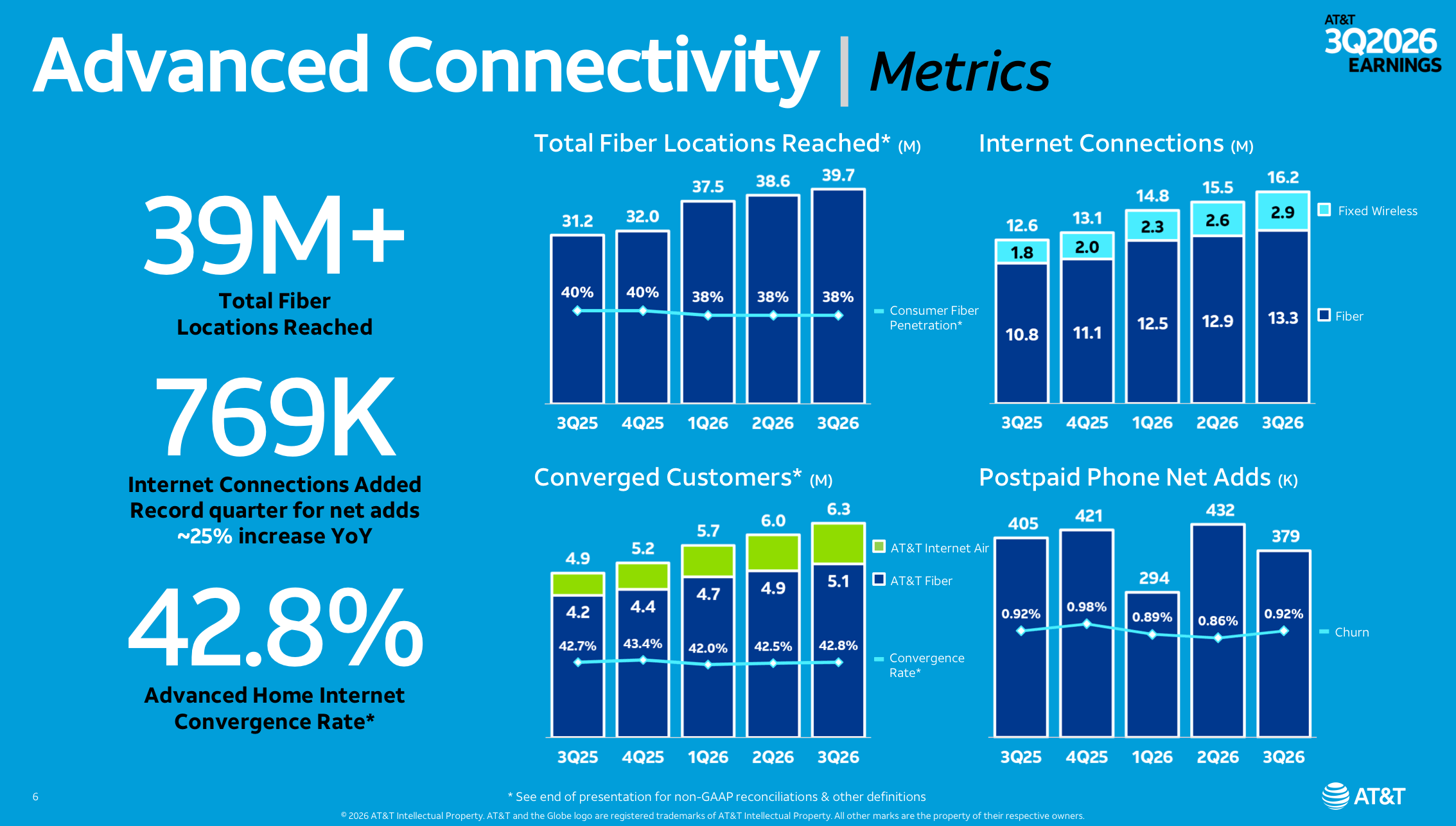
Third-quarter capital expenditures from continuing operations were $5.1 billion, up from $4.9 billion a year earlier. Capital investment, AT&T’s non-GAAP measure that also includes cash paid for vendor financing, reached $5.6 billion, versus $5.3 billion. The company reached more than 39 million fiber locations and remains on track to exceed 40 million by year-end. Its total includes owned-and-operated locations and locations available through fiber ventures and other commercial open-access providers; it does not represent an entirely wholly owned footprint. AT&T added 769,000 internet connections, comprising 442,000 fiber and 327,000 fixed-wireless customers, plus 379,000 postpaid phone customers.
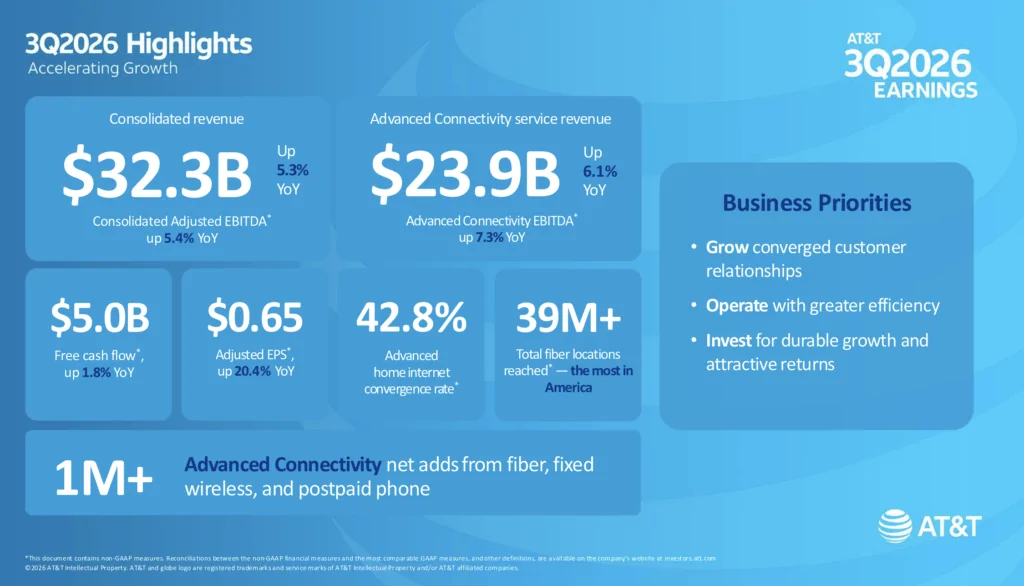
Revenue increased 5.3% to $32.3 billion, with consolidated service revenue rising 3.8%, its strongest growth in more than four years. Advanced Connectivity service revenue grew 6.1% to $23.9 billion, while consolidated adjusted EBITDA increased 5.4% to $12.5 billion. Adjusted EPS rose to $0.65 from $0.54, and AT&T raised its 2026 outlook to approximately $2.40. GAAP diluted EPS from continuing operations was $0.13, including a $2.6 billion non-cash impairment associated with the pending Mexico wireless sale and employee separation charges. Free cash flow was $5.0 billion, and net debt reached $149.8 billion following the EchoStar spectrum acquisition.
| AT&T Q3 2026 · Capital and Connectivity | |
| 2026 investment | $23–24 billion; outlook retained |
| 2027–2028 investment | $22–23 billion annually; long-term outlook lowered |
| Q3 spending | $5.1 billion capex + $0.5 billion vendor-financing payments |
| Fiber footprint | 39 million+ locations; 60 million+ targeted by end-2030 |
| Customer additions | 442,000 fiber • 327,000 fixed wireless • 379,000 postpaid phone |
| Convergence | 42.8% of advanced home internet households also take AT&T wireless |
| Cash and returns | $5.0 billion Q3 free cash flow; $4.8 billion returned to shareholders |
| Balance sheet | $159.6 billion total debt; $149.8 billion non-GAAP net debt |
“Our asset base positions us well for the AI era, with a leading position in fiber – the best technology available,” said John Stankey, AT&T Chairman and CEO.
Analysis
AT&T’s outlook offers a different capital allocation model from the AI compute buildout. In his 2025 shareholder letter, Amazon CEO Andy Jassy described approximately $200 billion of planned 2026 capex and a willingness to accept near-term free-cash-flow pressure to build AI capacity. AT&T’s updated plan instead concentrates on monetizing fiber, fixed wireless and mobile connectivity while lowering its future annual investment range. That supports an interpretation of AT&T as pursuing a more conservative route to AI-related demand: supplying the connectivity layer, with no hyperscale AI compute construction program disclosed in these results. The budgets cover different businesses and accounting measures, so their absolute size is not a like-for-like test of efficiency.
The ownership and accounting structure matters as much as the spending headline. AT&T’s proposed venture with Global Infrastructure Partners and CPP Investments would combine Forged Fiber 37 and Gigapower, with AT&T owning 50%; closing is expected in the first half of 2027. Forged Fiber 37 is already classified as discontinued operations and excluded from the continuing-operations outlook. AT&T can therefore expand commercial fiber reach through infrastructure funded with partners, and a lower reported investment envelope does not by itself establish lower total construction spending across that footprint. Its approach still involves substantial commitments: the approximately $23 billion EchoStar spectrum acquisition increased debt, while copper retirement must remove costs as legacy revenue declines. AT&T expects legacy EBITDA to turn negative after 2027 until direct copper-network costs are substantially eliminated, making execution important to its free-cash-flow targets of more than $18 billion in 2026 and more than $21 billion in 2028.
Adjusted EPS, adjusted EBITDA, free cash flow, capital investment and net debt are non-GAAP measures. Capital investment includes capital expenditures and cash paid for vendor financing. Figures and outlook are on a continuing-operations basis; the 2027–2028 outlook also excludes AT&T Mexico.
| AT&T Q3 2026 Investor Call Addendum |
| October 21, 2026 · Company executives John Stankey — Chairman and CEO Pascal Desroches — Senior Executive Vice President and CFO Brett Feldman — Treasurer and Head of Investor Relations Jennifer Biry — Deputy CFO; attended the call |
| • Lower investment does not translate directly into higher free cash flow. Desroches explained that approximately $300 million–$400 million of the roughly $1 billion annual spending reduction reflects the exclusion of Mexico wireless, with the remainder coming from deployment efficiencies. He expects the Mexico exit to reduce annual cash flow by approximately $400 million–$500 million. Higher device-related working capital and interest payments also absorb cash, helping explain why free-cash-flow guidance did not increase. |
| • AI connectivity already includes hyperscaler engagements. Stankey identified AWS as using AT&T high-capacity fiber to connect locations and said AT&T is also supporting Microsoft’s capacity requirements. According to management, more than 80% of mapped U.S. data centers are within one mile of AT&T fiber and more than 90% are within 10 miles. These proximity figures describe network positioning, rather than contracted connections or disclosed revenue. |
| • The AI opportunity extends into managed network performance. Stankey described customer discussions about packet marking and consistent application performance across fixed networks, mobile networks and multiple cloud environments. Inference is increasing requirements for capacity and round-trip latency. He sees potential additional investment requirements as robotics and warehouse autonomy develop, with cloud ingress, egress and end-to-end visibility becoming important service capabilities. |
| • Fiber investment cases assume 40% penetration. Stankey said AT&T requires adequate returns at that level before investing, while targeting higher penetration operationally. Moving from 40% toward 50% takes longer and depends on different sales tactics and converged relationships. He also left open selective wholesale access after retail opportunities mature, potentially involving reciprocal fiber access or an exclusive mobile virtual network operator relationship. |
| • Fiber ARPU pressure reflects customer mix and introductory offers. Desroches reported a 4% year-over-year decline in fiber average revenue per user, citing introductory pricing, convergence discounts and lower-ARPU Quantum customers acquired from Lumen. He expects a similar annual decline in Q4. Management continues to expect broadly stable ARPU over its multiyear planning period, with most growth coming from customer additions. |
| • Fixed wireless has a role that may change over time. Stankey expects fixed wireless to remain suitable for particular customers and applications, but said industry adoption could eventually peak and decline as fiber expands and competing technologies develop. He described LEO satellite broadband as potentially efficient in sparsely populated areas, while emphasizing the investment required to match terrestrial mobile coverage and indoor performance. |
| • Copper retirement has reached customer-free wire centers. Management said more than 100 wire centers no longer support customers on legacy services. AT&T targets discontinuing copper-based services in 50% of wire centers outside California by end-2027 and substantially all of those wire centers by end-2029. Stankey also identified potential proceeds from recovering embedded copper; no valuation or proceeds forecast was provided. |
| • The EPS upgrade has an accounting driver. Desroches attributed the higher full-year adjusted EPS outlook primarily to lower depreciation following held-for-sale accounting for Mexico. Separately, the roughly $800 million employee separation charge is expected to affect cash mainly in 2027. Q4 EBITDA growth will also face higher acquisition and marketing costs and approximately $100 million of unfavorable vendor dispute settlements, primarily in Legacy. |
| • Further fiber acquisitions remain conditional. Stankey said AT&T would consider additional footprints where price, infrastructure standards and geographic fit support its operating model. He emphasized assets that connect with existing network operations and strengthen local scale, rather than expansion for its own sake. |
| Source: AT&T Q3 2026 earnings call, October 21, 2026; supplied LSEG edited transcript. Management expectations are forward-looking. |
| AT&T · NYSE: T | |
| Headquarters | Dallas, Texas, United States |
| Leadership | John Stankey, Chairman and CEO |
| Business | Wireless, fiber broadband and enterprise connectivity |
| Platforms | AT&T Fiber • AT&T Internet Air • 5G wireless |
| Financial scale | Q3 2026 revenue: $32.3 billion |
| Fiber strategy | Owned infrastructure, fiber ventures and commercial open access; 60 million+ locations targeted by end-2030 |
| Pending transactions | Mexico wireless divestiture; proposed Forged Fiber 37–Gigapower joint venture |
| Review | Verified against the supplied October 21 results and AT&T’s October 6 joint-venture announcement. |

-
 C114 Communication Network
-
 Communication Home
