
 Search


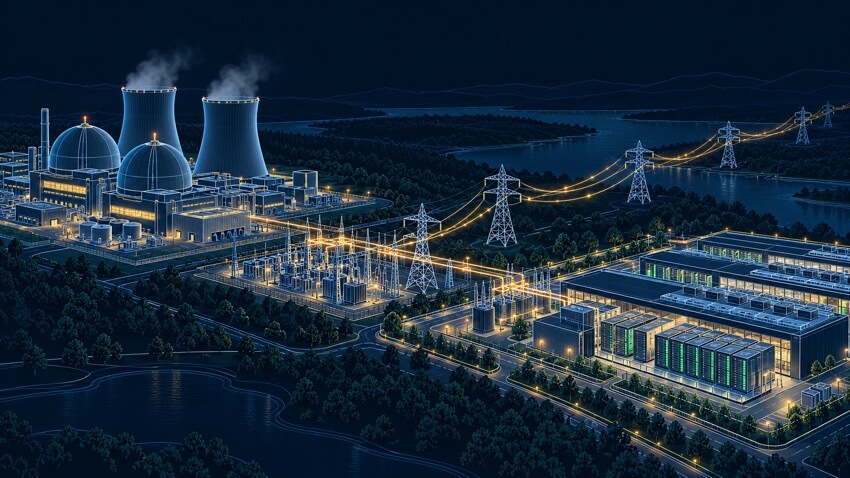
X-energy, American Electric Power (AEP), and Amazon have signed a development agreement for a proposed 960 MW small modular reactor facility at the retired Breed Generating Station site in Sullivan County, Indiana. The proposed project would deploy twelve Xe-100 reactors, each rated at 80 MWe. Amazon is providing development funding. The facility remains in feasibility and development, with no construction or commercial operation date announced.
The Xe-100 is a Generation IV high-temperature gas-cooled reactor that uses helium coolant and TRISO particle fuel. The multi-unit design could allow phased deployment, subject to site engineering, grid interconnection, environmental review, licensing and financing. The project is intended to add electricity to the regional grid rather than exclusively power an Amazon data center.
The Indiana proposal follows Amazon and X-energy’s Cascade advanced nuclear project with Energy Northwest in Washington. X-energy is also developing an initial four-unit deployment for Dow’s Seadrift industrial site in Texas. The Amazon–X-energy collaboration has a broader goal of supporting more than 5 GW of nuclear capacity by 2039; these are development targets rather than operating capacity.
Key Developments
| ADVANCED NUCLEAR • 960 MW PROPOSED | |
| Partners | X-energy • AEP • Amazon |
| Reactors | 12 × 80 MWe Xe-100 |
| Technology | Helium-cooled Generation IV; TRISO fuel |
| Location | Former Breed power plant, Sullivan County, Indiana |
| Funding | Amazon development funding; amount undisclosed |
| Status | Feasibility and development; no commercial operation date announced |
| Long-term target | Amazon–X-energy collaboration: more than 5 GW by 2039 |
Analysis: Can Advanced Nuclear Power Meet AI Infrastructure Demand Before 2035?
Amazon’s proposed 960 MW nuclear project in Indiana illustrates how hyperscaler energy strategies are moving beyond power purchase agreements toward direct investment in new generating capacity. However, the timeline for commercial deployment remains a significant consideration. X-energy’s most advanced U.S. project is its proposed four-reactor installation at Dow’s Seadrift manufacturing complex in Texas, which is progressing through the Nuclear Regulatory Commission’s construction permit review. Its Cascade project in Washington is targeting regulatory approvals later this decade, while the Indiana facility remains in preliminary development. Commercial deployment will depend on completing licensing, securing financing, establishing manufacturing capacity for Xe-100 reactors, and scaling production of specialized TRISO fuel. Initial deployments could potentially contribute electricity in the early 2030s, but achieving gigawatt-scale fleet capacity before 2035 will require successful execution across multiple projects.
Hyperscalers are pursuing several nuclear strategies with different deployment timelines. Microsoft’s agreement with Constellation Energy supports restarting the 835 MW Crane Clean Energy Center in Pennsylvania, while Amazon’s agreement with Talen Energy secures electricity associated with the existing Susquehanna nuclear facility. Google is supporting advanced reactor development through Kairos Power, including a planned 50 MW deployment with the Tennessee Valley Authority around 2030 and a broader target of up to 500 MW by 2035. These approaches highlight the distinction between securing output from existing nuclear facilities, restarting retired reactors, and constructing entirely new advanced nuclear plants. Existing facilities and restarts generally offer shorter potential timelines, while SMRs could eventually expand total generating capacity if developers demonstrate repeatable construction, competitive economics, and reliable commercial operation.
The scale of the Indiana proposal is significant for AI infrastructure. At an illustrative 90% capacity factor, a 960 MW nuclear facility could generate approximately 7.57 terawatt-hours annually, equivalent to the annual electricity consumption of roughly 1.7 continuously operating 500 MW data center campuses. Actual electricity delivery would depend on transmission capacity, grid requirements, operating performance, and contractual arrangements. Importantly, the proposed Indiana reactors would supply the regional electricity grid rather than exclusively serve Amazon facilities. The larger strategic development is the increasing involvement of hyperscalers in financing new power generation, potentially helping utilities address rising electricity demand while expanding long-term access to carbon-free energy. Whether SMRs can contribute meaningfully before 2035 will ultimately depend on the licensing, construction, and operating performance of the first commercial projects.
Company Profile — X-energy
| X-energy | Company Profile | |
| Headquarters | Rockville, Maryland |
| Leadership | J. Clay Sell, CEO |
| Technology | Xe-100 high-temperature gas-cooled reactor; TRISO-X fuel |
| Output | 80 MWe per reactor |
| Projects | Dow Seadrift; Cascade; Indiana Breed site |
| Website | https://x-energy.com |

-
 C114 Communication Network
-
 Communication Home
