
 Search

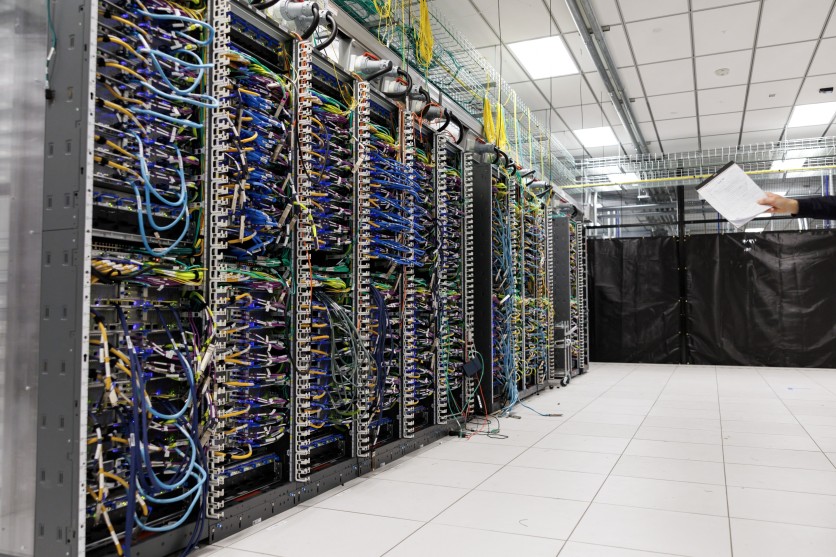
Wires from Amazon Web Services Trainium3 UltraServers are seen at a QA lab in Austin, Texas, on February 3, 2026. Tech titan Amazon is working to step out of Nvidia's shadow with custom "Trainium" chips designed specially for machine learning as billions of dollars are poured into artificial intelligence (AI). Amazon subsidiary Annapurna Labs in Austin, Texas, was testing the longevity of its latest generation Trainium during a recent visit by AFP to the facility. Texas is emerging as a US tech world El Dorado, luring investments with cheap energy, relaxed regulations, tax incentives and reasonably affordable real estate for massive data centers. Mark Felix/AFP via Getty Images
On June 22, 2026, Nvidia published a reference design claiming its next-generation AI data centers can run on virtually no water at all. The announcement landed at London Climate Week with maximum impact: the world's dominant AI chip company saying it has effectively solved the industry's water problem. But the claim rests on a boundary line drawn around the data center building — and everything outside that boundary accounts for the majority of AI's actual water consumption. A reader who can hold that distinction in mind will understand something the headline does not tell them: fixing the cooling loop is not the same as fixing the water problem.
What Nvidia Actually Built
Nvidia's DSX reference design, developed for its Rubin-generation AI infrastructure, achieves something genuinely new: 100% liquid cooling of every chip and networking component in a closed loop, with no fans anywhere in the system. The coolant is a mixture of 75% water and 25% propylene glycol — the same chemistry used in automotive antifreeze — circulated through cold plates that sit directly on every processor, pulling heat out at the source before routing it to outdoor dry cooler radiators.
The key engineering insight is temperature. The industry standard for coolant inlet temperature has historically been around 30°C. Nvidia's system runs the coolant in at up to 45°C — hotter than a hot tub — and it exits the servers at roughly 55°C after absorbing chip heat. That higher temperature matters because of a basic physical principle: heat flows from warmer objects to cooler ones. The warmer the coolant is when it reaches the outdoor radiator, the easier it becomes for passive outdoor dry coolers to draw heat away without mechanical chillers or evaporative cooling towers. Each degree of increase in chiller plant target temperature cuts cooling energy costs by roughly 4%; at 45°C, most temperate climates can run on dry coolers alone.
"The NVIDIA DSX reference design for AI factories has zero water consumption — we have eliminated massive amounts of power usage and pretty much all water usage," said Ali Heydari, Nvidia's director of data center cooling and infrastructure. "With dry-cooler-based designs, it's a closed-loop system with no evaporative water cooling — outside of maybe 1% of the year when we might need chillers in some climates."
The numbers are real. A conventional cooling-tower system consumes roughly 2.6 million gallons of water per megawatt per year. In favorable climates, Nvidia says the DSX design reduces that to near zero — up to a 100% reduction. For a 50-megawatt hyperscale facility, that translates to more than $4 million in annual savings on cooling-related energy and water costs. Rack density also improves: systems that previously occupied six rack units now fit in two, and the elimination of cooling fans — which previously generated 85-plus decibels of noise — makes the next generation of AI facilities dramatically quieter.
Read more: Supermicro Claims 1,000x Impedance Coolant for AI Racks at Computex: Independent Testing Pending
Why This Is a Genuine Engineering Milestone
Andrew Chien, a computer science professor at the University of Chicago who directs the CERES Center for Unstoppable Computing, put it plainly: "The thing that's exciting about what Nvidia announced is it shows really what's possible in terms of pushing up this liquid input temperature to 45°C. It's super important to push it up, because in many cases it allows you to do that cooling without running HVAC units, without running air conditioners. Because if it's cool enough outside, you don't need to."
What makes Nvidia's announcement significant is not that warm-water liquid cooling is new — IBM's Aquasar research system ran at 60°C as far back as 2010 — but that the world's dominant AI chip vendor is designing its flagship infrastructure around it and building a business case for broad adoption. Rubin-generation racks, expected to ship in the second half of 2026, integrate 72 GPUs and 36 CPUs at power densities exceeding 100 kilowatts per cabinet, at which point air cooling is no longer physically viable. Every major cloud provider and data center operator building on the Rubin platform is making the transition to liquid cooling, making the DSX reference design an industry-wide inflection point, not just a product announcement.
The market reacted accordingly. HVAC stocks dropped on the news: Modine Manufacturing fell 7.5%, Johnson Controls declined 6.2%, and Trane Technologies shed 5.3% — a signal that investors believe Nvidia's design will reshape how the industry approaches cooling infrastructure.
The Boundary Problem: Where the Claim Ends
Here is the structural limitation that several outlets — including TechCrunch, Fortune, and Axios — flagged immediately: Nvidia's "zero water" accounting draws a boundary around the data center building. Everything outside those walls — and that's where the majority of AI's water footprint actually lives — is excluded from the calculation.
Fossil fuel power plants, which supply roughly half of all data center power today according to reporting citing the International Energy Agency, are among the largest water users in the country, consuming about 2.7 billion gallons per day nationally according to the U.S. Geological Survey. Natural gas plants consume roughly 1.17 liters of water for every kilowatt-hour of electricity they generate; coal plants consume about 2.2 liters per kilowatt-hour. Even hydropower loses an estimated 6.8 liters per kilowatt-hour to reservoir evaporation.
A 2026 analysis by Xylem and Global Water Intelligence found that direct data center cooling accounts for only about 4% of the additional water AI will demand by 2050. Power generation accounts for roughly 54%; semiconductor fabrication accounts for the remaining 42%. On those figures, Nvidia's solution addresses roughly one-twentieth of AI's projected total water demand growth — not the quarter-to-a-third estimate cited in earlier analyses that counted only operating data center cooling.
"The water consumption challenge for data centers is largely solved," Josh Parker, Nvidia's chief sustainability officer, told Axios. Professor Chien offered a more measured assessment: while zero water use inside the facility is a genuine achievement, he said, absolute zero is unrealistic when the full chain of electricity generation is included. "It is a direction that more people should be trying to get to," he added, "because it'll reduce the total power consumption of these large data centers" — a meaningful endorsement of the architecture, not the claim it has solved AI's water footprint.
Does Nvidia's Cooling Design Work in Hot Climates?
The "near-zero water" figure is also heavily dependent on where a data center sits geographically. The 45°C closed-loop works without chillers in temperate climates — places like the Pacific Northwest, Scotland, or Scandinavia, where outdoor air temperatures are cool enough most of the year to passively reject heat through dry coolers. In Arizona, Texas, or Singapore, those dry coolers will need mechanical backup on the hottest days. Heydari acknowledged the system may require conventional chillers for roughly 1% of annual operating hours in some climates — a figure that could be considerably higher in regions where ambient temperatures regularly approach or exceed 45°C.
This matters because two-thirds of the 809 data centers currently planned across the United States are located on land that has been in drought over the past year, according to a Guardian analysis cited by Tom's Hardware. The regions under the most acute water stress are also the regions where the chiller-free promise is least likely to hold. The Bureau of Reclamation declared a Level 1 Shortage Condition on Lake Mead for 2026, requiring Arizona to cut approximately 18% of its annual water apportionment — the same desert region that has attracted substantial data center investment.
The Efficiency Trap: Jevons Paradox and AI's Water Rebound
There is a structural tension baked into Nvidia's own framing. The company is explicit that efficiency gains are intended to support more growth, not less. "AI workloads are not getting lighter," the Nvidia blog post states. If every watt of AI compute becomes cheaper and easier to cool, the likely outcome — in line with a well-documented economic principle — is that significantly more compute gets deployed, potentially offsetting the per-unit water savings at the total system level.
Economists call this the Jevons Paradox, named for 19th-century economist William Stanley Jevons, who observed in 1865 that improvements in coal engine efficiency led not to less coal consumption but to more — because cheaper energy made coal economically viable across a wider range of industries. Every major efficiency improvement in computing since the 1970s has been accompanied by growth in total compute demand that has exceeded the per-unit efficiency gain. There is no documented historical example of a major computing efficiency improvement that produced a net reduction in total resource use at the system level. Nvidia's announcement contains no mechanism that would prevent the same outcome here.
The context in the United States is already under acute strain. In the first quarter of 2026 alone, more than 75 data center projects worth approximately $130 billion were blocked by local opposition, according to Data Center Watch — as many as were blocked throughout all of 2025. Amazon disclosed in June 2026 that its global data centers consumed 2.5 billion gallons of water in 2025 — the first time the company had published a full annual total — noting the figure declined 2% year over year even as its data center footprint expanded.
What Will and Will Not Change
Nvidia's DSX design is a legitimate engineering milestone. Cooling a hyperscale AI facility on near-zero on-site water is not trivial — it required a complete thermal engineering redesign of the Rubin server architecture, with simplified cooling loops and single-inlet/outlet cold-plate routing across multiple high-power chips. The 45°C architecture could become the new industry standard over the next five years, particularly as local opposition to data center water use intensifies in drought-stressed regions.
What it does not address: the water drawn by the power plants feeding those buildings, the water embedded in the manufacturing of Nvidia's chips, and the question of how many additional facilities will be built as each one becomes cheaper to run. Microsoft announced in August 2024 that new data centers would cease using water for cooling, targeting more than 125 million liters in annual savings per facility. Google has committed to becoming water positive by 2030, reporting that it replenished 64% of its freshwater consumption in 2024. These are supply-side sustainability commitments that operate on a different timescale and across a different perimeter than what Nvidia announced this week.
Nvidia's announcement changes one chapter of AI's water story. The full story — the power plants, the chip fabs, and the rebound curve that cheaper compute always traces — continues.
Frequently Asked Questions
How much water does AI data center cooling actually use, and does Nvidia's design change that?
Existing data centers using evaporative cooling towers consume roughly 2.6 million gallons of water per megawatt per year for on-site cooling alone. Nvidia's DSX closed-loop design reduces that on-site figure to near zero in temperate climates, by circulating a sealed water-glycol coolant through cold plates on every chip and rejecting heat through outdoor radiators rather than evaporation. However, on-site cooling accounts for only about 4% of the additional water AI will demand through 2050, according to a 2026 analysis by Xylem and Global Water Intelligence. Power generation accounts for roughly 54% and semiconductor fabrication for most of the remainder, meaning Nvidia's design addresses a genuine but small fraction of AI's total water footprint.
Does Nvidia's Rubin DSX cooling design work in hot climates like Arizona or Texas?
Only partially. The 45°C coolant design works without mechanical chillers in temperate climates where outdoor air temperatures stay below the coolant temperature for most of the year. In hot climates — Phoenix, Dallas, Singapore — dry coolers alone are insufficient on the hottest days, and conventional chillers will still need to operate. Nvidia's director of data center cooling acknowledged the system may require chillers for roughly 1% of annual operating hours in some climates, though that figure could be substantially higher in the hottest markets. This is particularly relevant because two-thirds of the approximately 809 data centers currently planned across the United States are located in areas that experienced drought conditions over the past year.
What is the Jevons Paradox, and why does it apply to AI cooling efficiency?
The Jevons Paradox, named for 19th-century economist William Stanley Jevons, describes the documented tendency for efficiency improvements to increase total resource consumption rather than reduce it, because lower per-unit costs expand the range of economically viable uses. In computing, every major efficiency advance since the 1970s has been followed by growth in total compute demand that exceeded the per-unit efficiency gain. If Nvidia's cooling innovation makes AI data center construction cheaper and more acceptable to communities, the likely result is more data centers — which could offset per-unit water savings at the total-system level.
Which companies are making progress on the broader AI water footprint beyond on-site cooling?
Microsoft announced in August 2024 that new data centers would cease using water for cooling, targeting more than 125 million liters in annual savings per facility. Google has committed to becoming water positive by 2030 and reported replenishing 64% of its freshwater consumption in 2024. Amazon disclosed in June 2026 that its global data center operations consumed 2.5 billion gallons of water in 2025, a 2% reduction year over year despite continued expansion, and stated it is 75% of the way toward a 2030 goal of returning more water than it consumes. These commitments address the on-site operational footprint; the power plant and chip manufacturing portions of the water chain remain largely outside direct industry control.

-
 C114 Communication Network
 -
 Communication Home
