
 Search


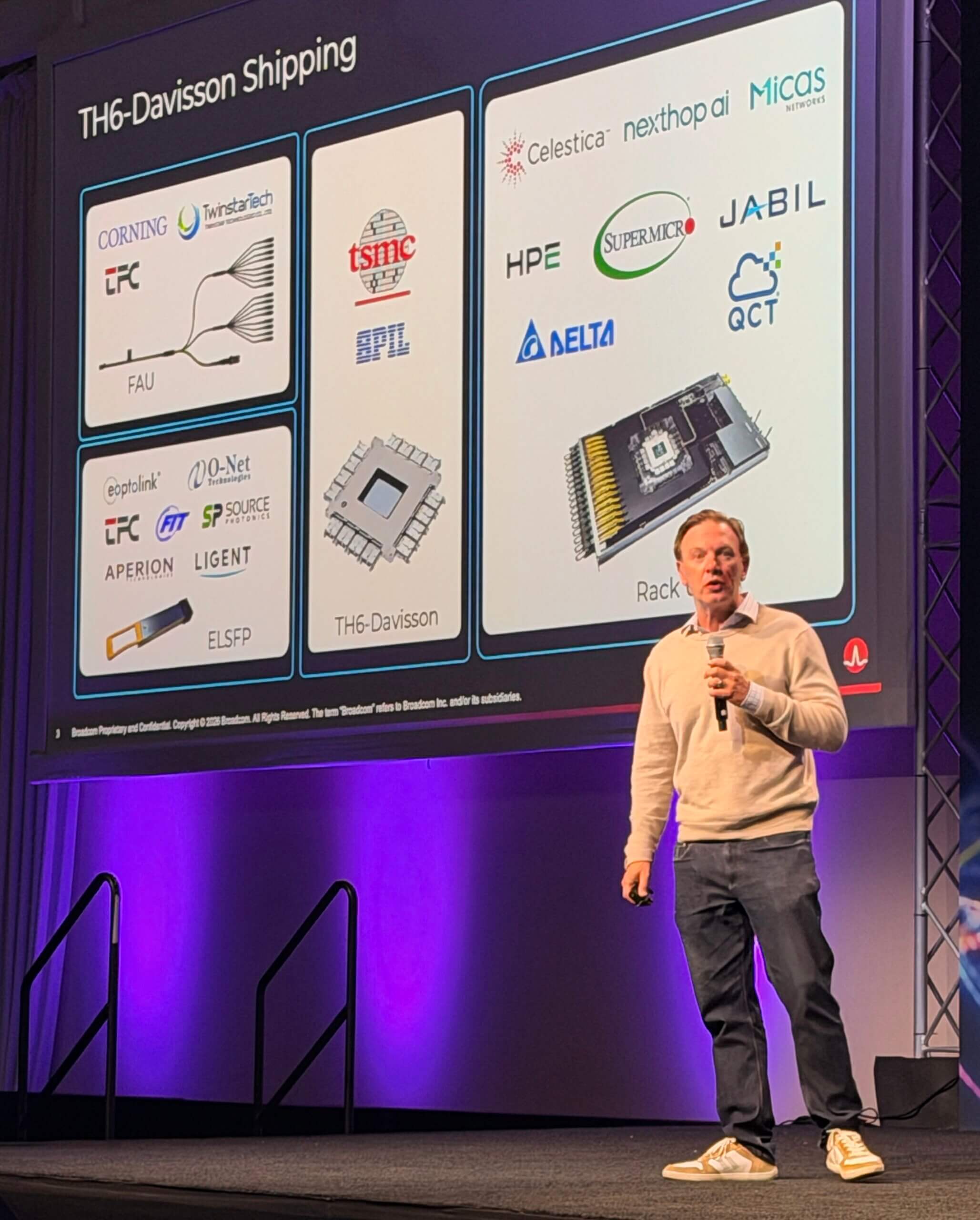
Broadcom outlined an optical networking architecture that would extend AI scale-up domains across multiple racks and use those larger domains to simplify the scale-out fabric. Speaking at the PECC Summit on October 20, Near Margalit, Vice President and General Manager of Broadcom’s Optical Systems Division, described a design comprising 1,024 scale-up pods of 1,024 XPUs each—1,048,576 accelerators—with a single layer of scale-out switching connecting the pods over multiple parallel rails. The proposal combines optical backplanes with Ethernet for Scale-Up Networking (ESUN), allowing high-bandwidth connectivity inside each pod to support communication between pods. It is an architectural proposal, rather than a report of a deployed million-XPU system.
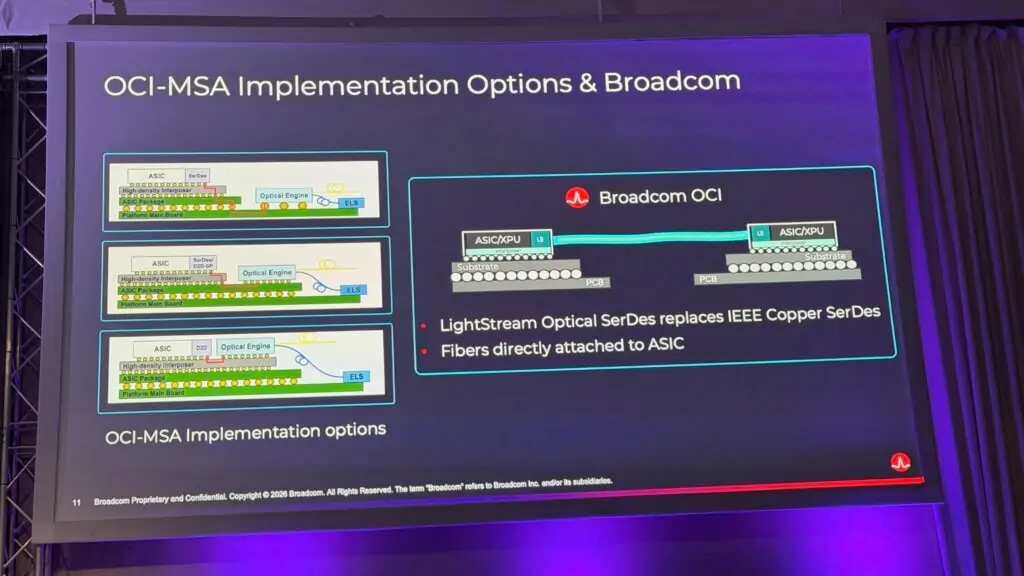
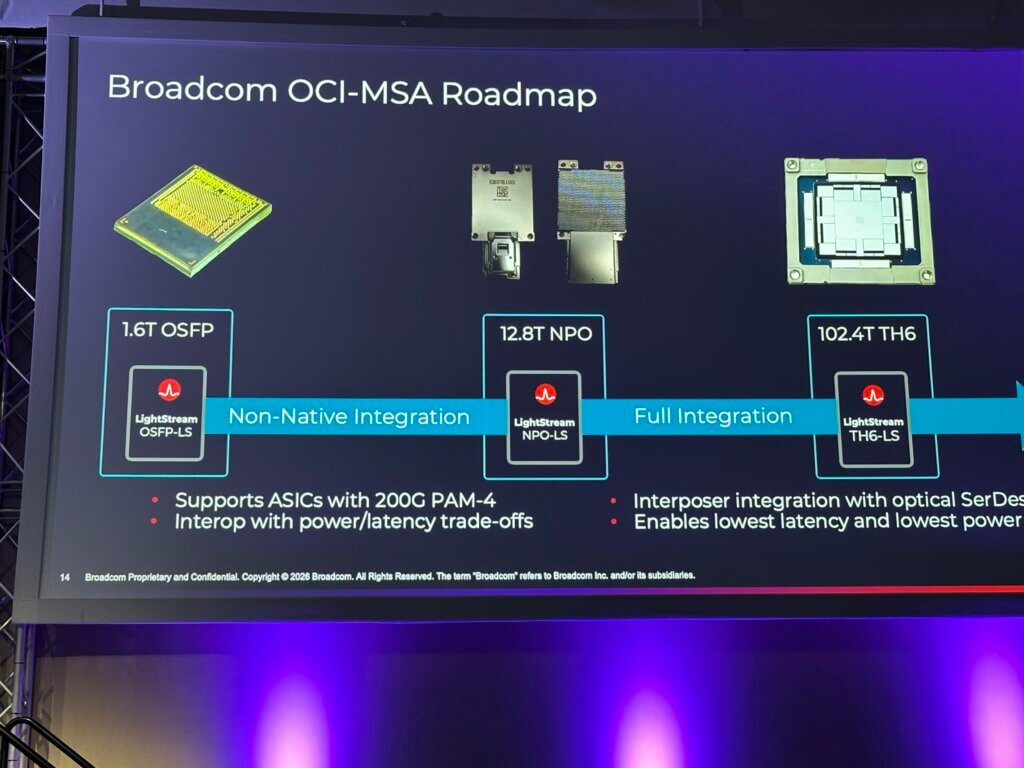
The optical foundation is the Optical Compute Interconnect Multi-Source Agreement (OCI MSA), which uses wavelength-division multiplexing and bidirectional fiber transmission to increase bandwidth without depending solely on faster serial signaling. Margalit argued that optical backplanes could bring in-row connectivity closer to electrical backplanes in cost, power and latency, expanding the scale-up domain beyond the physical limits of a single rack. Broadcom’s slides identified LightStream optical SerDes as a replacement for IEEE copper SerDes, with fibers attached directly to the ASIC assembly and optical integration on the interposer. Its roadmap spans 1.6T OSFP-LS, 12.8T NPO-LS near-packaged optics and a fully integrated 102.4T TH6-LS implementation. The non-native integration path supports ASICs with 200G PAM4 electrical interfaces, while full integration targets lower power and latency by removing that intermediate high-speed electrical connection.
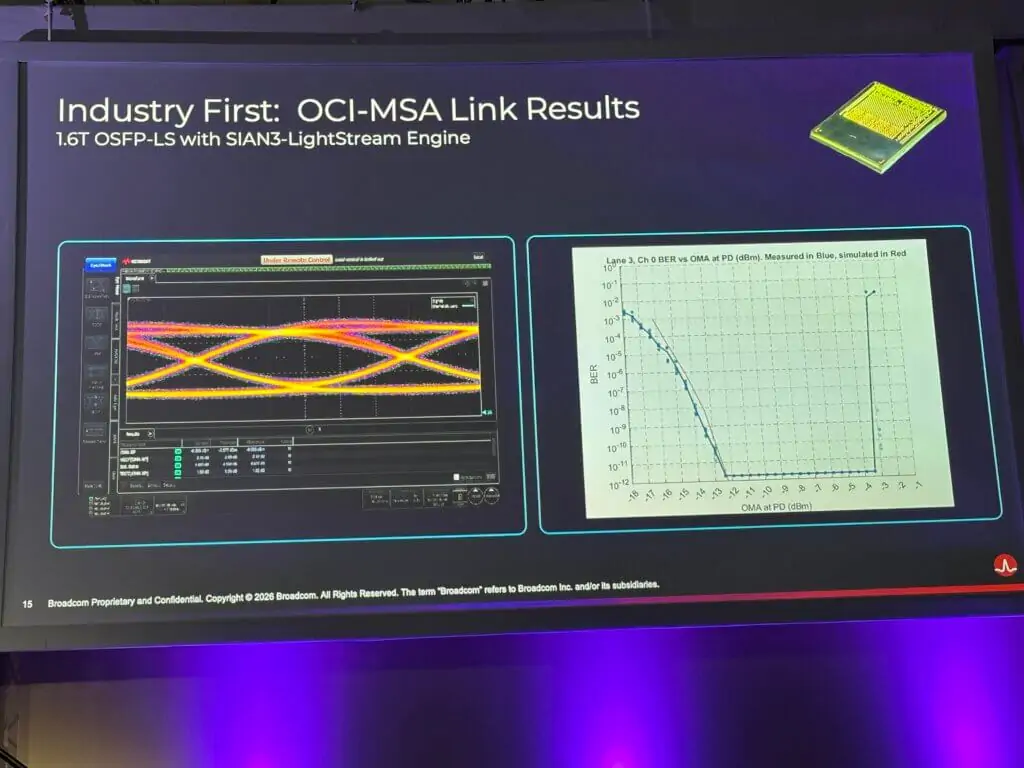
Margalit also addressed the manufacturing and infrastructure requirements behind the proposal. In an illustrative approximately 1,000-XPU scale-up cluster delivering roughly 25 Tbps per accelerator, he estimated about 32,000 fibers using bidirectional links carrying 200 Gbps per direction, warning that lower bandwidth per fiber substantially increases fiber and connector counts. He said external laser-source manufacturers could temperature-tune individual lasers to meet OCI wavelength requirements, rather than requiring every laser to emerge from manufacturing at the final wavelength tolerance, and projected a laser-source contribution of approximately $0.01–$0.02 per Gbps at high production volumes. Broadcom presented transmitter eye diagrams and receiver results across 32 channels for a 1.6T OSFP-LS implementation using its SIAN3-LightStream engine; Margalit described operation without per-channel tuning. These were company-presented results and cost projections; the presentation did not establish general availability dates for the LightStream roadmap.
| Broadcom’s Optical Scale-Up Proposal | |
| Architecture | • 1,024 × 1,024 XPUs: proposed pod architecture supporting 1,048,576 accelerators. |
| Network layers | • A single scale-out switching layer across parallel rails; switching remains inside the scale-up pods. |
| Optical approach | • OCI combines wavelength multiplexing, bidirectional fiber and lower-rate NRZ signaling to balance bandwidth, switch radix and fiber count. |
| Roadmap | • 1.6T OSFP-LS → 12.8T NPO-LS → 102.4T TH6-LS; these describe different integration levels and capacity units. |
| Integration | • Full integration places LightStream optical SerDes on the interposer, avoiding the intermediate 200G PAM4 interface used by non-native implementations. |
| Manufacturing | • Laser temperature tuning and fiber/connector manufacturing are key ecosystem requirements; laser costs cited are volume projections. |
“Fibers directly attached to ASIC.” — Broadcom’s PECC Summit presentation slide, describing its integrated OCI approach.
Analysis
Broadcom’s proposal links optical design to network topology. Extending a tightly connected scale-up pod across a row creates an opportunity to use that internal fabric when distributing traffic across scale-out rails. The claimed reduction from three scale-out layers to one therefore depends on the proposed pod size, rail arrangement, available bandwidth and unified networking framework. It does not mean one switch connects every accelerator, nor that all traffic crosses only one switch. OCI supplies the optical interconnect foundation; ESUN addresses Ethernet scale-up networking. Those efforts operate at different layers and neither alone establishes end-to-end application performance.
The implementation choices also carry different trade-offs. OSFP-based OCI can connect to existing electrical interfaces, while near-packaged and interposer-integrated designs move optical conversion closer to the ASIC. Broadcom’s fully integrated approach targets the electrical SerDes power and latency that remain in an adapted pluggable design. Assessing the complete system will require measured link power including external lasers, optical loss budgets, fiber and connector costs, serviceability, interoperability and workload-level results. The presentation’s fiber-count example highlights why bandwidth per fiber and switch radix must be considered together when evaluating optical scale-up architectures.
| Company Profile — Broadcom | |
| Company | Broadcom Inc. · NASDAQ: AVGO |
| Headquarters | Palo Alto, California, United States |
| Leadership | Hock Tan, President and CEO Near Margalit, Vice President and General Manager, Optical Systems Division |
| Business | Semiconductors and infrastructure software; AI accelerators, Ethernet switching, optical connectivity and VMware software. |
| Article focus | OCI MSA · LightStream · optical SerDes · Tomahawk 6 · CPO/NPO |
| Status | LightStream implementations described at PECC are roadmap and demonstration disclosures; no general availability dates established in the presentation. |
| Website | https://www.broadcom.com |

-
 C114 Communication Network
-
 Communication Home
