
 Search

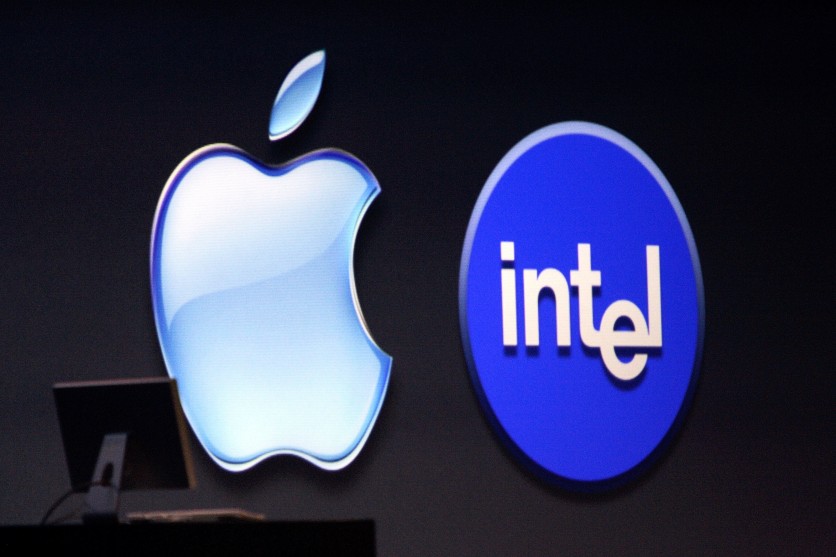
The Apple and Intel logos appear on a screen during the keynote speech at the Apple Worldwide Developers conference with his keynote speech June 6, 2005 at the Moscone Center in San Francisco, California. In the presentation Jobs announced that Apple will be switching from IBM to Intel for it's processing chip. David Paul Morris/Getty Images
President Donald Trump confirmed Thursday that Apple has agreed to partner with Intel to design and manufacture chips on American soil, pushing Intel's stock up 10.5% in a single session and turning the U.S. government's $8.9 billion bet on the struggling chipmaker into a paper gain worth more than $60 billion.
Trump's announcement came one day after Apple CEO Tim Cook told the Wall Street Journal that iPhone price increases were "unavoidable" — a warning he linked directly to TSMC's inability to supply enough advanced-node capacity to keep up with Apple's production needs. The timing frames the Intel partnership not just as a national security move, but as a commercial escape valve from the supply bottleneck squeezing Apple's device margins.
Read more: Apple Confirms iPhone Price Hikes: AI Memory Crunch Adds $270 to iPhone 18 Pro
What Trump Said — and What the Companies Did Not
In a post on Truth Social, Trump wrote that Apple had "agreed to work with Intel to design and build its Chips in America," adding: "I decided to help Intel because we need to design and build our Chips right here in America."
Both companies declined to confirm the deal independently. Intel said it would not comment "about a potential Apple–Intel agreement." Apple did not respond to requests for comment. According to Semafor, Intel's own executives were surprised by the announcement, which reached them through Trump's post rather than through formal internal communication — a detail that underscores the unusual degree to which this deal has been brokered through political channels rather than conventional corporate process.
The preliminary foundation, however, is not new. The Wall Street Journal reported in May 2026 that Apple and Intel had reached a preliminary agreement after more than a year of negotiations. Supply chain analyst Ming-Chi Kuo reported separately that Intel had already begun small-scale testing of Apple chips using its 18A-P process node — the enhanced variant of Intel's most advanced manufacturing technology.
Why Intel Cannot Make Apple's Most Demanding Chips Yet
The deal is real. Its scope, for now, is not unlimited — and the reason is physics.
Apple's flagship processors — the A-series chips in its newest iPhones and the M-series chips in its newest Macs — are fabricated at transistor densities that Intel's current process cannot match. Independent analysis by TechInsights, reported by Tom's Hardware, found that Intel's 18A node packs roughly 238 million transistors per square millimeter, while TSMC's competing N2 node achieves approximately 313 million per square millimeter. That 31% density gap is not a rounding error — it represents a fundamental difference in how many transistors Apple can fit on a given die size, which directly determines a chip's performance-per-watt ratio and, in practical terms, iPhone battery life.
Intel's initial manufacturing role will therefore focus on lower-end or legacy Apple processors — chips for older iPhone, iPad, and Mac models still being sold, where the performance requirements are less demanding and where a second supplier adds commercial resilience without risking device competitiveness. Kuo estimates the first Intel-made Apple chips could ship as early as the second or third quarter of 2027, and that even in Intel's best scenario, TSMC will still supply more than 90% of Apple's chip volume.
There is also a gating factor at the engineering level. Before Apple's silicon team can design a chip for Intel's fabrication line, it needs Intel's process design kit — a foundry-provided package of files that defines exactly how the manufacturing process works and what design rules chip architects must follow. Think of it as the blueprint that translates a chip design into a set of physical instructions a fab can execute. Kuo reported that Apple was expecting Intel to deliver an updated 18A-P process design kit in early 2026; the maturity of that blueprint governs how quickly Apple can move from testing to committed production volumes.
Intel announced at the VLSI Symposium in Honolulu on June 16 that it had begun risk production of the 18A-P node — the specific enhanced process variant intended for Apple's chips, which delivers 9% higher performance at the same power level compared to the base 18A process. Risk production is a critical milestone: it means Intel is manufacturing test chips on the new process ahead of full customer volume, allowing yield and reliability data to accumulate before binding production commitments are made. Intel's current yield target for these initial Apple chip runs is 50% to 60%, meaning up to half the chips coming off the line may be rejected or diverted to lower-tier devices. That figure will improve with production experience, but it illustrates the gap between a preliminary agreement and a mature foundry relationship.
Intel's Government-Backed Foundry Comeback
For Intel, landing Apple as a foundry customer would be the most significant external validation since the company pivoted its strategy to building chips for others. Intel spent years in the shadows of the AI chip boom, losing ground to TSMC and struggling with manufacturing delays that caused customer defections. CEO Lip-Bu Tan, who took the helm in early 2025, rebuilt Wall Street confidence by attracting high-profile manufacturing commitments — and the Apple relationship is by far the highest-profile of them.
Chip analyst Ben Bajarin of Creative Strategies said he was certain the deal would materialize. "I 100% believe this is going to happen. I don't know when," Bajarin told CNBC. He called Intel a "newly validated credible second source" for elite chip customers — a meaningful shift from where the company stood even a year ago, when its foundry segment was losing money and some analysts were calling for it to be shut down or spun off.
The government's role in the outcome is difficult to separate from the commercial story. Last August, the Trump administration converted $8.9 billion in previously committed CHIPS and Science Act grants into a 9.9% equity stake in Intel — purchasing 433.3 million shares at $20.47 each, a discount to the then-market price. The Cato Institute called the arrangement "unprecedented government ownership of private enterprise" and argued it represented "a dangerous turn in American industrial policy." Critics also noted that Intel's board approved the below-market share price without a shareholder vote, prioritizing government interests over conventional fiduciary duties.
In his Thursday post, Trump framed the outcome as a financial return: "They were worth around 100 Billion Dollars when we made our offer. Now they are worth over 600 BILLION DOLLARS! Nine months, and they've increased in value over HALF A TRILLION DOLLARS. America's stake is now over 60 Billion Dollars." The government's return, if realized, would represent one of the most profitable single equity positions in U.S. industrial policy history.
Trump also cited other foundry commitments in the same post: Nvidia agreed to build chips with Intel, and Elon Musk committed to Terafab — a chip manufacturing complex being built in Austin, Texas, as a joint venture between Tesla, SpaceX, and xAI, planned to use Intel's 14A process node.
Read more: Intel Hires Former SK hynix CEO Seok-Hee Lee to Lead Its Foundry Packaging Push
What Comes Next for Apple's Chip Supply Chain
Dan Ives of Wedbush Securities said the deal gives Apple a tool to reduce its heavy reliance on TSMC, whose capacity has come under increasing pressure from Nvidia, AMD, and other AI chipmakers competing for the same leading-edge production lines. Apple CEO Tim Cook acknowledged during Apple's Q2 2026 earnings call that iPhone 17 production had been "constrained" because TSMC could not produce enough A19 chips to satisfy demand — a supply ceiling that made commercial diversification as urgent as strategic resilience.
Analysts who track chip supply chains caution, however, that Intel is unlikely to displace TSMC for Apple's most advanced silicon within any reasonable planning window. Intel's next process node — 14A, which would use High-NA extreme ultraviolet lithography tools and is projected to offer a 15–20% performance-per-watt improvement over 18A — is targeting risk production in 2027 and volume production no earlier than around 2029. Apple's flagship A20 and M7 chips will almost certainly still be manufactured by TSMC on its most advanced nodes by then. The Intel partnership is a strategic hedge and a credibility signal, not a near-term replacement.
What Apple does gain immediately is leverage. By credibly demonstrating that it can source chips from a second advanced foundry — even at modest volumes — Apple strengthens its negotiating position with TSMC at a moment when TSMC holds most of the cards on advanced-node pricing and capacity allocation.
National Security and the Taiwan Contingency
The security dimension of the deal runs deeper than the business story. U.S. defense planners have identified a Taiwan contingency — a crisis or conflict that disrupts TSMC's operations — as one of the most significant risks to American electronics supply chains. Apple's devices, along with the servers and networking equipment that run on advanced chips, would be acutely vulnerable if TSMC's Taiwan fabs were cut off from global markets.
Anchoring even a portion of Apple Silicon production at Intel's Chandler, Arizona facility — where the base 18A process has been in volume production since December 2025 — converts an abstract resilience argument into physical infrastructure on American soil, not exposed to Taiwan Strait risk.
The Cato Institute's critique frames this as a tradeoff rather than a free good: the same government ownership that produced the Apple deal also blurs lines between market incentives and political outcomes, concentrating industrial decision-making in a way the U.S. government has historically avoided.
Can Intel Actually Deliver?
The deeper question Intel still needs to answer is not whether Apple will send it orders — Trump's announcement suggests that part is settling — but whether Intel's fabs can execute at the quality and consistency Apple demands. Apple is the most exacting semiconductor customer in the world, with yield requirements and schedule adherence standards that TSMC has spent decades calibrating to. Intel's foundry has struggled with yields. Its 50–60% initial target for Apple chip production reflects honest acknowledgment of that gap.
Bajarin put it plainly: Intel has gotten through the rough patch, but proving it to Apple at production scale over multiple quarters is a different test than proving it in preliminary discussions.
Frequently Asked Questions
Why is Apple making chips with Intel instead of TSMC?
Apple is not replacing TSMC — it is adding Intel as a second supplier to reduce its dependence on a single manufacturer. TSMC currently produces more than 90% of Apple's chips and is running short on advanced-node capacity as AI chipmakers like Nvidia and AMD compete for the same production lines. Intel will initially manufacture older or lower-performance Apple chips using its 18A-P process.
Can Intel make chips as advanced as TSMC?
Not yet at the densities Apple's flagship chips require. Independent analysis found Intel's 18A node packs about 238 million transistors per square millimeter compared to roughly 313 million for TSMC's competing N2 node. That gap is why Intel's initial Apple order covers legacy and lower-end processors, not the A-series or M-series chips that power Apple's newest iPhones and Macs.
What role did the U.S. government play in this deal?
The Trump administration converted $8.9 billion in CHIPS and Science Act grants into a 9.9% equity stake in Intel in August 2025. That ownership stake, critics argued, blurred the line between industrial policy and government control of a private company. Trump cited the stake explicitly in his announcement, noting the government's position has grown from roughly $8.9 billion to more than $60 billion in nine months as Intel's stock has climbed.
When will Intel-made Apple chips appear in actual devices?
Supply chain analyst Ming-Chi Kuo estimates first shipments in the second or third quarter of 2027. Intel is expected to spend 2026 on production testing at 50–60% yield rates, with a full ramp through 2028. Even at peak output, Intel's contribution is expected to be a small fraction of Apple's total chip supply.
Intel and Apple had not issued formal statements as of publication. TechTimes will update this story as additional details emerge.

-
 C114 Communication Network
 -
 Communication Home
