
 Search

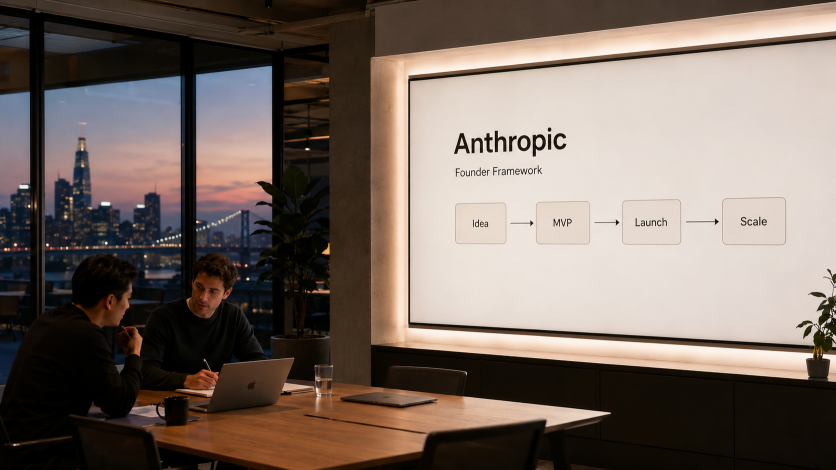
Anthropic's New Founder Playbook TechTimes
Anthropic published The Founder's Playbook: Building an AI-Native Startup on May 14, 2026, one day after launching Claude for Small Business — a package of prebuilt workflows wired into QuickBooks, PayPal, HubSpot, Canva, and DocuSign that, for the first time, brings Anthropic's agentic platform directly into the daily operations of lean teams and solo founders. Together, the two releases represent the most aggressive downmarket push Anthropic has made since the company closed a $30 billion Series G round in February 2026 that valued it at $380 billion.
The playbook is a 35-page guide that remaps the traditional startup arc — validate, raise, hire, build, raise again — across four stages: Idea, MVP, Launch, and Scale. Its central claim is that AI has removed the three bottlenecks that historically gated each transition: capital, headcount, and technical skill. The document is also, unambiguously, a sales document for Anthropic's own products. Both things are simultaneously true, and separating the durable insight from the marketing requires reading the document against its own vendor's support guidance.
For the startup founder who reads only the headline, the most consequential finding in this article is this: the playbook instructs founders to use Claude Cowork for compliance and security workstreams in the Launch stage. Anthropic's own documentation explicitly states that Cowork activity is not captured in audit logs, the Compliance API, or data exports — and that Cowork should not be used for regulated workloads. That is not a configuration issue. It is an architectural limitation. A founder who follows the playbook's compliance advice while handling customer data under SOC 2, HIPAA, PCI-DSS, or GDPR could expose the company to enforcement action before the first enterprise contract lands.
Updated Startup Failure Data Reinforces — Rather Than Undermines — the Playbook's Core Argument
The playbook opens with a claim that 42% of startups failed because they built something nobody wanted, sourced to CB Insights. That figure is real, but the underlying dataset has since been updated. In March 2026, CB Insights refreshed the study using 431 venture-backed companies that shut down since 2023, rather than the original pool of roughly 110 post-mortems collected between 2014 and 2021. The headline number shifted to 43% citing poor product-market fit. More importantly, CB Insights now explicitly frames "running out of capital" — which affects 70% of failed startups — as a symptom of product-market failure rather than a root cause in its own right. The playbook's argument not only survives this update; the updated data sharpens it.
The document's counterintuitive core point holds up under scrutiny. Rather than celebrating frictionless building, the playbook argues that removing build friction makes validation discipline more critical, not less. When a prototype takes an afternoon instead of a quarter, founders are more likely to mistake the existence of a prototype for proof that anyone wants it — what the document calls "mistaking building for validating." The playbook also warns that AI-assisted research supercharges confirmation bias: ask a model to justify your idea and it will, convincingly. That is a genuinely useful principle, and it cuts against Anthropic's commercial interest in accelerating building — which makes it more credible than the surrounding product pitch.
The MVP chapter cites the Sean Ellis test — if more than 40% of users say they would be "very disappointed" without your product, you likely have product-market fit. Ellis, the growth advisor who coined "growth hacking," introduced the benchmark after observing the pattern across multiple companies. The playbook accurately describes the test and frames it as one litmus test among several, not a definitive threshold. The caveat the document glosses over: the 40% figure is an empirical rule of thumb derived from observation, not a validated statistical threshold, and Ellis himself has repeatedly stressed it requires an adequate sample drawn from the right user cohort to mean anything.
The Compliance Gap the Playbook Does Not Mention
The document's sharpest practical flaw sits in the Launch stage, in a section titled "Make security and compliance a product workstream." The playbook instructs founders to use Claude Code to surface code-level issues that arise in SOC 2, GDPR, and HIPAA audits, and to use Claude Cowork to "build the compliance workstream into your development cycle rather than running it as a one-time project."
The problem is that Cowork activity is explicitly excluded from Anthropic's audit logs, Compliance API, and data exports. Multiple independent security firms, including IRM Consulting and MintMCP, have documented the gap: organizations pursuing SOC 2, HIPAA, PCI-DSS, CMMC, or ISO 27001 certification should block or restrict Cowork in any environment that touches regulated data. IRM Consulting's guidance is direct: "Anthropic is explicit: do not use Cowork for regulated workloads. This is not a grey area."
Claude Chat at the Enterprise tier includes full audit logs, Compliance API access, and 180-day export capabilities. Cowork does not. A founder who builds a compliance workstream on Cowork — precisely what the playbook recommends — would find that workstream invisible to the very auditors the compliance effort is meant to satisfy. The playbook does include one hedge: "Note: AI scans are an aid but not a substitute for qualified compliance review." That sentence does not disclose the audit-log gap, and it appears two paragraphs after the recommendation to build the compliance workstream in Cowork.
The "One-Person Unicorn" Has a Documented Proof Point — and Documented Risks
The playbook's broader premise — that lean, AI-native teams can run like organizations many times their size — sits inside what has become the defining industry argument of 2026. Anthropic CEO Dario Amodei predicted in May 2025 that the first one-person billion-dollar company would appear by the end of 2026; as of this month, he has said publicly he has seven more months left on the bet. OpenAI's Sam Altman has run a separate informal betting pool among tech CEOs on the same question.
The closest current proof point is Medvi, a GLP-1 telehealth startup whose founder, Matthew Gallagher, built to $401 million in 2025 revenue with two full-time employees — himself and his brother — starting with $20,000 and more than a dozen AI tools including Claude, ChatGPT, and Grok. The New York Times verified the financials in an April 2, 2026 profile. Medvi's 16.2% net profit margin triples that of Hims & Hers, a publicly traded competitor with more than 2,400 employees.
But the Medvi case also illustrates the structural fragility the playbook passes over. The company received an FDA warning letter in February 2026 for misbranding violations on its website. Medvi's clinical infrastructure partner, OpenLoop Health, disclosed a separate cybersecurity breach in January 2026 that exposed records from patients across the network, including Medvi enrollees, triggering multiple class-action lawsuits. Medvi's AI customer service chatbot hallucinated drug prices and fabricated product lines that did not exist, both of which Gallagher had to correct manually. These are the documented costs of a solo founder who becomes, in the words of critics, "the single point of failure for every lawsuit, every compliance issue, every AI hallucination that reaches a customer."
Fortune, which described itself as "famously skeptical of any and all revenue-related startup claims in the AI era," has noted that most "solo" founders still rely on contractors and outsourced infrastructure, and that the model concentrates legal liability and operational fragility onto a single person.
What the Playbook Gets Right — and What It Deliberately Omits
The document's most defensible claim is also its simplest: the binding constraint on startups has shifted from what a founder can build to what a founder chooses to build. That is a structural observation about the technology, not a product pitch, and it holds regardless of which tools a founder uses.
The validation-first framework is genuinely useful. The playbook's insistence on reaching problem-solution fit before touching a codebase — and its acknowledgment that AI makes it dangerously easy to skip that step — is honest advice that cuts against Anthropic's interest in faster building. The CLAUDE.md architectural context document recommendation, the scope-definition-before-build framework, and the explicit warning about AI-generated confirmation bias are all durable principles that would appear in any serious treatment of the subject.
What the playbook omits is the institutional context that would allow a founder to evaluate its advice critically. Anthropic raised $30 billion at a $380 billion valuation in a market where the central pitch to investors is that Claude is indispensable infrastructure for the next generation of companies. The Founder's Playbook is the marketing document that activates that thesis at the earliest possible stage of the startup lifecycle. Anthropic is describing a future in which its own products are essential — which is exactly what a founder evaluating the document should keep in mind, especially before wiring Cowork into a compliance workflow that the vendor's own documentation says it cannot support.
Read as practical strategy from a knowledgeable vendor, the playbook is useful. Read as independent guidance on how to build a company, it is not.

-
 C114 Communication Network
 -
 Communication Home
