
 Search

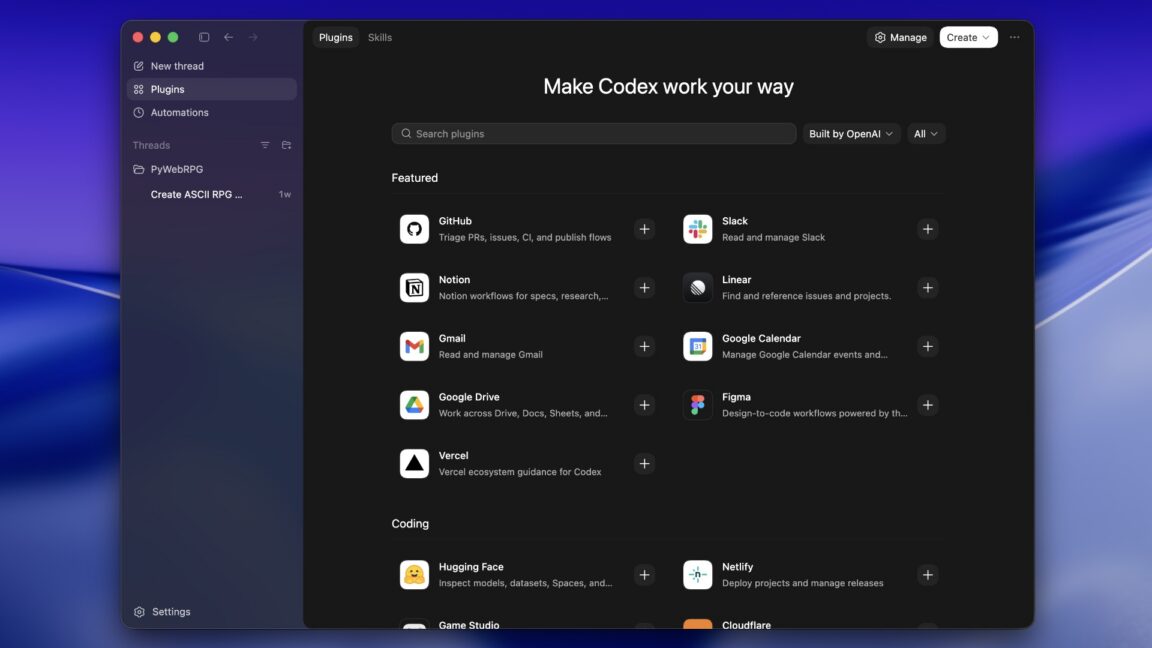
Credit: Samuel Axon
OpenAI has added plugin support to its agentic coding app Codex in an apparent attempt to match similar features offered by competitors Anthropic (in Claude Code) and Google (in Gemini’s command line interface).
What OpenAI calls “plugins” are actually bundles that may include skills (“prompts that describe workflows to Codex”—a standard feature in tools like this these days), app integrations, and MCP (Model Context Protocol) servers.
The idea is that they make it possible to configure Codex in certain ways for specific tasks to be easier for the user and replicable across multiple users in an organization.
By and large, they don’t enable anything that wasn’t possible before. Power users could already introduce custom instructions, use MCP servers, and so on to create much of this functionality. But in this case, it’s basically a one-click installation.
There’s now a Plugins section in the Codex app that takes users to a searchable library of plugins meant to allow Codex to integrate tightly with some external service or application—examples include GitHub, Gmail, Box, Cloudflare, and Vercel.
This marketplace closely mirrors one found in Claude Code, and OpenAI says people will be able to add more plugins to it.
In many ways, this is a game of catch-up; Claude Code already introduced this feature earlier this year, and it has found widespread use. Combine that with the recent fervor around OpenClaw and the relatively more secure and buttoned-down alternatives from companies like Anthropic and Perplexity, and you see OpenAI trying to capture lightning that’s already in its competitors’ bottles. If you talk to developers, you’ll find a lot more Claude Code users than Codex users—but maybe expanding beyond that specific user base is an opportunity for OpenAI to gain some ground.
Notably, several of these plugins are indirectly related to coding tasks. OpenAI’s competitors have been exploring using apps like Codex to enable broader knowledge-work functionality, and this is one of the first major steps in that direction for OpenAI.
If you want to learn more about how plugins work in Codex or find out how to install them via the CLI, there’s documentation for that. Plugins are already available in the Codex app as of today.

-
 C114 Communication Network
 -
 Communication Home
