
 Search

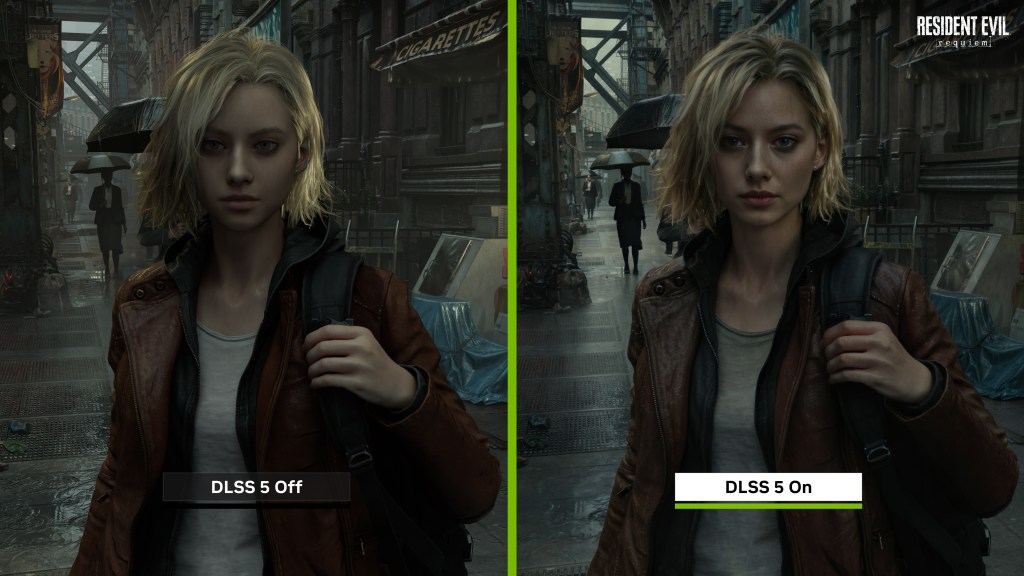
Image Credits:Nvidia
Nvidia CEO Jensen Huang used the company’s keynote at Nvidia GTC on Monday to introduce DLSS 5, a new version of the chipmaker’s AI graphics tech designed to make video games more realistic while using less compute power.
The new DLSS 5 system combines traditional 3D graphics data with generative AI models that can predict and fill in parts of an image, allowing Nvidia’s GPUs to produce detailed scenes and lifelike characters without rendering every element from scratch.
“We fused controllable 3D graphics, the ground truth of virtual worlds, the structured data … with generative AI, probabilistic computing,” Huang said during his keynote speech. “One of them is completely predictive, the other one is probabilistic yet highly realistic.”
Huang said combining those two ideas — structured data with generative AI — allows developers to create content that is “beautiful, amazing, as well as controllable.”
“This concept of fusing structured information and generative AI will repeat itself in one industry after another,” Huang said. “Structured data is the foundation of trustworthy AI.”
Gaming makes up a smaller portion of Nvidia’s revenue today than it has historically, though that’s the industry that made Nvidia into what it is today. Huang framed DLSS 5’s approach as an example of a broader computing shift, suggesting the approach could extend far beyond gaming and even into enterprise computing.
Disrupt 2026: The tech ecosystem, all in one room
Your next round. Your next hire. Your next breakout opportunity. Find it at TechCrunch Disrupt 2026, where 10,000+ founders, investors, and tech leaders gather for three days of 250+ tactical sessions, powerful introductions, and market-defining innovation. Register now to save up to $400.
Save up to $300 or 30% to TechCrunch Founder Summit
1,000+ founders and investors come together at TechCrunch Founder Summit 2026 for a full day focused on growth, execution, and real-world scaling. Learn from founders and investors who have shaped the industry. Connect with peers navigating similar growth stages. Walk away with tactics you can apply immediately
Offer ends March 13.
The billionaire executive pointed to enterprise data platforms such as Snowflake, Databricks, and BigQuery as examples of structured datasets that future AI systems could analyze and generate insights from.
“In the future, what’s going to happen is these data structures are going to be used by AI, and AI is going to be much, much faster than us,” Huang said. “Future agents are going to use structured databases as well as the unstructured database, the generative database. This database represents the vast majority of the world.”

-
 C114 Communication Network
 -
 Communication Home
