
 Search

Odyssey
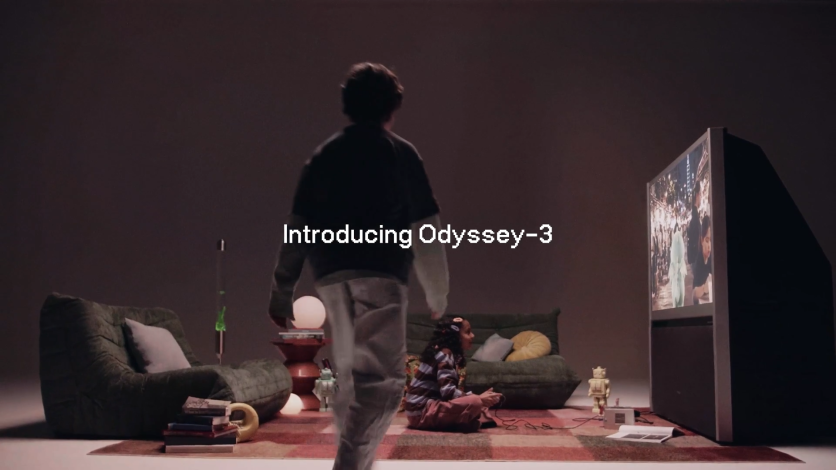
An autonomous vehicle policy trained on roughly 20 hours of generated video — no real roads, no real sensors, no real miles — drove on actual streets in India last week. That demonstration is the headline number in Odyssey's launch of Odyssey-3, its most capable foundation world model to date, and it encapsulates what makes the release significant: if a startup with a simulated environment can produce a real-road capable driving policy at that data volume, the capital barrier to physical AI development just dropped.
The Palo Alto AI lab released Odyssey-3 on October 8, 2026 and made a free research preview of Odyssey-3 immediately available at experience.odyssey.systems — no API key required. Researchers and developers active in the world model space this week are treating the launch as a milestone in the effort to close the sim-to-real gap that has historically separated synthetic training environments from real-robot deployment.
What a World Model Actually Does
A generative video model produces a clip and stops. A world model keeps predicting what happens next as a user or agent acts within the scene — walking through an environment, repositioning a camera, triggering a new event. Each new frame is conditioned on everything that came before and on whatever input was just provided. The system is not playing back a recorded video; it is computing what the world should look like given the current state and the chosen action.
Odyssey-3 is built on an autoregressive diffusion transformer architecture: an architecture that combines causal temporal prediction (each frame conditioned on all prior frames, like a language model predicts the next token from all prior tokens) with diffusion-based spatial generation (each frame produced by iterative denoising rather than one-shot prediction). The full diffusion sampler requires many denoising steps and runs too slowly for real-time interaction. Odyssey resolved this through adversarial distillation — training a student model that generates high-quality frames in a fraction of the steps while matching the quality distribution of the full-step teacher. The result: the base tier runs at 832 × 480 pixels at 16 frames per second; the Pro tier outputs at 1,280 × 720, with a trade-off between resolution and inference speed.
What makes the architecture a foundation model rather than a single-task system is that the same pretrained weights generalize across different control interfaces and embodiments. Adapting it to a new domain requires changing the control conditioning — how actions are represented as input — rather than retraining the model from scratch.
One Model, Six Domains
What distinguishes Odyssey-3 from its predecessors is the breadth of control tasks the company has demonstrated using a single pretrained foundation, rather than bespoke models for each use case as covered in Odyssey's six-domain launch post.
Autonomous vehicles. The driving policy trained on approximately 20 hours of simulated data derived from Odyssey-3 drove on real roads in India. That data-efficiency figure is the core argument for the value of high-fidelity synthetic training environments: when real-world mileage is expensive or geographically constrained, a capable generative world model can substitute for a significant fraction of it.
Humanoids. Odyssey-3 powers control policies developed with Flexion, a company focused on humanoid autonomy. Odyssey reports the Flexion policies generalized better to environmental changes — including lighting variations not present in training — than baseline comparisons the team tested internally. The claim is company-reported; no independent evaluation has yet reproduced these results.
Robot arms. Trained on tens of hours of robot demonstrations, the model completed robot-arm tasks and displayed recovery behaviors — handling a missed grasp, for example — that were not explicitly present in the training data. This suggests the pretrained world knowledge is generalizing rather than memorizing task sequences.
Drones. Aerial navigation policies for indoor obstacle avoidance were trained using simulated data from Odyssey-3 and subsequently evaluated in physical environments.
AI agent training. The model generates interactive environments in which AI agents can act, observe consequences, and expose gaps in the world model itself — a feedback loop that the company argues can simultaneously accelerate agent training and improve model fidelity.
Games. Odyssey-3 can play Grand Theft Auto V and has shown early behavioral transfer to Red Dead Redemption 2 and Sleeping Dogs without additional policy-specific training.
Benchmarks: Leading Numbers With Important Caveats
Odyssey's headline performance claim is a score of 66.1 on the video-to-video track of the Physics-IQ Verified benchmark paper — an audited re-scoring of the original Physics-IQ benchmark developed by Anates Labs and DeepMind researchers that tests models on real physical experiments.
The benchmark tests models on real physical experiments — fluid dynamics, optics, solid mechanics, magnetism, thermodynamics — and scores how accurately their continuations match what actually happened. Odyssey's 66.1 is the highest absolute score reported on the video-to-video track as of the launch date. That figure uses a best-of-eight protocol: the model generates eight candidate continuations for each task and submits the best. This is worth noting because the leaderboard mixes submission protocols — some entries use prompt rewriting, others use best-of-N sampling — making direct row-to-row comparisons imprecise. The Pro model also posted 54.7 on the image-to-video track, also self-reported, also best-of-eight.
The Physics-IQ Verified leaderboard entry is a submission to an externally maintained benchmark — a stronger signal than a purely internal metric.
On WorldMark, a benchmark covering control-following, visual quality, and world memory across four splits, Odyssey says it leads three of four. Those numbers are vendor-reported, run using the WorldMark benchmark's evaluation methodology and averaged across its reported metrics; no independent lab has yet reproduced them. On the first-person realism split — arguably the most demanding for real-world simulation fidelity — Odyssey-3 ranks third with a score of 80.6, behind Lyra 2.0 (84.4) and AlayaWorld (83.0). The WorldMark benchmark paper evaluated ten models across standardized cases spanning styles and viewpoints.
Why the Data-Efficiency Number Matters
The robotics and embodied AI research community has confronted a data problem for years. Training a robot to perform a new task typically requires large quantities of task-specific demonstrations or real-world experience — both expensive and slow to collect. Traditional physics engines can substitute for some real-world experience, but they require hand-authored assets and detailed environment descriptions, and the visual and physical gap between simulator and reality remains persistent.
Generative world models like Odyssey-3 represent a different approach: a pretrained prior over how environments look and behave, which downstream policies can draw on before encountering the real world. If a capable AV policy emerges from 20 hours of model-generated driving — rather than the hundreds or thousands of real-world hours conventional approaches require — the implication extends well beyond any single company's roadmap. It means that organizations without large vehicle fleets, robot farms, or expensive physical testing infrastructure can, in principle, train competitive physical AI policies using compute rather than capital equipment. That shift, if the data-efficiency results hold across additional domains and independent replications, could compress the timeline for physical AI deployment and open the field to a broader set of participants.
Multiple frontier AI labs are pursuing this direction in parallel. NVIDIA's Cosmos 3 open physical AI launch in June 2026 explicitly targets the same physical AI use cases. AMD agreed to acquire World Labs — another world model startup — for $8.2 billion in a September 2026 AMD World Labs acquisition announcement, signaling that chip companies view world modeling capability as infrastructure rather than application. Runway raised $315 million in world model funding in 2026 to build world models that extend beyond video generation.
Behind Odyssey: Founders, Funding, and a CIA-Affiliated Backer
Odyssey was founded in 2023 by Oliver Cameron and Jeff Hawke. Cameron previously co-founded autonomous vehicle startup Voyage, which GM's Cruise acquired; he subsequently became VP of product at Cruise. Hawke is a New Zealand roboticist who completed a DPhil at Oxford's Mobile Robotics Group researching perception for self-driving cars and served as Wayve's founding engineer from 2016 to 2023, rising to VP of technology. Hawke co-authored "Learning to Drive in a Day" in 2018, presenting the first deep-RL autonomous driving application to appear in the academic literature. Both founders bring a background in spatially grounded, physics-aware AI that autonomous driving demands — a lineage the company has deliberately applied to world modeling.
In June 2026, Odyssey closed Odyssey's $310 million Series B at a $1.45 billion valuation, led by Natural Capital with participation from Amazon, AMD Ventures, GV, EQT, and In-Q-Tel. In-Q-Tel is a CIA-affiliated investment fund; its involvement signals US defense and intelligence interest in high-fidelity simulation capabilities. The round brought total funding to $337 million. Angel and existing investors include Google's Jeff Dean, Y Combinator president Garry Tan, Vercel founder Guillermo Rauch, and Cruise co-founder Kyle Vogt, as confirmed by Odyssey's angel investor roster.
Alongside the fundraise, Amazon Web Services became Odyssey's preferred cloud provider, with the company committing to optimize its models for AWS Trainium accelerators — a strategic bet on Amazon's chip roadmap as an alternative to NVIDIA's dominant AI hardware ecosystem.
Odyssey CEO Oliver Cameron framed the release around what physical AI has historically lacked: "World models give physical agents a foundation of knowledge they can carry from one machine, environment, or task to another. We believe that the ability to learn broadly and then adapt with relatively little experience is the path toward increasingly general physical intelligence," as stated in Oliver Cameron's Odyssey-3 launch statement.
About half of Odyssey's roughly 35-person staff are based in London and half in Palo Alto, reflecting the founding team's roots at Wayve (London) and Cruise (California).
Open Access, Open Questions
Odyssey-3's public research preview — freely accessible at experience.odyssey.systems with no API key required for the browser experience — supports Odyssey-3 preview navigation features including first-person and third-person navigation as well as independent camera control. This is enough to let a user verify whether the generated world behaves consistently from multiple vantage points, and enough for game designers, robotics researchers, and AI developers to experiment with interactive generative environments without a commercial agreement.
Developer API access requires a separate contact form, with Odyssey positioning the model as commercial infrastructure for autonomous systems developers.
Whether the benchmark leads hold up under independent scrutiny will determine how the model is received by the research community in the coming weeks. The Physics-IQ Verified submission is to an externally maintained leaderboard — a stronger signal than internal metrics. The WorldMark numbers are self-reported and await third-party reproduction. The driving demonstration in India is compelling but represents a limited real-world test, not a commercial deployment.
What makes Odyssey-3 a meaningful release regardless of where specific benchmark scores settle is the combination: a freely accessible research preview, credible demonstrations across six distinct physical AI domains, and a data-efficiency result that, if it survives replication, changes what physical AI development requires from organizations without deep hardware infrastructure.
Frequently Asked Questions
What is a world model in AI, and how is it different from a regular video generator?
A video generator produces a clip from a prompt and stops. A world model keeps generating new frames in response to actions — a user walking forward, an agent turning a robot arm — so the simulated environment evolves continuously based on what happens within it. Odyssey-3 uses an autoregressive architecture that conditions each new frame on all prior frames and the most recent action, making it responsive to live input rather than fixed to a predetermined script. This property is what makes world models useful for training physical AI systems: a robot policy can learn by acting inside the simulation and observing consequences, rather than needing a real-world environment.
Can a world model actually replace real-world training data for robots and autonomous vehicles?
The 20-hour demonstration from Odyssey is the most specific evidence presented so far that a generative world model can substitute for a meaningful fraction of real-world data. A driving policy trained on model-generated video drove on real roads in India — a result that, if it holds across independent replications and more complex scenarios, would compress the data requirements for AV development significantly. The caveat is important: this is one demonstration on a limited real-world test, not a commercial deployment or a systematic evaluation across edge cases. Independent researchers have not yet reproduced or stress-tested the result.
How does Odyssey-3 compare to NVIDIA's Cosmos models?
Both target physical AI — robots, AVs, drones — but with different distribution strategies. NVIDIA released Cosmos 3 in June 2026 as open-source software via the NVIDIA Cosmos 3 launch press release, using NVIDIA's compute ecosystem and developer relationships to drive adoption. Odyssey-3 is proprietary, with a free browser preview for researchers and a contact-form API for commercial users. On the Physics-IQ Verified leaderboard rankings, Cosmos-family models appear in the top results alongside Odyssey-3, though direct comparison is complicated by different submission protocols across entries.
What does the In-Q-Tel investment in Odyssey mean for users of the research preview?
In-Q-Tel is a CIA-affiliated venture fund that invests in companies whose technologies may be of interest to the US intelligence community, as described in the In-Q-Tel official Wikipedia overview. The investment does not impose any documented obligations on how the company treats user data in its public research preview — Odyssey is a US company subject to US law, not an authoritarian-jurisdiction entity with compelled data-sharing obligations. The investment does signal that US defense and intelligence agencies view high-fidelity simulation capability as strategically significant infrastructure.

-
 C114 Communication Network
 -
 Communication Home
