
 Search

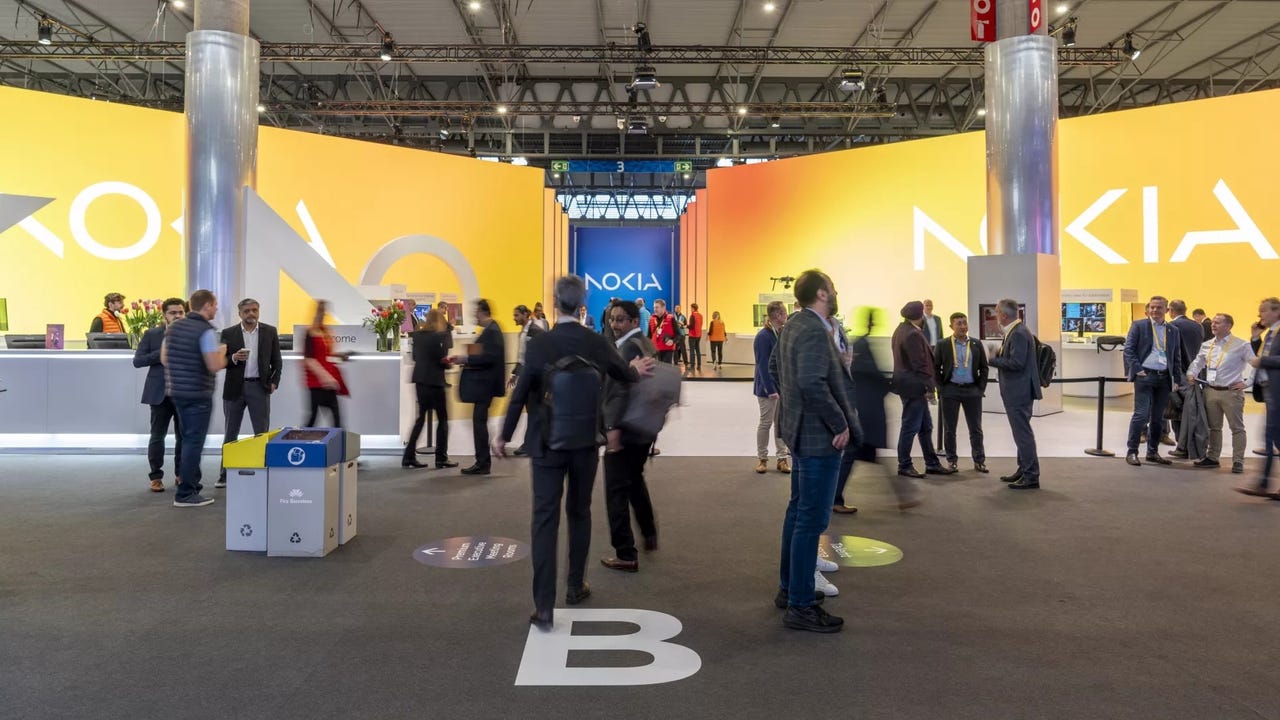
(Source: Nokia)
Some drivers are happy to run a car until the chassis has corroded and the engine coughs with every agonizing change of gear. Others less constrained by economic circumstances want a new vehicle every time the paint is nicked. Many big telcos currently seem to have more in common with the first group, determined to run their mobile networks until the basestations are shrouded in cobwebs. Any upgrades, including to 6G, should not have to require hardware replacement, they are telling vendors. Yet Nokia wants to sell them a completely new engine.
The Finnish company has publicly teamed up with Nvidia to design radio access network (RAN) products built on the giant chipmaker's graphics processing units (GPUs). It has stopped developing new custom silicon with partner Marvell Technology, although it will continue to support its existing 4G and 5G range for years. Ultimately, however, customers will have to buy new hardware to enjoy new features.
There is no guarantee the situation will be all that different for customers of Ericsson. Operators using its purpose-built 5G products today may need to invest in newer application-specific integrated circuits (ASICs) to support forthcoming 5G-Advanced and 6G software. But Nokia's GPU strategy is undoubtedly much riskier.
While commonplace in data centers and certain gadgets, Nvidia's chips have never been used for RAN compute. If telcos balk at the idea, Nokia could be in trouble. "If you don't have a companion strategy that's based on classic ASICs, you really have created jeopardy, I think," said Marcus Weldon, a former Nokia chief technology officer who was also president of its Bell Labs research unit.
Yet the rewards could be immense if Nokia can prove that GPUs have advantages over ASICs in the RAN. In recent months, it has argued that its GPU-led strategy will support a doubling in spectral efficiency, among other benefits, by 2028. In a RAN market that is not expected to grow in the next few years, such improvements could justify the initial hardware outlay and even translate into market share gains for Nokia, allowing it to recover 5G ground lost to Ericsson and Samsung. That could be a disaster for Nokia's rivals.
Slimline GPUs
Numerous operators are now giving Nokia's AI-RAN products a test drive before they become commercially available early next year. None has yet said anything in public about the initial experience, and many operators have previously voiced concern about using what is still perceived to be a very expensive and energy-hungry chip in the RAN. Overkill has been the word on some lips, as if putting a GPU in the RAN is like using a rocket launcher to kill a rat.
But Nokia has been advertising a slimline GPU that could be slotted into an existing Airscale chassis originally designed to support Marvell Technology's silicon. It will have to function with the same power constraints and be available for the same price, according to executives. They have also promised it will support software upgrades and new AI algorithms for years – unlike any ASIC.
"What we anticipate with AI-RAN is that it gives customers an opportunity to reduce the ongoing hardware investment, or to elongate that," said Nokia CEO Justin Hotard, responding to a question from Light Reading on a call about first-half financial performance. "Then they can get the benefit of ongoing enhancements once they deploy AI-RAN software."
There is some advocacy from the analyst community, too. "ASIC refresh cycles typically run on three-to-five-year timescales," said Chetan Sharma, the CEO of Chetan Sharma Consulting, in a recent white paper on the topic. "While ASIC-based platforms do support algorithm refinement within a given generation, the scope is ultimately bounded by fixed hardware constraints."
A GPU, he explained, should free Nokia from these constraints thanks to its HAL. No ominous relation to the rogue AI of the same name in 2001: A Space Odyssey, it is short for the Hardware Abstraction Layer that "insulates RAN software from silicon-level changes," said Sharma. While his paper was endorsed by Nokia, Sharma is an acknowledged and highly respected authority on this subject who has advised many of the world's biggest telecom players.
Even so, new and more powerful GPU models seem to show up more often than warnings that AI will kill us. When it started promoting the AI-RAN concept around two years ago, Nvidia sported a GPU called Hopper. Since then, it has cycled through Blackwell and is now flaunting Rubin. Feynman lies ahead, and all are named in Sharma's paper. "The algorithms that are compute-constrained on Blackwell run more efficiently on Rubin," said Sharma. That seems to jar with the messaging about years of software upgrades on the same hardware platform.
HAL would also not allow Nokia to escape from the Nvidia camp and run the software developed for GPUs on alternative silicon. It is bound by CUDA, the Nvidia software platform specific to its GPUs and often described as a moat. "If the GPU thing doesn't catch on, they don't have an alternative," said Vincent Loncke, the founder of a startup called Kenyi Technologies and a former developer at Qualcomm, during a previous conversation.
That said, such portability has generally proven elusive in Layer 1, the slice of RAN software responsible for the most demanding functions. ASICs offer even less freedom, uniting hardware and software developed for a singular purpose. Because it designs the technology in-house, Ericsson might argue it is not dependent on a third party, unlike Nokia. But CUDA naturally supports a much bigger software ecosystem that could work to Nokia's advantage.
Algorithmic argumentation
An argument advanced by the Finnish company, and supported by Sharma, is that the computing muscle of a GPU would allow it to deploy much more advanced algorithms than it was able to run on its custom silicon. One identified by Pallavi Mahajan, Nokia's chief technology officer, and discussed in Sharma's white paper is RKHS. Short for "reproducing kernel Hilbert space," it is a sophisticated method of cleaning a signal and separating out any noise, explained Loncke, an expert in the field.
But he is unconvinced of the need for RKHS. In all but what Loncke refers to as "corner" cases, noise can be more efficiently suppressed with an algorithm called "fast Fourier transform" (FFT), he believes. Nor would there be anything to stop a company from supporting RKHS on custom silicon if it so wanted, he told Light Reading. Qualcomm seemingly examined RKHS but decided to go for an FFT-based approach instead. "If you build custom silicon, you can put whatever you want in it," said Loncke. "If you really want to do RKHS, you just dimension it to do that. It's just a matter of scaling up the circuitry to support it."
The corollary is that an ASIC would require adaptation to support the various features a GPU might already be able to handle. An ASIC in Layer 1 is more efficient than a GPU because it has been designed for the specific purpose of digital signal processing, said Weldon. But a GPU, as a general-purpose alternative to that ASIC, would offer greater versatility. "It may be that for a deployment scenario there is an optimization you can do in real time," he said. "The GPU might be better at that because it has more degrees of freedom."
Regardless, the size of a model or complexity of an algorithm will always be constrained by the transmission time interval (TTI), which imposes a hard limit on how long a basestation takes to perform critical tasks. Any calculation that misses the TTI is worthless because radio conditions will have changed, explained Michael Begley, Ericsson's head of RAN compute, at this year's MWC Barcelona.
"You have 500 microseconds, so you have to be responsive," said Loncke, in full agreement. A model facing this kind of limit cannot be one that includes millions of parameters, and a more lightweight model would probably not need the muscle of a powerful GPU. Larger models might come into play only for initial training. "You build a large model with many parameters, you train it off a rich set of data and then you train a smaller model to just follow it," said Loncke. "You run that distilled model at the edge."
Another technical expert at one of the big vendors concurred with the argument that "TTI time budgets" must be met. But not all RAN functions that could potentially benefit from a GPU are subject to the TTI, he pointed out, asking not to be named. Certain aspects of scheduling can be executed within 5 or 10 milliseconds, for instance. Adjustments for things like channel quality and multi-user MIMO can feasibly take even longer. Larger models based on GPUs might bring benefits in these areas, he believes.
The Stradivarius theorem
Much of the uncertainty is over the scale of those benefits and whether they would be realized outside a few scenarios, Loncke's "corner" cases. Weldon is dubious. "We started a GPU RAN project in Bell Labs, so we know these numbers well, and the gains, in my view, are more like the Ericsson-level gains," he said. While the Swedish vendor claims to have improved RAN performance by running AI algorithms on its custom silicon, its published figures are much smaller than Nokia's.
"Those were the numbers – 20%, 30%," said Weldon. "You can get 2x, but it is more about continuous optimization of some very specific scenarios. If you looked at all use cases across mobile traffic in a network on any given day or hour, it's a very small subset of potential use cases this applies to. So, the 2x is real, but I would argue niche."
Even Sharma's white paper, endorsed by Nokia, sets out numerous caveats. Custom silicon remains more energy efficient, he concedes. To enjoy success, the total energy cost of a GPU RAN must not be higher than the cost of using a traditional RAN plus a separate server for AI inference.
But the assumption that GPU platforms will run both RAN and AI workloads at the same time is controversial. Yago Tenorio, Verizon's chief technology officer, sees the attractions of GPUs but disagrees they have any role in the RAN. "You will not be running the RAN workloads on those GPUs," he said during a discussion this time last year. "You'll be using them for what they are really good at, which is to run AI inference."
After describing a scenario in which software changes do not demand GPU upgrades, Sharma also seems to express doubt that abstraction can be sustained. Blackwell brought changes that required software adaptation, he notes. "If HAL portability holds cleanly across two generations, the capex model works as described: hardware investment amortizes over a seven-year window without a forced replacement cycle," he writes. "If it requires significant operator re-engagement at each transition, the operational cost of those transitions must be added to the TCO [total cost of ownership] model, and the ASIC alternative's lower operational cadence becomes more attractive."
Most importantly, perhaps, Sharma talks in the final pages not about a 2x improvement in spectral efficiency but one of 40% to 50% "under favorable conditions" at target deployment sites. The most impactful sentence of all alludes to the baseline for comparison. "A site already achieving near-theoretical spectral efficiency under classical processing has less headroom for AI-driven improvement than a site operating well below its theoretical ceiling due to interference, channel estimation errors, or suboptimal scheduling."
Improving spectral efficiency does not appear to be like Moore's Law, an aging, non-scientific observation about doubling the number of transistors on a microchip every two years. In spectral efficiency, a scientific limit would seem to exist based on the Shannon-Hartley theorem, which effectively determines how much information can be shoved into a given amount of bandwidth.
Some of the algorithms used in RAN processing have been refined over a period of about 40 years by men and women who are the wireless communication world's equivalents of Stradivarius. In the late seventeenth and early eighteenth centuries, the famous Italian luthier spent years optimizing the design of a violin to produce instruments that have been unrivaled ever since. No AI is likely to better those.

-
 C114 Communication Network
 -
 Communication Home
