
 Search

Stoneridge.com
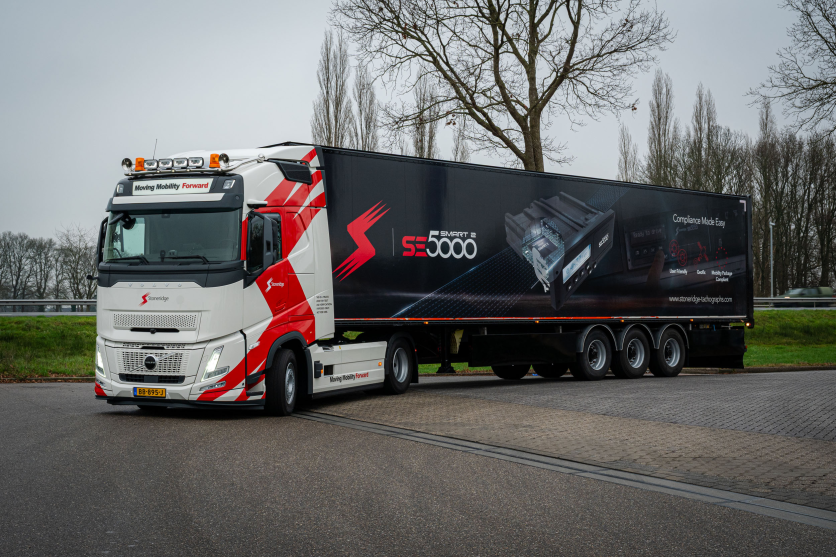
Stoneridge, Inc. (NYSE: SRI) has unveiled the EVO ECU platform at IAA Transportation 2026 in Hannover, Germany — a centralized electronic control unit built natively for commercial vehicles that addresses the industry's sharpest unsolved problem: how to bring over-the-air updates and software-defined capability to heavy trucks without compromising the brakes-and-steering firmware that keeps those trucks on the road. The platform debuted on September 14, IAA Transportation's press day, with a live demonstration on the company's Innovation Truck at Hall 21, Stand C44 during the show's run through September 20.
The design decision that separates EVO ECU from passenger-car-adapted platforms now being retrofitted for commercial use is an explicit choice of architecture: Stoneridge built the system around Renesas Electronics' R-Car system-on-chip and Green Hills Software's INTEGRITY real-time operating system, deploying Green Hills' INTEGRITY Multivisor hypervisor to enforce hardware-level partition isolation between safety-critical functions — braking, stability, safety-zone ADAS — and the connectivity, telemetry, and over-the-air update layers that modern fleet management demands. That isolation is not only good engineering; it is the specific architectural condition required for EU commercial vehicle type approvals under UN Regulation 155, the cybersecurity management system mandate that took full effect for all new heavy vehicle types in mid-2024.
Why Truck ECU Architecture Has Lagged Passenger Cars by Nearly a Decade
Modern passenger cars have been consolidating ECU functions for years, moving from 80 to 150 discrete microcontrollers toward centralized domain or zone controllers that handle compute-intensive tasks — camera processing, ADAS, infotainment, over-the-air updates — on a handful of powerful processors. Heavy commercial vehicles never followed that path. Their multi-supplier, purpose-specific ECU architectures were entrenched, their development cycles ran ten to fifteen years, and the J1939 bus protocol that connects nearly all commercial vehicle electronics was designed for reliability, not cybersecurity.
That gap has become a compliance problem. National Motor Freight Traffic Association researchers presented findings at Black Hat USA 2026 and DEF CON 34 confirming that Bendix EC80 recalls also remediated wireless exploits through J1939 signal injection — and that fleets were unaware their cybersecurity exposure was being closed alongside the safety fix. The same J1939 architecture that allows a trailer's status to flow to the cab with no authentication allows a sufficiently positioned attacker to inject arbitrary commands. Distributed ECU architectures do not contain that attack surface; they expose it across every discrete node.
The software-defined commercial vehicle market is expected to reach roughly $1.9 trillion by 2034 at a 22.6% compound annual growth rate, according to Allied Market Research, with domain-centralized architecture as the dominant segment. Volvo Group and Daimler Truck announced a joint venture in 2024 specifically to develop a shared digital operating system for heavy trucks. TRATON is pursuing the same through a partnership with Applied Intuition. Stoneridge's EVO ECU is a Tier-1 supplier's answer to the same architectural question those OEM-level ventures are racing to answer.
How the Architecture Actually Works: R-Car, INTEGRITY, and indie Semiconductor
The EVO ECU's processing backbone is Renesas Electronics' R-Car system-on-chip family — the same ASIL D-certified SoC line (the highest automotive safety integrity level under ISO 26262) used in passenger-car ADAS and domain controller applications. Renesas is providing the R-Car processor, power-management silicon, and programmable mixed-signal technologies; Aish Dubey, the company's vice president and head of the HPC SoC division, described the collaboration as bringing together Stoneridge's commercial-vehicle expertise and Renesas' R-Car system-on-chip, power-management and programmable mixed-signal technologies "to create a scalable, automotive-grade foundation for connected and software-defined commercial vehicles."
Running on top of that silicon is Green Hills Software's INTEGRITY RTOS with INTEGRITY Multivisor virtualization — a hypervisor-class operating environment certified to ISO 26262 ASIL D and ISO/SAE 21434 CAL4, the cybersecurity assurance level that maps to UN R155 CSMS compliance. The Multivisor enforces memory partitioning in hardware: a safety-critical partition runs its braking, steering, and ADAS functions with no possibility of cross-contamination from whatever happens in the connectivity partition managing telematics data, OTA update delivery, or fleet management APIs. A software vulnerability exploited through the vehicle's cellular or Wi-Fi connection cannot escape that partition boundary to reach the safety-critical functions. This specific capability — certified software isolation on a safety-rated SoC — is the mechanism that satisfies UN R155's requirement for a Cybersecurity Management System at the architecture level, rather than as a bolt-on compliance documentation exercise.
A third partner completes the stack: indie Semiconductor (Aliso Viejo, California) co-designed the image processing chip inside the EVO ECU specifically for Stoneridge's commercial-vehicle camera requirements. The August 10, 2026 pre-IAA press release confirms indie's image processor was designed with direct Stoneridge engineering input "to support the demanding performance, best-of-the-market image quality and scalability requirements of commercial vehicles."
The resulting platform replaces the logic of dozens of function-specific ECUs with one consolidated controller — reducing wiring harness complexity (and the weight and fuel cost that goes with it), cutting the multi-supplier validation load that currently forces OEMs to certify security postures across every ECU in a distributed network, and enabling a single OTA update path that can propagate a security patch or new ADAS capability to the entire vehicle without rolling it into a workshop.
What Does This Mean for Fleet Operators?
For a fleet maintenance director, the operational math is straightforward. A commercial vehicle averaging 100,000 miles per year across a seven-to-fifteen year service life interacts with dozens of ECU suppliers across its lifetime. Every security vulnerability in any of those ECUs is a separate remediation problem; every regulatory update to ADAS requirements may require a hardware visit to each affected node. A centralized platform with OTA capability replaces that fragmented exposure with a single update path.
Christian Leblanc, Stoneridge's global vice president of product and project management, framed the fleet operator value proposition directly: "EVO helps enable faster troubleshooting, fewer service interruptions and the ability to continuously improve vehicle capabilities throughout the vehicle lifecycle."
The platform has been hardened for the specific duty profile of commercial vehicle operation: extreme temperature ranges, continuous vibration, dust, and around-the-clock running hours that differ fundamentally from the 1–2 hours daily of average passenger car use. Stoneridge validated EVO ECU on its own test fleet and in customer fleet conditions before the IAA showing.
Two New MirrorEye Features Built on the EVO Foundation
Stoneridge also used IAA Transportation to announce two new capabilities built on top of the EVO ECU platform, both extending the MirrorEye Camera Monitoring System — the digital mirror replacement that has now shipped more than 200,000 units globally since its commercial launch in 2020, across six OEM programs worldwide, with two more launching in 2028.
MirrorEye Surveillance Mode activates automatically when a vehicle is parked, triggering an alert and recording a video clip the moment someone approaches or attempts access to the truck. Cargo theft is a persistent and growing operational cost for fleets; a detection-and-evidence system that requires no driver action and ties directly into the vehicle's existing camera infrastructure addresses that cost without adding hardware.
Surround View generates a bird's-eye composite of the truck and trailer from the existing MirrorEye camera array, designed to assist drivers maneuvering in docking bays, tight urban delivery zones, and intermodal yards — environments where low-speed incidents between articulated vehicles and fixed structures are disproportionately expensive and insurable.
Both features are demonstrations on the Innovation Truck at IAA Transportation through September 20, alongside the full MirrorEye ecosystem: Interactive Central Display with trailer health information, Object Detection, Forward Trailer Safe Path, Trailer Connectivity, and a new Center High Mounted Display.
Regulatory Tailwind: Why European Fleets Cannot Wait
The timing of the EVO ECU launch is not incidental. UN R155 has mandated a Cybersecurity Management System for new EU heavy vehicle type approvals since mid-2024, meaning any new commercial vehicle type entering the European market must demonstrate a documented Cybersecurity Management System covering its full electronic architecture. The European Union separately mandated advanced emergency braking systems and lane departure warning on new heavy trucks — ADAS mandates that require the kind of high-performance sensor processing the R-Car SoC provides. Fleet operators in Europe who are evaluating next-generation OEM truck specifications are now choosing between platforms that cleared the UN R155 gate and platforms that have not yet reached it.
Natalia Noblet, who became Stoneridge's president and chief executive officer on April 1, 2026, after nearly two decades at commercial vehicle technology suppliers WABCO and ZF, framed the industry context at IAA: "Connectivity, automation and changing regulations are reshaping commercial transportation, and Stoneridge's EVO ECU helps our customers adapt, delivering a flexible platform that evolves with their needs."
Noblet's background is relevant to how the product was conceived. Her prior roles across WABCO's global operations and ZF's Commercial Vehicle Solutions division in EMEA included direct responsibility for the systems — braking, safety, vehicle dynamics — that now need to coexist on a shared certified controller with telematics and connectivity layers. That operational context informed EVO ECU's architecture in a way that passenger-car-first platforms, adapted downward for trucks, cannot replicate.
Frequently Asked Questions
What is UN R155 and why does it matter for fleet operators buying trucks?
UN R155 is a United Nations Economic Commission for Europe regulation, in full effect for new EU commercial vehicle type approvals since mid-2024, that requires all vehicle manufacturers to implement a Cybersecurity Management System (CSMS) covering their vehicles' electronic architecture. In practical terms, this means any new truck type sold into the EU market must demonstrate that its software and electronic control systems are designed to contain cybersecurity threats — including, specifically, ensuring that a compromise of the vehicle's connectivity layer cannot propagate to safety-critical functions like braking. Fleet operators buying trucks in Europe or from OEMs that sell into European markets will increasingly find that UN R155-compliant architecture is a baseline requirement, not an option, for new type approvals. For a detailed breakdown, see the UNECE WP.29 cybersecurity regulations overview.
What is the difference between distributed ECUs and a centralized ECU platform?
Traditional commercial vehicles distribute control functions across 50 to 150 or more individual electronic control units — one ECU controlling braking, another managing emissions, another handling camera displays, and so on — each with its own firmware, update schedule, and security posture. A centralized platform consolidates those functions onto one high-performance controller with a certified operating system running isolated software partitions for safety-critical and non-critical workloads. The practical fleet benefit is a single OTA update path, a single security architecture to manage, fewer physical components to source and validate, and reduced wiring harness mass. IBM's software-defined vehicle architecture explainer provides useful context on how this transition is unfolding across the industry.
Does over-the-air updating of a truck's safety-critical software create new cybersecurity risks?
The risk is real and is the reason architecture matters. An OTA update capability that shares a software environment with the vehicle's safety-critical partition creates a pathway from the internet to the brakes. The architecture the EVO ECU uses — Green Hills INTEGRITY Multivisor hypervisor running safety-critical functions in a hardware-enforced isolated partition — is designed to prevent exactly that. An OTA update delivered to the connectivity partition cannot cross the partition boundary to affect braking or steering firmware. UN R156, the companion regulation to UN R155, separately governs the security requirements for the OTA update pipeline itself.
What is indie Semiconductor's role in the EVO ECU?
indie Semiconductor is a US semiconductor company based in Aliso Viejo, California, that co-designed the image processing chip inside the EVO ECU platform in collaboration with Stoneridge's engineering team. The processor was specifically optimized for the performance, image quality, and scalability demands of commercial vehicle camera applications — supporting both the existing MirrorEye camera monitoring system and the new Surround View and Surveillance Mode features announced at IAA Transportation 2026. Details on indie Semiconductor's role in the platform appear in the pre-IAA press release from August 10, 2026.

-
 C114 Communication Network
 -
 Communication Home
