
 Search

Zf.com
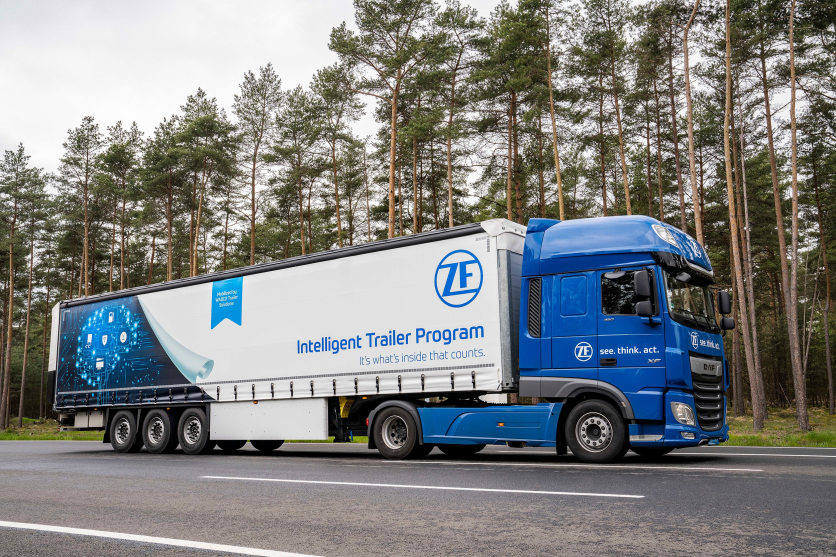
Every year in Europe, approximately 1,000 cyclists and pedestrians die in collisions with trucks — many of them in the near-side blind zone created when a tractor-trailer turns through an intersection and the trailer's length extends far beyond what any cab-mounted camera can see. According to the European Transport Safety Council's blind-spot research, trucks represent roughly five percent of registered vehicles but are involved in approximately 15 percent of road fatalities. At IAA Transportation 2026 in Hannover — the world's largest commercial vehicle show, whose press day is today, September 14 — ZF Friedrichshafen AG is presenting its answer to that structural gap: an automotive Ethernet link connecting truck and trailer that fuses sensor data from both units into a single environmental model, treating the full tractor-trailer combination as one coherent safety system for the first time. ZF says its Commercial Vehicle Solutions (CVS) division has secured more than €5 billion (approximately $5.77 billion USD) in awarded lifetime business so far in 2026, with a customer win rate approaching 90 percent, according to the company's IAA press disclosures.
How the Ethernet Link Closes a Decades-Old Perception Gap
The prior-generation architecture was the source of the problem: truck ADAS systems and trailer sensor systems operated independently. A truck's autonomous emergency braking (AEB) loop could only ingest data from sensors mounted on the truck cab itself. Trailer-mounted cameras could display images in the cab, but their data could not feed into the braking decision chain. The result was a perception gap running the full length of the trailer's near side — precisely the zone where cyclists are struck in turning collisions.
ZF's Truck Trailer Link (TTL) replaces the conventional low-bandwidth connector interface between truck and trailer with high-speed automotive Ethernet. The Ethernet link carries compressed radar point-cloud data and camera image streams from trailer-mounted sensors back to the truck's central processing unit in real time, where they are merged with the truck's own sensor streams into a unified environmental model. The ZF press release describes the result as continuous 360-degree object detection with far fewer perception gaps compared to traditional methods — and the specific gap it closes is not incidental: it is the near-side zone that was structurally undetectable in tractor-trailer combinations running conventional CAN-bus interfaces.
"ZF's system approach to these challenges integrates ADAS functions across the entire vehicle combination and includes advancements that go beyond warning-based driver assistance toward active collision prevention," said Dr. Thomas Dieckmann, Technology and Innovation Officer at ZF.
The architecture scales. ZF's ADAS platform accepts next-generation radar and camera modules from either the truck or trailer and fuses their outputs without requiring the truck OEM to redesign its platform. "Scalability is key for our customers. They need safety systems that protect their investments, meet today's requirements and evolve over time without redesigning the vehicle," said Martin Mayer, Head of Product Segment ADAS and Electronics at ZF CVS. That step-by-step upgradeability matters because commercial vehicles have service lives of 15 to 20 years — forcing a platform redesign would effectively exclude the retrofit market from safety improvement.
Why EU Regulations Are Driving the Biggest Commercial Vehicle Safety Cycle in a Decade
ZF's timing at IAA is not coincidental. The company's portfolio is engineered around a sequence of European regulatory milestones that are arriving in quick succession.
Phase 3 of the EU General Safety Regulation (GSR) — Regulation (EU) 2019/2144 — entered force in July 2026. Thatcham Research confirms GSR Phase 3 mandates expanded ADAS features on all newly registered commercial vehicles in the EU, including Advanced Driver Distraction Warning (ADDW) and additional pedestrian and cyclist autonomous emergency braking. For commercial vehicle OEMs selling into Europe, this means GSR compliance is now a legal floor, not a competitive differentiator. ZF's ADAS architecture explicitly exceeds that floor — the 360-degree system's active collision-prevention capability goes beyond what the regulation requires, which is the technical basis for achieving higher Euro NCAP safety ratings.
The GSR requires Moving Off Information System (MOIS) and Blind Spot Information System (BSIS) on all newly registered EU trucks. MOIS warns when a cyclist or pedestrian is in the truck's path as it begins moving from rest. BSIS warns when a vulnerable road user is in the near-side blind zone. ZF's system meets both requirements but extends them: where the regulation mandates a warning, ZF's OnGuardMAX platform can actively initiate braking.
India is the next wave. ZF's CVS division reported 41 percent year-on-year growth in India, driven by the country's own safety legislation and mandatory Electronic Stability Control requirements for trucks that take effect this year. "Technology leadership ultimately has to be proven in the market, and these results show that customers around the world continue to choose ZF," said Fabian Schlegel, Global Head of Sales and Head of EMEA Region for ZF CVS.
MAXX Uniper: How Single-Piston Geometry Meets Euro 7's Brake-Dust Limit
Alongside its ADAS announcements, ZF is presenting the world premiere of the MAXX Uniper, a new air disc brake designed for commercial vehicles that specifically addresses the particulate emission requirements of Euro 7.
Euro 7 — the European emission standard currently phasing in — is the first regulation to set limits on non-exhaust particulate matter. It regulates the PM10 particles generated by brake and tire friction. Thatcham Research documents that the brake-dust limits take effect for heavy commercial vehicles in July 2027, giving suppliers roughly ten months from today to complete product qualification cycles. The urgency of MAXX Uniper's IAA premiere reflects that timeline directly.
The engineering mechanism: conventional multi-piston air disc brake calipers use two to four pistons pressing against the rotor through a friction pad. More piston-pad contact points mean more friction interface area per braking event — and more brake-dust particle generation per unit of kinetic energy absorbed. MAXX Uniper's single-piston architecture achieves equivalent stopping force through optimized caliper geometry, with fewer contact points per braking event, thereby reducing total particulate output. This is how brake hardware redesign directly addresses an atmospheric chemistry problem.
ZF also extended its Electronic Air Processing Unit contract with a major global truck and bus manufacturer and reported continued compressor business growth in North America, including a new long-term agreement with Cummins. Production of ZF's two-stage compressors will reach one million units in 2026, twenty years after their IAA 2006 debut.
City Bus Assist: Coordinating Approach, Kneeling, and Collision Prevention
ZF is also bringing additional detail to City Bus Assist, a concept previewed at its CV Tech Day ahead of IAA. The system integrates three functions that urban bus operations currently manage independently: automated lateral guidance toward the curb during a stop approach, coordinated activation of the bus's kneeling function (lowering the air suspension to reduce the boarding gap for passengers with limited mobility), and collision mitigation scanning for vulnerable road users during the approach.
The integration matters because lateral scrub — the sideways tire slip that occurs when a bus approaches a curb at an imprecise angle — both accelerates tire wear and creates inconsistency in boarding-gap distance. City Bus Assist computes the approach trajectory to minimize slip angle in the final meters of docking while simultaneously commanding the air suspension kneeling sequence via the braking and steering ECUs. The result is a tighter curb approach for the passenger who uses a wheelchair or cane, and a lower total cost of ownership for the operator through extended tire life.
Ivan Brajdic, Head of R&D for ZF's CVS division, described the design challenge: "In complex urban environments, city buses must meet multiple demands at the same time: protecting road users and passengers, ensuring a smooth ride even during stop-and-go city traffic, while also continuing to work reliably."
Software-Defined Vehicles: OTA Compliance, Central ECUs, and Connected Fleets
ZF's IAA showing extends beyond hardware into the software-layer infrastructure that software-defined commercial vehicles require. Two elements stand out for their regulatory and architectural significance.
The SUMS Service Suite manages over-the-air (OTA) software updates in compliance with UNECE Regulation 156, which mandates Software Update Management Systems (SUMS) for vehicles. ZF's SUMS press release confirms that R156 requires every software update to a vehicle system be secure against unauthorized modification, fully traceable in documentation, and validated against the vehicle's existing type approval before deployment. ZF holds ISO 24089 certification — the industry standard for automotive software update management — making it the first Tier-1 supplier certified to this standard in the trailer industry. More than 150 trailer manufacturers now use the SUMS Service Suite, meaning ZF effectively operates the compliance infrastructure for a significant fraction of the European trailer fleet's software lifecycle.
ZF has also developed a new centralized electronic control unit for zonal electrical/electronic architectures, enabling software functions to be added, modified, or updated across a vehicle's lifetime without replacing physical hardware. The [pro]Diagnostics platform extends this with SaaS-based diagnostic functions and cybersecurity compliance, updated regularly via the SUMS infrastructure.
The Truck Trailer Link's Ethernet architecture reinforces the software-defined vehicle vision in a specific way: it transforms the conventional connector between truck and trailer from a point-to-point signal cable into a bidirectional data pipe capable of carrying any sensor, actuator command, or software payload — including, in future architectures, in-cab control of trailer lift axles, landing legs, and lighting systems via software.
Electric Drivelines: India, China, and Europe
ZF is also presenting several milestones in its electrification portfolio at IAA. AxTrax 2, the company's electric axle for buses, has secured a major city bus order in India and entered production in China. CeTrax 2 dual, the central electric drive for rigid trucks, is beginning series production in Europe. The TraXon automated manual transmission platform has surpassed 1.5 million cumulative units since its 2014 launch. The Modular e-Drive Kit and TraXon Hybrid round out the electrification lineup.
Andreas Moser, Member of the ZF Board of Management and Head of CVS, acknowledged the complexity of the market transition: "The long-term vision for commercial vehicles remains clear: safer transport, lower emissions and increasingly intelligent vehicles. However, the pace of transformation differs significantly across regions, applications and customer requirements. Our role is to help customers navigate this complexity and support them with the right technologies for their specific transformation pathways."
ZF's CVS division is exhibiting at Hall 21, Booth B42, through the close of IAA Transportation 2026 on September 20. In the first half of 2026, ZF reported group sales of €19.3 billion (approximately $22.27 billion USD).
Exchange rate as of September 14, 2026; conversions are approximate.
Frequently Asked Questions
What is the EU General Safety Regulation and how does it affect trucks sold in America?
The EU General Safety Regulation (GSR, Regulation EU 2019/2144) is a European law that mandates minimum ADAS features on all vehicles newly registered in EU markets. Its Phase 3, which entered force in July 2026, added requirements including expanded pedestrian and cyclist automatic emergency braking for commercial vehicles. The GSR does not directly govern US-market trucks, which are regulated by FMCSA standards. However, global truck manufacturers — including North American-market suppliers — frequently develop to the more stringent EU standard to maintain a single global platform, meaning GSR-compliant systems often reach US fleets through shared platforms. The MAXX Uniper brake and ZF's BSIS and MOIS systems are initially positioned for European compliance but are designed to be globally deployable.
How does the truck-trailer Ethernet link improve safety compared to older systems?
Prior-generation truck ADAS relied solely on sensors mounted on the truck cab, leaving a perception gap that ran the full length of the trailer's near side — the area where cyclists are most often struck in turning collisions. The Truck Trailer Link connects trailer-mounted cameras and radar to the truck's central safety computer via automotive Ethernet, merging their data with the truck's own sensor streams in real time. The truck's AEB system can now see and react to objects alongside the trailer that were previously invisible to it. European Transport Safety Council data, cited by Transport and Environment's blind-spot study, indicate trucks — which represent only about five percent of registered vehicles — are involved in approximately 15 percent of road fatalities and roughly 1,000 vulnerable road user deaths per year in Europe.
What does Euro 7 mean for truck brake systems, and when does it take effect?
Euro 7 is the European emissions standard currently phasing in. Unlike its predecessors, it regulates non-exhaust particulate emissions for the first time — meaning the fine PM10 dust particles generated by brake friction, which make up the majority of urban particulate matter now that exhaust emissions have been sharply reduced. For passenger cars, the brake-dust limits came into force in 2025. For heavy commercial vehicles, the applicable limits take effect in July 2027. This forces a redesign of commercial vehicle brake hardware — the MAXX Uniper's single-piston architecture directly reduces the number of friction contact points per braking event, lowering total particulate output to comply with the new limits.
Is ZF a US company?
No. ZF Friedrichshafen AG is a German multinational automotive supplier, headquartered in Friedrichshafen, Germany, and is the world's second-largest automotive parts supplier by revenue. Its Commercial Vehicle Solutions division was substantially expanded through ZF's acquisition of WABCO — a longtime commercial vehicle braking specialist — in 2020. ZF operates production facilities in more than 30 countries, including in the United States, but remains a German-headquartered company. In the first half of 2026, ZF reported group sales of €19.3 billion (approximately $22.27 billion USD).

-
 C114 Communication Network
 -
 Communication Home
