
 Search

Pony.ai
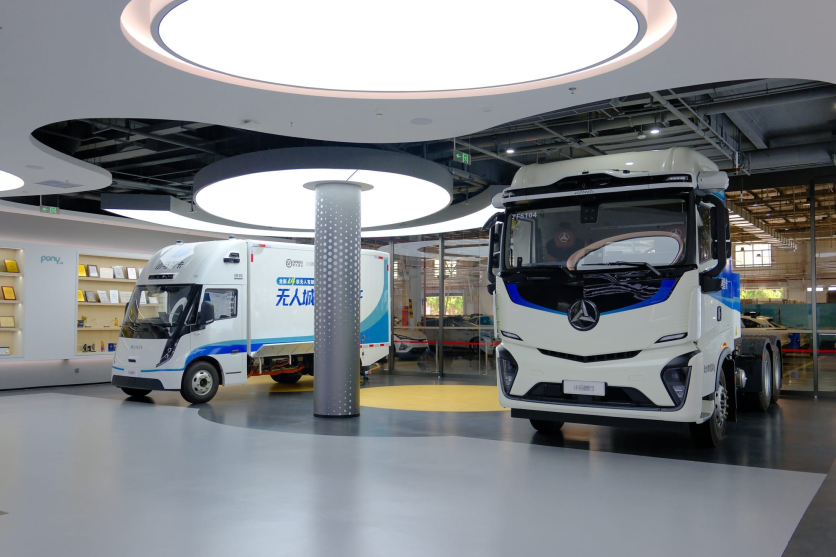
At IAA Transportation 2026's press day in Hannover — the world's leading commercial vehicle trade platform — Pony.ai unveiled a Level 4 (L4) autonomous heavy-duty truck built on GAC Commercial Vehicle's T9 battery-electric platform, marking the moment the company's Robotaxi-proven autonomy stack formally crossed into volume freight production. The bill-of-materials cost of the autonomous driving kit has fallen roughly 70% from the previous generation, not because of procurement bargaining but because Pony.ai designed the system to share its domain controller and most of its components directly with its commercially operating Gen-7 Robotaxi fleet — a shared-architecture strategy that let the company go from signed partnership agreement to global debut in five months.
What Sets This Truck Apart: One Computer, Two Vehicle Types
The single most important technical fact about Pony.ai's Gen-4 T9 Robotruck is not its sensor count or its drag coefficient. It is that the vehicle runs on the identical domain controller as Pony.ai's seventh-generation (Gen-7) Robotaxi fleet — the same commercial urban taxi service currently operating across Guangzhou, Beijing, and multiple international markets, with more than 1,400 Gen-7 vehicles in commercial service.
A domain controller is the central compute platform that handles all autonomy functions simultaneously: perception of the surrounding environment from sensor data, prediction of how other vehicles and objects will move, planning the vehicle's own path, and issuing real-time commands to steering, brakes, and throttle. Building separate, independently validated domain controllers for taxis and trucks would require duplicating the most expensive and time-consuming part of autonomous vehicle development. By designing a single platform that serves both vehicle types, Pony.ai pools the component volumes of its entire fleet — which is how 70% of the hardware cost can exit the system without sacrificing the specifications.
This is what made the five-month sprint from partnership signing to global stage possible. Pony.ai and GAC Commercial Vehicle inked their strategic cooperation agreement on April 16, 2026. Within five months, the companies completed vehicle testing and validation ahead of the Hannover debut. That timeline would be implausible for a ground-up truck autonomy system. It was achievable for a system that borrowed a mature, production-validated compute architecture already running in commercial service.
The Sensor Suite and Safety Architecture
The Gen-4 T9 carries 25 sensors arranged for total environmental coverage: nine lidars, three millimeter-wave radars, and 13 cameras, providing 360-degree sensing with no blind spots. The multi-sensor approach is deliberate and significant. Lidar provides precise three-dimensional point clouds of the environment; cameras provide color and semantic context; millimeter-wave radar performs reliably in rain, fog, and low-visibility conditions where lidar performance can degrade. A freight truck operating overnight on highway corridors, in fog, and in the early morning hours before sunrise needs all three.
Redundancy runs six layers deep in the GAC T9's drive-by-wire chassis: steering, braking, communications, power supply, computing, and sensing each have fully independent backup architectures. This mirrors the redundancy philosophy Pony.ai already applies in its Robotaxi fleet, applying it to a vehicle class where a fully loaded heavy-duty truck can weigh more than 40 metric tons (about 88,000 pounds). A single-point failure in any of these systems on a loaded truck moving at highway speed is a life-safety event. The six-system redundancy is designed to prevent exactly that.
The truck also carries an ultra-low drag coefficient of 0.4 Cd, comparable to best-in-class battery-electric semi-trucks — a notable aerodynamic achievement for a heavy commercial vehicle. Combined with Pony.ai's energy-efficiency algorithms, the company projects a 10% reduction in energy consumption relative to conventional trucks.
Production Timeline and Commercial Economics
Volume production of the T9 Robotruck is scheduled to begin later this year, with vehicles targeted for long-haul freight corridors, dedicated-route logistics operations, and port transportation. Pony.ai's stated projection is that transportation costs per ton-kilometer will fall by 30% once the trucks are commercially deployed — a figure that, if it holds at scale, would represent a structural shift in freight economics. The company cautions that these are projections, not measured results from a deployed fleet.
The trucking segment's commercial traction is already visible in Pony.ai's financial filings. Robotruck services revenue for H1 2026 totaled $23.5 million, an increase of 36% compared with the same period in 2025. Q1 revenue was $10.2 million and Q2 reached $13.3 million — a sequential acceleration that suggests volume is growing, not plateauing. The increase was attributed primarily to growth in freight transportation services, supported by the company's collaboration with Sinotrans.
Pony.ai has accumulated more than one billion ton-kilometers (approximately 621 million ton-miles) of autonomous freight transport across its operations in China since entering the trucking market in 2018. The company holds autonomous truck road test permits in Beijing and Guangzhou and has run commercial-grade operations across logistics corridors in the Beijing-Tianjin-Hebei region, the Yangtze River Delta, and the Pearl River Delta.
"The global debut of the T9 autonomous heavy-duty truck with GAC Commercial Vehicle marks another important step in accelerating the mass production and commercial deployment of Pony.ai's Robotrucks," said He Xing, Vice President of Pony.ai and Head of its Robotruck business. "Looking ahead, we will deepen our collaboration with GAC Commercial Vehicle, continue advancing volume production and deployment of the T9 Robotrucks, and bring our jointly developed autonomous trucking solutions to markets around the world."
How Does L4 Freight Autonomy Actually Work in Practice?
Level 4 autonomous driving, as defined by SAE standard J3016, means the automated driving system handles all aspects of the dynamic driving task — steering, braking, acceleration, monitoring, responding to hazards — within a defined Operational Design Domain (ODD), even if a human driver fails to respond to a handover request. The critical phrase is "within a defined ODD." A truck that is L4 on a monitored highway freight corridor is not necessarily L4 on a narrow urban delivery street in rain at night. Pony.ai's stated deployment scenarios — long-haul highway corridors, dedicated logistics routes, port approaches — are exactly the operational domains where the ODD can be tightly controlled and where L4 performance is most tractable to validate.
This matters for European and US logistics operators evaluating the technology. The Gen-4 system's L4 claim is made within the context of China's permitted freight corridors. European type approval for L4 autonomous vehicles on public roads falls under EU Regulation 2022/1426, and as of the time of this writing, L4 autonomous trucks have not received type approval for general European public road use. Pony.ai has stated plans to enter European and Middle Eastern freight markets "within the next two years." That timeline presupposes a regulatory approval pathway that is being actively pursued — the DAF/Einride partnership announced in August 2026, for example, is working with European type-approval authorities toward a 2027 L4 integration on depot-to-depot routes — but for Pony.ai specifically, that approval process has not yet publicly reached a defined timeline.
The Competitive Landscape: China's Production Scale vs. US Commercial Traction
Pony.ai's Gen-4 T9 debut at IAA lands as autonomous trucking globally transitions from technology demonstration into early industrialization. The competitive picture has two distinct theaters.
In the United States, Aurora Innovation has operated driverless commercial trucks on US public highways since April 2025, running routes between Dallas and Houston for logistics companies including McLane. Aurora expects to reach more than 200 driverless trucks in operation by the end of 2026, targeting an annual revenue run rate of approximately $80 million. Aurora's approach is US-focused, regulatory-cleared for its specific operational domains, and purpose-built rather than derived from a taxi platform.
Pony.ai's target is different in scale and geography. The company has stated plans to deploy 500 to 1,000 Gen-4 heavy-duty trucks in China over the next two to three years, according to a media briefing by He Xing in August 2026 — a revised target that is substantially lower than earlier forecasts of up to 10,000 trucks per year. The reset reflects a global pattern: autonomous truck developers have consistently revised deployment timelines downward as production realities clarify. Light-duty autonomous trucks are targeted at a more ambitious scale — Pony.ai aims for 100,000 L4 light-duty trucks by 2030.
The autonomous trucking market reached approximately $42.9 billion in 2025 and is projected to grow to $107.7 billion by 2034 at a compound annual rate of roughly 11%. North America currently represents 38% of the global market.
The European opportunity is driven in large part by a structural driver shortage. As of 2025, more than 502,000 truck driver positions were unfilled across Europe, representing approximately 13% of total demand. The International Road Transport Union projects that figure will reach 745,000 by 2028. Trucks carry 75% of Europe's freight by volume. The structural case for autonomous freight in Europe is not primarily about cost reduction — it is about the physical absence of qualified drivers to move goods.
What European Logistics Operators Need to Know Before Buying
For European logistics decision-makers evaluating Pony.ai as a potential fleet technology partner, the T9 Robotruck's technical credentials and commercial momentum are genuine. The shared-architecture cost reduction is real. The five-month development timeline reflects a mature autonomous system being adapted, not built from scratch. But three dimensions require independent scrutiny before any procurement decision.
European regulatory approval is not yet in place. L4 autonomous trucks are not approved for general public road use in Europe under current type-approval frameworks. Any evaluation of Pony.ai for European freight operations should include a specific question about the anticipated regulatory timeline and what EU Regulation 2022/1426 type-approval process the company is pursuing. The two-year market-entry timeline is a stated intention, not a regulatory guarantee.
Performance on European routes is unverified. Pony.ai's one billion ton-km of accumulated freight experience is entirely from Chinese logistics corridors. Weather conditions, road geometry, regulatory edge cases, and mixed-traffic scenarios on European motorways differ from Chinese expressways. No independent published evaluation of Pony.ai Robotruck performance on European road conditions exists yet.
The Gen-4 system's benchmark claims are self-reported. The 70% BOM cost reduction, the 30% freight cost reduction projection, and the 10% energy efficiency improvement are all figures stated by Pony.ai in its press release. The comparison baselines are not fully disclosed, and no independent third-party audit of these figures has been published. Logistics operators should treat these as starting points for technical due diligence, not verified performance specifications.
Data Sovereignty: What the National Intelligence Law Means for Road Mapping Data
Autonomous trucks accumulate a category of data that has specific national security implications: high-resolution road mapping data. Every route a Pony.ai Robotruck operates generates lidar point clouds, camera imagery, and GPS traces that constitute a detailed map of the infrastructure it traverses. This data is operationally valuable to Pony.ai for improving its Virtual Driver software. It is also, under Chinese law, legally accessible to the Chinese government on demand.
China's National Intelligence Law (2017), specifically Article 7, requires all organizations and citizens to cooperate with national intelligence work obligations. China's Data Security Law (2021) and Cybersecurity Law (2017) add additional data localization requirements and government-access provisions that apply to companies operating under Chinese jurisdiction. These are not contested allegations — they are the operative legal structure under which Pony.ai and GAC Commercial Vehicle function as Chinese-domiciled entities, regardless of where their trucks physically operate or where their servers are located.
The practical implication for a European logistics operator that contracts Pony.ai's Robotruck services on, say, a German autobahn freight corridor: the road mapping data generated on that corridor would be subject to Chinese government access requests under the National Intelligence Law. This is the same category of concern that produced Congressional scrutiny of TuSimple in the United States after that company was found to have transmitted autonomous-vehicle data to China despite assurances to US authorities. Pony.ai is not accused of any similar conduct, but the structural legal condition is identical.
This is not a reason to dismiss the technology. It is a structural condition that any serious procurement evaluation must address — through contractual data-handling requirements, network segmentation of truck telemetry systems, and a clear-eyed assessment of whether the freight corridors in question involve infrastructure sensitivity. Logistics operators moving commodity goods on public motorways face a different calculus than those operating near ports, military facilities, or critical infrastructure.
IAA Transportation 2026: The Stage and Its Significance
IAA Transportation 2026 runs through September 20 at Hannover Messe, organized by the German Association of the Automotive Industry (VDA). The show draws more than 2,500 exhibitors from 48 countries and expects more than 240,000 visitors, making it the largest commercial vehicle and logistics technology platform globally. Professional visitor days open September 15; the September 14 press day is when manufacturers make their major announcements to the trade press.
For Pony.ai, choosing IAA as the venue for the T9's global debut sends a specific signal to European logistics operators and policymakers. The company is not simply announcing a product for the Chinese market — it is presenting to the audience it intends to serve within two years. The show also provides direct access to potential fleet operator partners, competing OEM autonomy programs (including the DAF/Einride L4 integration in development), and the regulatory stakeholders whose approval will determine whether Pony.ai's European entry timeline materializes on schedule.
What This Means for US Logistics Operators
American freight operators evaluating the broader autonomous trucking market should take note of the Gen-4 T9 for three reasons, even though the truck will not operate in the US in the near term. First, the shared-architecture cost model — if it scales as Pony.ai projects — establishes a unit-economics benchmark that US-focused autonomous truck developers will need to address. Aurora's second-generation "Harbor" hardware is projected to cut costs by 50%; the Gen-4 system claims 70%, achieved through a different mechanism. Second, the 30% projected freight-cost reduction, if realized in commercial operations, would compress margins across any freight corridor where driverless trucks operate, including US Sun Belt routes where Aurora is expanding. Third, the EU type-approval process for Chinese autonomous trucks will establish regulatory precedents that may inform US federal rulemaking as the NHTSA framework for L4 commercial vehicles evolves.
None of this changes the immediate US competitive picture, where Aurora Innovation has a meaningful first-mover advantage in regulatory clearance, commercial mileage, and established shipper relationships. But a Chinese autonomous truck developer with a production-scale BEV platform, a commercially proven autonomy stack, and a stated intent to enter European freight markets in two years is not a future story. It is a present development with near-term implications for the global logistics technology landscape.
Frequently Asked Questions
What is Level 4 autonomous driving, and what does it mean for trucks?
Level 4 autonomous driving, as defined by the SAE J3016 standard, means a vehicle's automated driving system handles all driving tasks within a specific, pre-defined operational domain — without requiring any human driver intervention, even if the driver fails to respond. For trucks, this typically means a defined highway freight corridor, port approach, or dedicated logistics route rather than all-purpose urban driving. A truck that is L4 for a Shanghai-to-Beijing highway run may not be L4 on a narrow urban street. The operational boundary, called the Operational Design Domain, defines exactly where the truck can operate autonomously and where it cannot.
How is Pony.ai's approach different from Aurora Innovation's in the US?
Aurora built a purpose-designed autonomy system specifically for US highway freight from the ground up, cleared US public-road regulatory approval, and is now running more than 200 driverless trucks commercially on Sun Belt routes. Pony.ai's approach adapts an autonomy stack already validated in commercial Robotaxi service — sharing the domain controller across vehicle types to drive down hardware cost. Aurora is further ahead on US regulatory approval and American market presence. Pony.ai is targeting higher deployment volumes in China's freight corridors and a European entry that Aurora has not attempted. The strategies reflect different bets on where and how autonomous freight scales first.
What data does an autonomous truck collect, and what are the privacy implications?
An L4 autonomous truck like the Gen-4 T9 continuously generates lidar point clouds, high-resolution camera imagery, GPS position traces, vehicle telemetry, and route timing data. For a commercial fleet operator, this data is the raw material for improving the system's Virtual Driver software. For a Chinese-domiciled technology company like Pony.ai, it is also subject to China's National Intelligence Law (2017), which legally obliges all organizations to cooperate with government intelligence requests. This applies regardless of where the trucks physically operate or where the data is stored. European and US logistics operators evaluating Pony.ai as a technology partner should seek contractual data-handling commitments, independent audit rights, and network segmentation architectures that address this structural legal condition.
What is the truck driver shortage, and does autonomous trucking solve it or worsen it?
Europe's truck driver shortage has reached approximately 502,000 unfilled positions as of 2025, projected to grow to 745,000 by 2028 as the workforce ages and recruitment struggles to keep pace. The US faces a shortage of approximately 78,000–80,000 drivers. Autonomous trucks address this structural gap on the specific routes where L4 performance is achievable — controlled highway corridors and fixed logistics routes — which is precisely where driver shortages are most acute because long-haul routes require drivers to spend nights away from home. However, the same technology reduces the number of driving jobs that exist on those routes over time. Whether the net effect is complementary (filling gaps that cannot otherwise be filled) or competitive (displacing drivers who currently hold those positions) depends heavily on how quickly automation scales relative to the rate of natural workforce attrition.

-
 C114 Communication Network
 -
 Communication Home
