
 Search

Mercedes-benz.com
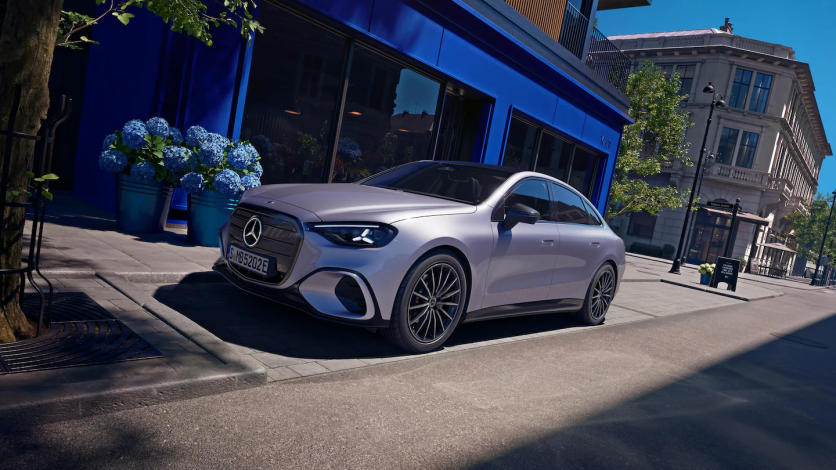
The electric C-Class is no longer a concept or a prototype. On July 13, 2026, Mercedes-Benz started production of the all-new electric C-Class — model code W520 — at its Kecskemét plant in Hungary, following a €1 billion expansion that more than doubled the facility's footprint and made it the largest Mercedes-Benz manufacturing site in Europe. The launch variant, the C400 4MATIC, delivers up to 762 km of WLTP range from a 94 kWh Samsung SDI battery pack, recharges at up to 330 kW DC, and carries a feature that until recently was found only on the Porsche Taycan: a two-speed rear-axle transmission that keeps the motor in its efficiency sweet spot across both city and highway driving. The electric C-Class is expected to reach European customers later in 2026 and arrive in the United States in early 2027.
This is not an incremental update to the old EQ lineup. The prior-generation EQ platform ran on 400-volt architecture and maxed out at around 200 kW DC charging, as Mercedes confirmed when it upgraded the EQS to 800-volt architecture in April 2026. The MB.EA platform that underpins the W520 operates at 800 volts, enabling it to accept up to 330 kW from a compatible station — enough to add approximately 325 km of range in 10 minutes. That is the architecture shift that puts the electric C-Class in the same technical conversation as the Taycan, not in the same one as its own predecessor.
Read more: Mercedes-Benz EV Sales Rose 50% in Q2, Fueled by a Record 26% European Share
Kecskemét Is Now Europe's Largest Mercedes Plant: Five New Halls, One BEV-Dedicated Line
The inauguration ceremony on July 13 brought together Hungarian Prime Minister Péter Magyar, Mercedes-Benz Group CEO Ola Källenius, and Michael Schiebe, the board member responsible for production, quality, and supply chain management. The investment added five new production halls in total, bringing the site's area from 200 to 440 hectares — making it not only Europe's largest Mercedes facility but the second-largest in the company's entire global network.
Production capacity at the site is targeted to rise from over 100,000 vehicles per year to as many as 350,000, while the workforce is expected to grow from approximately 5,000 employees to between 9,000 and 10,000. Neither figure is immediate: both represent goals for the expanded facility as production of the electric C-Class, the electric GLB, and eventually a compact version of the G-Class ramp up over the coming years.
The new hall dedicated exclusively to battery-electric vehicles sits alongside the existing assembly line, which continues to run both combustion and BEV models flexibly on a single track — giving Mercedes the option to adjust the mix in response to demand. That dual approach, combined with flexible production links to Mercedes' Rastatt plant in Germany, means the electric GLC can be built at either location depending on where demand is strongest.
Mercedes describes the supply structure at Kecskemét as a "local-for-local" approach: the body panels and drive batteries for both the electric C-Class and electric GLB are manufactured directly on site, shortening supply chains and giving the production network more flexibility to respond to market fluctuations. The batteries themselves are Samsung SDI prismatic NMC cells — sourced from the South Korean company's Göd, Hungary facility under a contract signed in April 2026, as covered in our earlier Samsung SDI Mercedes battery supply report.
How MB.EA's 800-Volt Architecture and Two-Speed Rear Axle Work
The engineering case for the electric C-Class centers on the MB.EA platform and a set of specific decisions Mercedes made about motors, transmissions, and power electronics.
At 800 volts, the system can transfer the same amount of power to the battery at half the electrical current compared to a 400-volt architecture. Lower current means less heat in the cables, which means charging doesn't slow down as aggressively at high power levels. The practical result is 330 kW peak DC charging — compared to 200 kW on the outgoing EQ generation — and a full 10-to-80% charge completed in approximately 22 minutes.
The two-speed transmission on the rear axle is the other engineering choice that sets this platform apart from most single-speed EV competitors. First gear uses an approximately 11:1 ratio for low-speed acceleration, towing response, and torque delivery. Second gear drops to approximately 5:1, keeping the permanent magnet synchronous motor in a narrower, higher-efficiency operating band at motorway speeds. Porsche pioneered this approach on the Taycan; Mercedes introduced it on the CLA and has now carried it through to the MB.EA midsize architecture used by the GLC and C-Class.
On the 4MATIC all-wheel-drive layout of the launch C400 variant, a front Disconnect Unit (DCU) decouples the front axle motor entirely under light-load conditions, cutting drag losses by up to 90% compared to a permanently engaged system. In practice, the car drives primarily on the rear motor during ordinary use, deploying the front motor for AWD traction or hard acceleration. The motor itself — developed in-house under the eATS 2.0 program — uses a silicon carbide (SiC) inverter rather than conventional silicon, which reduces switching losses and allows for a more compact, efficient power electronics package.
The battery pack is a 94 kWh lithium nickel-manganese-cobalt (NMC) unit. NMC chemistry provides higher energy density than the lithium iron phosphate (LFP) chemistry Mercedes uses for entry-level variants, enabling the 762 km WLTP figure — 112 km more than the MB.EA-based electric GLC achieves from the same battery capacity, largely due to the sedan's more aerodynamic fastback profile and lower ride height. Additional battery variants with smaller packs — potentially down to 64 kWh — are expected for the European market in 2027, along with a rear-wheel-drive model estimated at approximately 800 km WLTP range.
One practical note for buyers: the 762 km WLTP figure is measured under European test conditions, typically at mild temperatures and moderate speeds. Real-world range generally runs 15–25% lower than WLTP on similar premium EVs, placing the C400's realistic highway range in approximately the 580–650 km bracket.
What Can the Electric C-Class Do That the Competition Cannot?
The direct rival is BMW's new i3 sedan, built on the Neue Klasse platform. The BMW leads on WLTP range at approximately 900 km from a 108 kWh battery, as detailed in a recent BMW i3 vs. Mercedes electric C-Class comparison. Both models are targeting dealership arrival in autumn 2026; full independent road test results are not yet published.
Where the electric C-Class differentiates: the cabin. The W520 ships with Mercedes' fourth-generation MBUX infotainment system, the first to simultaneously integrate AI assistants from three platforms — ChatGPT-4o, Microsoft Bing, and Google Gemini. An optional 39.1-inch Hyperscreen spans nearly the full width of the dashboard. An augmented reality head-up display — an 18-inch diagonal virtual image in the driver's field of view, brought down from the S-Class and EQS — is claimed as a segment first for compact executive sedans. Optional rear-wheel steering turns the rear wheels up to 4.5 degrees in the opposite direction at low speed, reducing the turning circle to 11.2 meters — useful given the sedan's 4,883 mm length.
Cargo space is a meaningful 470 liters in the trunk plus a 101-liter front trunk, and the car can tow up to 1.8 tonnes. These are practical numbers that position the C-Class as viable for buyers who want an executive EV without sacrificing utility.
US pricing has not been confirmed. Pre-launch estimates from automotive publications have suggested a starting figure around $55,000 for the US market, though the launch C400 4MATIC trim is likely to sit above that. European pricing has also not been published by Mercedes at time of writing.
Read more: Samsung SDI Wins Volkswagen Unified Cell Contract: Hungary Plant Joins BMW, Mercedes Supply Chain
What the Plant Expansion Tells You About How Mercedes Is Building Its Network
The Kecskemét factory story is partly about this one car and partly about Mercedes' answer to a question every legacy automaker has to answer: how do you reconfigure a global manufacturing network that was designed around combustion engines?
Mercedes' approach at Kecskemét is additive rather than replacement. The new BEV-dedicated hall runs alongside, not instead of, the existing flex line. The Rastatt plant in Germany continues as a parallel production node for MMA-platform models including the CLA. The electric GLC can be built at either Bremen or Kecskemét, depending on demand — and a recent industry report cited by Electrive noted that some GLC production may shift to Kecskemét if Mercedes relocates that model's Bremen line to its Tuscaloosa, Alabama plant.
That network logic — build in more than one place so you can move volume around — is a hedge against demand uncertainty. Mercedes' Q2 2026 BEV sales jumped 50% year-over-year globally, driven primarily by European demand for the electric CLA, GLC, and GLB, with European BEV share reaching 26% in the quarter. But the company also reported a 30% year-over-year drop in China passenger car sales for the same period — a reminder that EV demand is not uniformly strong across all major markets. A factory structure that can serve Europe with short supply chains while adjusting mix between ICE and BEV on the same lines provides more resilience than a fully committed, single-market BEV-only facility would.
For manufacturing technology, the Kecskemét expansion is being used as a testbed. Mercedes built a full digital twin of the new assembly hall using NVIDIA's Omniverse platform, allowing production engineers to simulate process changes virtually before implementing them on the physical line. AI-based visual inspection systems analyze vehicles for surface defects in real time. The new paint shop, which handles both the electric C-Class and other models, delivers lower energy consumption and reduced CO₂ emissions compared to its predecessor.
The company has also significantly expanded on-site renewable energy. The facility now operates a total solar generation capacity that covers a meaningful share of its electricity needs, with a new 27.4 MW solar installation complementing existing rooftop arrays. Mercedes has not provided an independently verified total site solar output figure; the 42.3 MW figure cited in early coverage originates from the company's own materials and has not been confirmed by an independent assessor.
AMG Performance Variant and Compact G-Class Are Both Confirmed for Kecskemét
Two additional models confirmed for Kecskemét are worth flagging for buyers watching the future pipeline. Mercedes confirmed at the inauguration ceremony that a compact version of the G-Class will be built exclusively in Hungary — on the MMA compact platform — complementing the full-size G-Class, which is one of the brand's most profitable model lines.
For the electric C-Class specifically, AMG is preparing a performance variant that will be manufactured in Kecskemét. That model will use axial flux motors — a motor type that achieves significantly higher power density than conventional radial motors by routing magnetic flux parallel to the shaft rather than perpendicular to it — produced at Mercedes' Berlin facility. The AMG variant is expected in 2027 and is projected to produce more than 680 horsepower.
How Does the Electric C-Class Fit a Buyer's Decision Right Now?
The practical decision frame for anyone in the premium executive EV market: the electric C-Class is in production and on sale in Europe now, with deliveries beginning later in 2026. It offers the most technologically complete compact executive EV package from a legacy German automaker currently entering full production — with a platform architecture that genuinely closes the engineering gap with the Porsche Taycan on the dimensions that matter most for real-world ownership (charging speed, charging time, efficiency at speed). The BMW i3 will likely beat it on peak WLTP range, but the competitive picture won't be clear until independent back-to-back tests are published, which both companies have indicated will happen when both models reach dealerships in autumn 2026.
For US buyers, the market window opens in early 2027. European buyers who want the launch C400 4MATIC trim are already in a position to place an order; additional rear-wheel-drive and longer-range variants are planned for 2027 in both markets.
Frequently Asked Questions
What makes the electric C-Class different from Mercedes' previous EQ electric cars?
The electric C-Class runs on the MB.EA platform rather than the old EV Architecture (EVA2) used by the EQC, EQA, and original EQB. The practical differences are substantial. MB.EA operates at 800 volts versus the old platform's 400 volts, enabling peak DC charging at 330 kW versus the prior generation's approximately 200 kW maximum. The new platform also adds a two-speed rear-axle transmission — a feature the old EQ cars did not have — which keeps the motor in a more efficient operating band during highway driving. The silicon carbide inverter in the new drive units is also more efficient than conventional silicon. The result is both faster charging and better real-world efficiency, which contributes to the 762 km WLTP figure. The old EQ lineup was criticized for lagging behind Porsche and Hyundai on these fundamentals; MB.EA was designed specifically to close those gaps.
How fast does the electric C-Class charge, and how long does a charge stop take?
The C400 4MATIC supports peak DC fast-charging at up to 330 kW at a compatible 800-volt station. At that rate, Mercedes claims approximately 325 km of WLTP range can be added in 10 minutes. A full 10-to-80% charge takes around 22 minutes. For 400-volt stations (which remain the majority of public chargers in most markets), the car includes an integrated DC converter that allows it to use those chargers at a reduced charging rate. AC home charging is supported at 11 kW standard, with an optional 22 kW upgrade for faster overnight charging.
When does the electric C-Class arrive in the United States, and what might it cost?
Production at Kecskemét has now begun, and European deliveries are expected later in 2026. The US market launch is planned for early 2027. Mercedes has not confirmed US pricing; pre-launch estimates from automotive publications have placed a starting figure around $55,000, though the launch trim — the C400 4MATIC with full AWD and the 94 kWh pack — is likely to carry a premium above any entry point. For buyers on a US timeline, the practical question is whether to wait for the 2027 US arrival or consider the electric GLC (already available in the US) as an immediate alternative on the same MB.EA platform.
How does the two-speed rear axle in the electric C-Class actually improve efficiency?
Most battery-electric vehicles use a fixed single-ratio gearbox — typically optimized as a compromise between city torque and highway efficiency. A two-speed transmission gives the motor two distinct gear ratios: a lower ratio (approximately 11:1) for maximum torque at low speeds, acceleration, and towing, and a higher ratio (approximately 5:1) that allows the motor to spin at a lower RPM for the same road speed at highway cruise. Keeping the motor in a narrower efficiency band at motorway speeds reduces electrical losses and improves range — which is a core reason the Mercedes electric C-Class achieves 762 km WLTP where the electric GLC, on the same battery size and the same platform, achieves approximately 650 km. Porsche introduced this approach on the Taycan in 2019; Mercedes first adopted it on the CLA and has now standardized it across the MB.EA midsize platform.

-
 C114 Communication Network
 -
 Communication Home
