
 Search

Gov.ca.gov
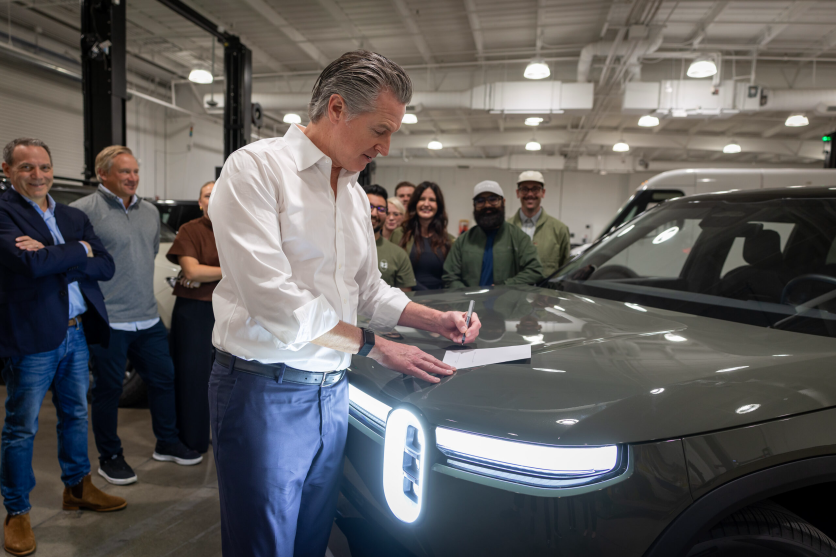
Three days after Governor Gavin Newsom signed California's new MyFirstEV program into law, first-time electric vehicle buyers face a situation the legislation did not resolve: they know a $3,500 discount is coming, but they do not yet know which vehicles will carry it, which dealerships will offer it, or exactly when it starts. The California Air Resources Board is still finalizing agreements with automakers — the entities that must match the state's funds dollar-for-dollar before a single rebate can be issued. Until those agreements are in place, the program exists on paper only.
That gap matters right now. Californians who have been waiting since the federal $7,500 EV tax credit expired last September to make a first EV purchase are still waiting — and the $270 million rebate pool, substantial as it is, will not last forever once the program opens, as California's Q1 2026 auto data makes clear.
California ZEV Sales Collapsed After Federal Credit Died — MyFirstEV Is the State's Countermove
The urgency behind SB 168 shows up in the registration numbers. In the first quarter of 2026 — the first full quarter without the federal incentive — California's zero-emission vehicle market share fell to 13.7%, the lowest level the state had recorded since the fourth quarter of 2021. Total ZEV registrations dropped 40.2% year-over-year, from 95,520 to 57,111 units. Hybrids, at 20.9% market share, surpassed pure-electric vehicles in California for the first time in years. Gasoline vehicles climbed back to 61.1% of new registrations, up from 54% in 2025.
The state has a statutory target of 35% ZEV market share for the 2026 model year. The Q1 data puts that target at less than half of where the market actually stands. The federal credit that Congress had authorized to run through 2032 was eliminated without a phaseout period by the One Big Beautiful Bill Act, effective September 30, 2025.
UC Davis Electric Vehicle Research Center analysis found that lost demand from the credit's expiration accounted for roughly a 20% sales reduction; a larger driver was supply-side contraction as traditional automakers canceled or delayed EV programs under tariff pressure. Ford killed the F-150 Lightning. Stellantis canceled the Ram EV. GM delayed next-generation EVs. Volkswagen ended ID.4 production in Chattanooga. SB 168 is California's most direct demand-side response to that two-front squeeze.
$3,500 Off at the Dealership: What the Program Offers, and Who Qualifies
The core structure of MyFirstEV is simple by design. Any California resident purchasing their first zero-emission vehicle receives $3,500 off a new EV with a manufacturer's suggested retail price at or below $50,000, applied at the dealership at the moment of sale. Used EVs priced at or below $25,000 qualify for a $1,750 discount. There is no income cap. Eligibility is confirmed through buyer attestation, not a document submission or post-purchase application.
The program is funded equally: $135.5 million from California's 2026-27 state budget, matched dollar-for-dollar by participating automakers, for a combined pool of $270 million. Vehicles must weigh no more than 8,500 pounds, restricting the program to light-duty passenger vehicles. The law also includes a four-year resale restriction: buyers cannot sell or transfer a rebate-backed vehicle to another state within four years of purchase.
That $270 million pool is not unlimited. At $3,500 per buyer, it covers roughly 77,000 new-EV purchases — a figure roughly equal to twice California's entire Q1 2026 ZEV registration count of 57,111 units. California's previous clean vehicle rebate programs regularly exhausted their funding ahead of schedule. CARB has confirmed only that funds will be available until exhausted — not that any reserve mechanism will replenish them.
Mainstream models well under the $50,000 threshold include the Chevrolet Bolt (starting below $30,000), the Toyota bZ and C-HR crossovers (under $40,000), the Hyundai Ioniq 5 (around $35,000), the Ford Mustang Mach-E (around $38,000), and specific Model 3 and Model Y configurations from Tesla.
Read more: California Signs $3,500 First-Time EV Rebate Into Law, With a Carve-Out Courts May Undo
Point-of-Sale Design Is the Rebate's Structural Advantage — and Its Research Validation
The most significant design choice in SB 168 is one that sounds procedural but is not: the rebate comes off the purchase price at the dealership, not months later through a tax return.
Research published in Environmental Research Letters by George Washington University economists found that car buyers value an immediate point-of-sale rebate by as much as $1,450 more than a tax credit of identical nominal value — meaning that a $3,500 instant discount may generate more consumer behavior change than a $4,950 delayed credit would. The researchers estimated that by delivering federal EV subsidies as tax credits rather than immediate rebates between 2011 and 2019, the government delivered $2.07 billion less in effective consumer value than the same dollar amount would have generated as instant rebates.
Gallagher and Muehlegger's earlier research reached the same conclusion: immediacy of delivery is a material driver of incentive effectiveness.
The practical implication: California's $3,500 instant rebate is not simply a smaller substitute for the $7,500 credit. Its delivery mechanism makes it structurally more efficient per dollar at converting fence-sitting buyers into purchasers — particularly in the $30,000–$50,000 price range where first-time buyers are most price-sensitive and where the rebate's $3,500 represents the largest fraction of vehicle cost.
Tesla Is Out of Its Best Models, Rivian and Lucid Are All In — Here Is the Structural Reason
The headline asymmetry in SB 168 involves three California EV names that almost never appear in the same sentence without tension.
The $50,000 MSRP ceiling is waived entirely for automakers that are both headquartered in California and exclusively manufacture zero-emission vehicles, as of January 1, 2026. Two companies meet that definition: Rivian, whose engineering headquarters is in Irvine, and Lucid, headquartered in Newark in the Bay Area. Their entire vehicle lineups — including models priced well above $50,000 — qualify for the full $3,500 rebate.
Rivian's currently available models, the R2 Performance at $57,990 and R2 Premium at $53,990, would be entirely outside the standard rebate window. Under the carve-out, both qualify. Lucid's Air sedan and Gravity SUV, both priced above $50,000, similarly become rebate-eligible, as Electrek reported.
Tesla does not qualify for the exemption. The company relocated its corporate headquarters from Palo Alto to Austin, Texas, in December 2021. Despite employing thousands of workers at its Fremont, California, factory and manufacturing hundreds of thousands of vehicles there annually, the company falls outside the California-HQ classification. Tesla's sub-$50,000 Model 3 and Model Y configurations qualify under the standard rules; the Cybertruck does not.
The contrast is pointed: Rivian builds its trucks in Normal, Illinois. Lucid manufactures in Casa Grande, Arizona. Neither company produces a vehicle in California. The carve-out rewards where a company's executives sit, not where its workers build things.
Whether a Court Can Undo the Carve-Out Is Less Clear Than It Sounds
The legal risk to the California-HQ exemption is real, but more genuinely uncertain than most early coverage has framed it.
The dormant Commerce Clause of the U.S. Constitution restricts states from discriminating against out-of-state commercial actors. A subsidy that awards benefits to companies incorporated in-state that are unavailable to identically situated out-of-state companies presents a classic target for challenge under the Clause's anti-discrimination doctrine. SB 168's authors anticipated this — the bill includes a severability clause that preserves the broader rebate program if a court strikes down only the carve-out.
But a countervailing legal doctrine significantly complicates that challenge: the market participant exception. Courts have generally exempted state governments from dormant Commerce Clause scrutiny when they act as direct market participants — spending their own money on goods and services — rather than as economic regulators. Because SB 168 is a grant program funded by state budget dollars, a court could treat California as a spending participant rather than a discriminatory regulator, potentially shielding the carve-out from challenge entirely.
The market participant exception was developed primarily in cases involving states buying goods for themselves, and courts have applied it inconsistently to broadly distributed consumer subsidies of this kind. The legal outcome is genuinely uncertain — a challenge could succeed, fail, or result in a narrowed application of the exemption depending on the court and the specific challenge theory. No lawsuit had been filed as of this article's publication.
For consumers: the program's severability clause means a successful legal challenge to the carve-out would not end the $3,500 rebate — it would simply impose the $50,000 cap on Rivian and Lucid as well.
What Buyers Still Need CARB to Confirm Before the Program Matters
As of July 16, 2026, the most important MyFirstEV update has not happened yet.
CARB must finalize grant agreements with each participating automaker before any vehicle can carry the rebate. Until those agreements are signed, no vehicle officially qualifies — including vehicles whose pricing appears to meet every other program requirement. No automaker has been publicly confirmed as a participating partner. No launch date has been announced, as JointCharging's program tracker confirms.
The practical advice for buyers is direct: watch for CARB's announcement of the participating automaker list, confirm that your target vehicle's manufacturer has opted into the matching program, and treat the program as imminent but not yet open. CARB's stated policy — funds are available until exhausted — means the pool begins depleting immediately on launch day. Previous California rebate programs have run short of funds ahead of schedule.
The $270 million program is the centerpiece of a $600 million ZEV investment in California's 2026-27 budget, funded through Cap-and-Invest revenue and smog-abatement fees. Surrounding programs include $150 million for the Community Air Protection Program, $135.5 million for the Clean Truck and Bus Voucher Incentive Project (HVIP), $130 million for heavy-duty engine replacement through the Carl Moyer Program, $35 million for clean off-road equipment, and $19.8 million for lower-income buyers through Clean Cars 4 All.
California accounts for roughly 30% of all US ZEV registrations. What it builds here will influence how other states design their own demand-side responses to the gap the federal credit's elimination left behind.
Read more: Rivian R2 Orders Open Today: $59,485 Launch Trim Arrives Without Federal EV Tax Credit
Frequently Asked Questions
When does the California MyFirstEV rebate actually start?
No specific launch date has been announced. Governor Newsom signed SB 168 on July 13, 2026, and CARB describes the program as launching "later this summer." But the program cannot open until CARB finalizes grant agreements with participating automakers — a process that was still ongoing as of July 16, 2026. No automaker has been publicly confirmed as a participant yet. Buyers should monitor CARB's official announcements and confirm their target vehicle's manufacturer has signed on before planning a purchase.
Does Tesla qualify for the $3,500 rebate?
Partially. Tesla's sub-$50,000 configurations of the Model 3 and Model Y qualify under the standard program rules — assuming Tesla opts into the automaker-matching requirement. The Cybertruck does not qualify; it exceeds the $50,000 MSRP cap. Tesla cannot access the California-headquarters exemption that waives the cap for Rivian and Lucid, because Tesla relocated its corporate headquarters to Austin, Texas, in December 2021. Tesla manufactures vehicles at its Fremont, California, factory, but the law uses corporate headquarters location — not manufacturing location — as the qualifying criterion.
Why does California's $3,500 rebate matter more than its smaller size compared to the $7,500 federal credit suggests?
Research in Environmental Research Letters found consumers value an immediate point-of-sale rebate by roughly $1,450 more than a tax credit of equal nominal value. The federal credit required waiting until tax filing season and depended on the buyer's tax liability — buyers who owed little or no federal income tax could not capture the full credit. California's rebate has no such limitation: it comes off the purchase price at the dealership regardless of income or tax situation, making it structurally more effective per dollar at converting first-time buyers.
Will the $270 million pool run out before I can use the rebate?
It is a real risk. The $270 million is a one-time allocation that covers roughly 77,000 new-EV purchases at $3,500 each — approximately twice California's entire Q1 2026 ZEV registration count. California's previous clean vehicle rebate programs regularly exhausted their funding ahead of schedule, and CARB has stated only that funds will be available until exhausted. Once the program launches and CARB confirms which automakers and vehicles participate, the pool begins depleting immediately. Buyers who intend to use the rebate should move promptly once the program opens rather than treating the funds as reliably available throughout the summer or beyond.

-
 C114 Communication Network
 -
 Communication Home
