
 Search

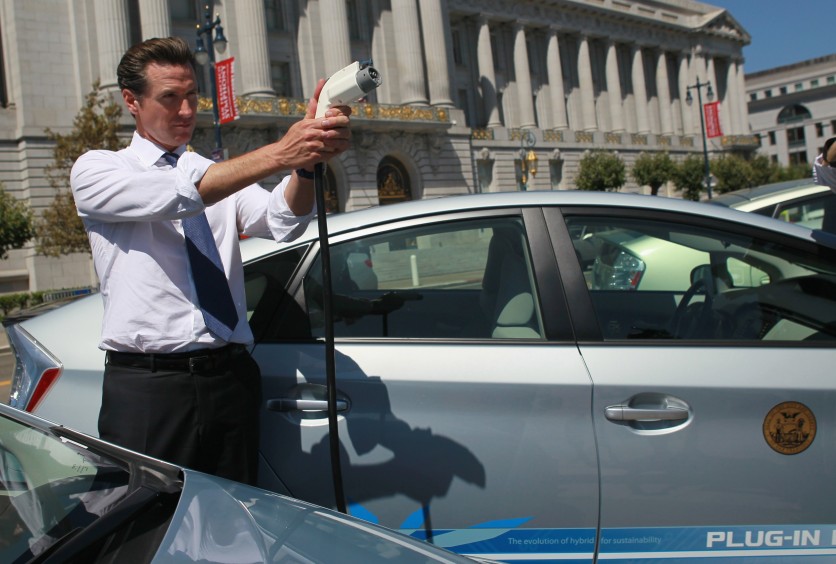
San Francisco mayor Gavin Newsom holds a power cable before test driving a plug-in version of the popular Toyota Prius that is one of four on loan to the city for evaluation August 25, 2010 in San Francisco, California. Justin Sullivan/Getty Images
California Governor Gavin Newsom signed Senate Bill 168 into law on Sunday, July 13, giving every Californian purchasing their first electric vehicle a $3,500 discount at the dealership — no tax return required, no application to file, no waiting. The program, named MyFirstEV, arrives as California's EV market records its steepest sales collapse in years, and it comes packaged with a headquarters-location provision that benefits Rivian and Lucid while locking Tesla out — a structural asymmetry that legislators built a legal escape hatch to survive.
California's $270 Million Bet on a Post-Federal-Credit EV Market
The incentive that drove California's EV boom for more than a decade disappeared on September 30, 2025, when the One Big Beautiful Bill Act eliminated the federal tax credit of up to $7,500 for new electric vehicles and up to $4,000 for used ones. Congress had authorized those credits to run through 2032; they were cut without a phaseout period. The market consequences were immediate and severe.
In the first quarter of 2026 — the first full quarter without the federal incentive — California's zero-emission vehicle registrations fell 40.2% year-over-year, dropping from 95,520 units to 57,111. The state's ZEV market share collapsed from 21% in full-year 2025 to just 13.7%, the lowest level since the fourth quarter of 2021. California has a statutory target of 35% ZEV market share for the 2026 model year — a figure the market is not remotely approaching, and one that the state's Advanced Clean Cars II mandate may no longer be able to enforce after it was invalidated by the Congressional Review Act earlier in 2025.
SB 168 is the state's most direct response to that vacuum. The $270 million pool is funded equally by California's 2026–27 budget ($135.5 million) and matching contributions from participating automakers, who must opt in and cover half of each rebate they want to offer. The California Air Resources Board is finalizing those automaker agreements now, with the program expected to launch at some point this summer — a date CARB has not yet specified.
"Donald Trump is doing everything in his power to pollute our air and surrender the clean car industry to China on a silver platter," Newsom said at the signing. "California is putting its foot on the accelerator."
First-Time Buyers Get $3,500 Off at the Dealership Starting This Summer
The core terms are straightforward. Any California resident purchasing their first zero-emission vehicle can receive $3,500 off a new EV with a manufacturer's suggested retail price at or below $50,000, applied directly at the dealership at the moment of sale. Used EVs priced at or below $25,000 qualify for a $1,750 discount. There is no income cap — the program uses vehicle price as the primary eligibility gate, not the buyer's household income.
That design choice represents a deliberate break from California's previous signature rebate, the Clean Vehicle Rebate Project, which had become increasingly means-tested over the years and reserved the largest incentives for lower-income buyers. The no-income-cap structure is administratively simpler, but it means a first-time EV buyer purchasing a $49,000 vehicle — regardless of their income — receives the same $3,500 as someone for whom that rebate is the difference between affording the car or not.
Multiple mainstream EV brands offer qualifying configurations under the $50,000 threshold. General Motors has three — the Chevy Blazer EV, the Equinox EV, and the Bolt, which begins below $30,000. Toyota's bZ and C-HR crossovers start under $40,000. The Hyundai Ioniq 5 starts around $35,000. The Ford Mustang Mach-E starts around $38,000. Certain Tesla Model 3 and Model Y configurations also fall under the cap.
Read more: Rivian R2 Orders Open Today: $59,485 Launch Trim Arrives Without Federal EV Tax Credit
Rivian and Lucid Win Big. Tesla Does Not. Here Is Why the Law Was Written That Way.
Buried in SB 168 is a provision that has drawn as much attention as the rebate itself. The $50,000 MSRP ceiling is waived entirely for automakers that are both headquartered in California and exclusively manufacture zero-emission vehicles, as of January 1, 2026.
Two companies qualify: Rivian, whose engineering headquarters is in Irvine, and Lucid, headquartered in Newark in the San Francisco Bay Area. Their entire vehicle lineups — including models that sit far above the $50,000 threshold — are eligible for the full $3,500 rebate.
In practice, the stakes are significant. Rivian's least expensive currently deliverable model, the R2 Performance with Launch Package, starts at $57,990. The R2 Premium, arriving later in 2026, starts at $53,990. Both would be entirely ineligible under the standard rules. Under the carve-out, both qualify. Lucid's vehicles are priced higher still — its Air sedan and Gravity SUV sit well above the $50,000 ceiling the carve-out removes for the company.
Tesla does not qualify. The company relocated its corporate headquarters from Palo Alto to Austin, Texas, in December 2021, placing it outside the California-HQ classification under the law's terms. Tesla's vehicles remain subject to the $50,000 cap, meaning only its least expensive configurations qualify for the rebate at all.
This asymmetry does not escape notice. Tesla still operates its Fremont factory — producing hundreds of thousands of vehicles annually in California, employing thousands of Californians — yet the company is excluded on the basis of its corporate mailing address. Rivian builds its vehicles in Normal, Illinois. Lucid manufactures in Casa Grande, Arizona. Neither company makes a single vehicle in California. The law rewards the location of a corporate flag rather than actual California manufacturing.
A Carve-Out Built for a Lawsuit
The legislators who wrote SB 168 understood the carve-out was legally exposed. They added a severability clause stipulating that if a court strikes down the California-HQ exception, the rest of the rebate program continues in force. The clause is a signal: even the bill's authors anticipated that the provision's logic — rewarding a company for planting its corporate headquarters in California while ignoring where it actually manufactures vehicles — could be challenged successfully in court.
The dormant Commerce Clause of the United States Constitution limits a state's ability to discriminate against out-of-state commercial actors. A subsidy that favors in-state businesses over identically situated out-of-state ones on the basis of corporate registration, rather than any manufacturing, employment, or environmental metric tied to California specifically, presents a structural target for challenge. No lawsuit has been filed as of this article's publication, and the date of any legal challenge is unknown.
For Rivian specifically, the timing adds complexity. The R2 Performance is the only Rivian model currently available for purchase. No standard-tier R2 — the one that starts below $50,000 — arrives until early 2027. If the carve-out is challenged and a court issues an injunction before the program fully launches, every Rivian currently available for sale in California would fall outside the rebate's price cap. After Q2 outperformance, Rivian raised its full-year delivery guidance to 65,000–70,000 vehicles, making that legal exposure real for a company ramping production of its most important new model.
What EVs Qualify at $50,000 and Under
For buyers shopping within the standard $50,000 cap, the program applies broadly to most mainstream EV brands — provided those brands opt in and cover their matching contribution.
The requirement that automakers match the state's contribution dollar-for-dollar means participation is a financial decision for each manufacturer. Any brand that declines will see its models excluded from the rebate entirely. CARB's ability to finalize agreements quickly will determine which vehicles actually carry the discount when the program opens.
Chevy's Bolt remains one of the most accessible options, starting below $30,000, putting the rebate's $1,750 reduction for used vehicles within range of even the current-model new price. Toyota, Hyundai, Ford, and GM's crossover lineup all offer models with starting prices that fall comfortably below the cap. For shoppers in that price range, the question is straightforward: does the brand participate, and when does the program officially open?
Read more: Rivian Q2 Deliveries Top Guidance by 16% as R2 Ramp Clears Manufacturing Test
Can $270 Million Move a Market That Lost $7,500 Per Car?
The math of the tradeoff is blunt. The federal credit that California is trying to replace was worth up to $7,500 per new-EV buyer. The state rebate offers $3,500. California cannot fully substitute what Congress took away, and it is not trying to.
What SB 168 is designed to do is sustain momentum in the lower-price segment of the market — the band between $30,000 and $50,000 where first-time buyers with no prior EV experience are most price-sensitive, and where a $3,500 reduction is most likely to convert a fence-sitter into a buyer. That is also the segment where EV competition is currently deepest, where automakers have the most financial incentive to opt into the matching program, and where the rebate pool is most likely to move meaningful unit volume before it runs out.
California's previous rebate programs regularly exhausted their funding ahead of schedule. The $270 million pool — substantial in absolute terms — is roughly equivalent to covering 77,142 new-EV buyers at $3,500 each, or the entire first quarter of 2026's ZEV registrations almost twice over. Once the automaker matching contributions are finalized and the program opens, the pace of uptake will determine how long it lasts. CARB's stated policy is that funds will be available until they are exhausted.
The broader package around MyFirstEV includes $150 million for the Community Air Protection Program, $135.5 million for the Clean Truck and Bus Voucher Incentive Project, $130 million for the Carl Moyer Program to replace polluting heavy-duty engines, $35 million for clean off-road equipment, and $19.8 million for lower-income buyers through Clean Cars 4 All.
What Happens If a Court Strikes the Carve-Out Down?
The rebate program's design anticipated this question. Under the severability clause, a successful legal challenge to the California-HQ exception removes the exception — not the program. If a court invalidates the carve-out, the $50,000 MSRP cap applies to every automaker, including Rivian and Lucid.
For Rivian, that outcome means its only currently purchasable models — the R2 Performance at $57,990 and the R2 Premium at $53,990, due later in 2026 — would immediately fall outside the rebate's eligibility window. The $48,490 R2 Standard, arriving in early 2027, and the sub-$50,000 base trim expected in late 2027 would qualify if the program still has funds at that point. Lucid's vehicles, priced above $50,000, would lose their rebate eligibility entirely.
For consumers, the practical implication is this: buyers who choose a Rivian or Lucid in the period between the program's launch and any court ruling are protected for their own transaction — but the broader availability of that discount for future buyers of those models depends on the outcome of litigation that has not yet been filed.
Frequently Asked Questions
Who qualifies for the California MyFirstEV rebate?
Any California resident purchasing their first zero-emission vehicle qualifies, with no income cap. New EVs with an MSRP at or below $50,000 are eligible for the $3,500 discount. Used EVs priced at or below $25,000 qualify for $1,750 off. For vehicles from Rivian and Lucid — both California-headquartered, EV-only automakers — the $50,000 cap is waived entirely under a provision that may face a legal challenge. The rebate is applied at the dealership at the moment of sale; no post-purchase application is needed.
How is this different from the old federal EV tax credit?
The federal tax credit of up to $7,500 for new EVs was repealed by the One Big Beautiful Bill Act and expired on September 30, 2025. That credit was larger, applied nationwide, and reduced tax liability after purchase. The California rebate is smaller ($3,500), applies only to first-time EV buyers in California, reduces the purchase price immediately at the dealership, and does not depend on the buyer's tax situation. Buyers who owe little or no federal income tax could not always fully use the federal credit; the California rebate has no such limitation.
Why do Rivian and Lucid get a carve-out, and what happens if that carve-out is struck down in court?
SB 168 waives the $50,000 MSRP ceiling for automakers headquartered in California that exclusively manufacture zero-emission vehicles. Rivian (Irvine) and Lucid (Newark) qualify. Tesla — which manufactures hundreds of thousands of vehicles at its Fremont, California, factory — does not qualify because it relocated its corporate headquarters to Austin, Texas, in December 2021. The carve-out rewards where a company is registered, not where it manufactures. That distinction is exactly the kind of state favoritism that can face challenge under the dormant Commerce Clause of the U.S. Constitution. SB 168 includes a severability clause to protect the broader rebate if the carve-out is struck down — but if a court does invalidate it, the $50,000 cap applies to all automakers, and every current Rivian model immediately loses rebate eligibility.
Will the $270 million pool run out before I can use the rebate?
Possibly, and potentially quickly. California's previous rebate programs regularly exhausted funding ahead of schedule. The $270 million pool is a one-time allocation from the 2026–27 state budget, and CARB has stated it will be available until the funds run out. The pool covers roughly 77,000 new-EV buyers at $3,500 each — significant, but finite against California's market of more than 1.7 million new vehicle sales projected for 2026. Buyers who intend to use the rebate should watch for CARB's announcement of the official launch date and confirm that their target vehicle's automaker has opted into the matching program before planning a purchase.

-
 C114 Communication Network
 -
 Communication Home
