
 Search

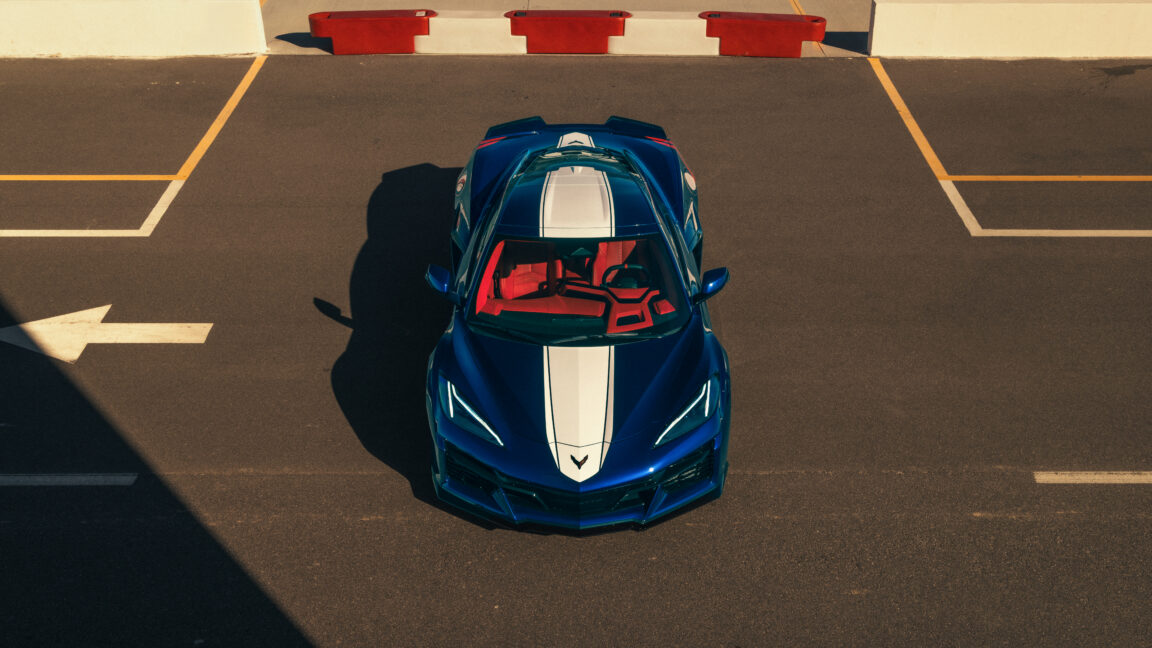
Credit: Chevrolet
Chevrolet has developed something of a modern tradition with recent generations of the Corvette: As a new generation approaches, the company rolls out the Grand Sport. It’s intended to be a sort of “sweet spot” version of the ’Vette, pairing the go-fast bits of the higher-spec machines with the entry-level motor found in the Stingray.
If that pattern holds, the mid-engined, eighth-generation Corvette may be nearing the end—because this is the new Grand Sport. This one, though, is different. It comes with an all-new V8 at its heart, one with substantially more power and torque than the current base Stingray. If that’s not enough, you can also get it with the ZR1X’s electric motor and battery. That model is called the Grand Sport X, and it’s the effective replacement for the first all-wheel-drive hybrid Corvette.
Yes, the E-Ray is dead, three years after Chevrolet raised eyebrows by putting a hybrid system where many said it didn’t belong. But you can’t argue with that system’s all-weather capability. It lives on in the new Grand Sport X, which pairs a 186-horsepower (139 kW) electric motor on the front axle with a new V8 at the rear.
Carbon ceramic brakes are an option, as is a front axle hybrid system.
Credit: Tim Stevens
New V8
The engine is called the LS6, and it’s a massive upgrade over the LT2 that powers the current base Stingrays. We’ll start with the most important numbers: 535 hp (399 kW) and 520 lb-ft of torque (705 Nm), coming from a 6.7 L V8. That’s 40 hp (30 kW) and 50 lb-ft (68 Nm) more power than the LT2, so much that Chevrolet says it’s the most torquey naturally aspirated production V8 on the planet.
A 13:1 compression ratio makes it the highest-compression small-block that Chevy has ever produced, up from the 12.5:1 in the current Z06.
That compression ratio is enabled by a number of tweaks, including better cooling around the valves and spark plugs and optimized direct injection. Mike Kociba, assistant chief engineer of small block engines at General Motors, told me that some extra processing power was key to unlocking that extra performance.
“With our newer controllers and control systems, you can process information faster. So, if you start to sense an issue, you can react to it faster,” Kociba said. The issue is a phenomenon called knock, in which combustion in the cylinders doesn’t happen at precisely the right time. When you’re talking about an engine spinning at 6,800 rpm, explosions occurring at the wrong time can have catastrophic effects.
The new LS6 engine.
Credit: Tim Stevens
Knock sensors are standard on every engine, but with the new LS6, Chevy’s engineers refined the system with a faster onboard engine controller called the E94. Using the same sensors as before, the extra processing power of the new controller means that the system can detect and react to knock more quickly, letting engineers push the envelope further on output.
“It’s still based on our knock sensors, which are vibration-based. So if you can start detecting an unusual vibration, if it meets a certain frequency profile, then we react to that,” Kociba said. The “new processors, faster speed… obviously helps us chew through the logic.”
That logic includes fast Fourier transforms and other algorithmic means of identifying specific wave patterns amid the overwhelming noise of a high-strung V8.
Kociba said this is still a discrete controller and not fully integrated into a broader software-defined vehicle platform. The company is starting to move that way, though. “That’s one more step on the journey to integrate and make the engine controls as agile as they can be… one step closer to what you’d consider a true software-defined vehicle,” he said.
The C7 Grand Sport was the pick of the bunch. Will the same hold true for the mid-engined ‘Vette?
Credit: Tim Stevens
The extra processor cycles and other tweaks make the new LS6 the most powerful base Corvette engine in the 70-plus-year history of the model, and yes, it will become the new base engine. While it’s debuting here on the new Grand Sport, base Stingrays from the 2027 model year onward will also get the LS6.
Differentiation
The Grand Sport, though, will differentiate itself with options like carbon ceramic brakes and a quad-center exhaust. You can also spec magnetorheological adaptive suspension and, perhaps most importantly, opt for the Grand Sport’s trademark colorful slashes across the fender. This time, though, those slashes are found behind the cockpit instead of the front, a not-so-subtle nod to the C8’s engine placement.
The fenders are wider than on the base Stingray, with the Grand Sport getting the same widebody treatment as the Z06, ZR1, and ZR1X. That makes for a much more menacing machine in person, which will help it stand out from the crowd on those crucial Cars & Coffee Sunday mornings. You can also spec out all the big wings and other aerodynamic appendages or keep it a little cleaner with a low, modest wing.
The Grand Sport also gets unique wheel designs, and, if you want something particularly loud, buyers of the Launch Edition model can select a lurid blue interior so bright that you’ll never suffer from drowsiness behind the wheel, regardless of the length of your road trip.
No word yet on how much any of those options will cost, or indeed the price of the Grand Sport or Grand Sport X. But we shouldn’t have to wait too long. Both of the new Grand Sports, along with the updated Stingrays and their new V8s, will hit dealers later this year.

-
 C114 Communication Network
 -
 Communication Home
