
 Search


Naturalcycles.com
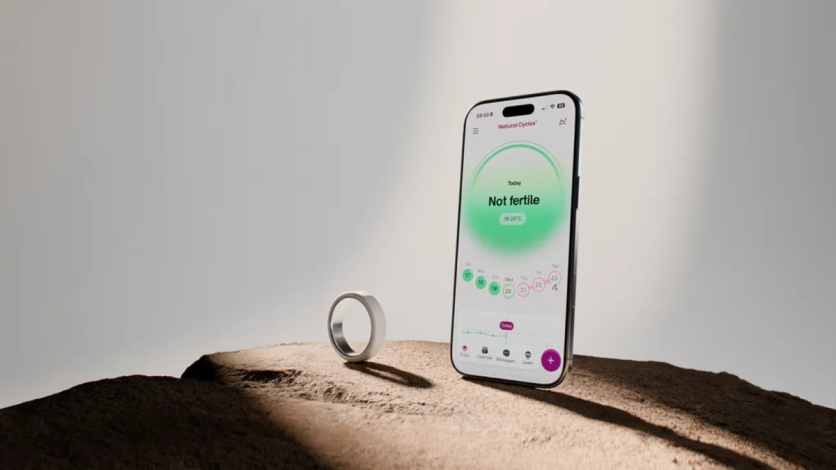
Natural Cycles launched the NC° Ring on Tuesday, a smart ring weighing as little as 1.9 grams (0.07 oz) that sends overnight finger temperature to its FDA-cleared birth control app, but the company has not listed the ring for the United States and has released no accuracy figures for the ring itself.
That gap matters because the app's contraceptive effectiveness figures, 93% with typical use and 98% with perfect use, describe the algorithm, and Natural Cycles ran validation work for the Oura Ring and Apple Watch, including an Apple Watch clinical evaluation and an Oura Ring validation study. Americans get a different device instead: NC° Band 2, a wrist wearable that includes the heart-rate sensor the ring lacks.
Natural Cycles reports more than six million registered users and says about 80% of its active users already measure temperature with a wearable. The ring comes at no extra cost with a new annual subscription until Dec. 31, 2026.
Ring Opens for Orders in UK, Europe, Canada and Australia While U.S. Gets NC° Band 2 Instead
Natural Cycles' own collection page lists the ring for the UK, Europe, Canada and Australia and marks it as not available in the United States, while NC° Band 2 is listed as U.S.-only. Orders for the ring opened Tuesday in Europe, Canada and Australia, and T3 reports UK orders and shipping are starting as well. The original NC° Band, which the company introduced in October 2025 alongside a perimenopause mode, remains available in the ring's markets.
Band 2 is 4 mm (0.16 in) thick, weighs about 9.9 grams (0.35 oz) with its strap and runs up to 21 days per charge, according to Natural Cycles. It measures temperature, heart rate and movement, is open for U.S. pre-order with shipping expected in December, and comes free with a new annual plan for a limited time. Eligible U.S. users can also get a 12-month subscription that includes a Band through insurance.
Natural Cycles has not said why the ring is not listed for the U.S. or whether it will arrive later. The launch releases also do not say whether the ring itself carries a clearance; the FDA, Health Canada, CE and MHRA statements in them describe the app rather than the ring.
Read more: 'Natural Cycles' App Gets FDA Approval for Tracking Menstrual Data, Birth Control via Wearable Tech
Is Natural Cycles Smart Ring Accurate? Oura Ring and Apple Watch Each Got Their Own Study
Natural Cycles says the app is equally effective with all compatible wearables. Its research pages, however, describe separate validation work for the Apple Watch, saying oral basal body temperature and wrist temperature are "two distinct physical quantities."
For the Oura Ring, participants wore the ring overnight and logged oral temperatures for four months, and the company says ovulation was confirmed in every case with both inputs; it does not state participant numbers. For the Apple Watch, 272 women contributed 505 complete cycles with ovulation-test results as the reference, and the FDA's 2023 summary reports 0.6 fewer non-fertile "green" luteal-phase days than an oral thermometer without a higher unintended-pregnancy risk. The same summary credits Oura input with 1.6 additional green days, so the two devices shifted the result in opposite directions.
Outside experts question how far such validation reaches. Jessica Walter, an ob-gyn at Northwestern who co-authored a 2024 review of 23 fertility-tracking wearables, told Scientific American the devices have been "validated in a very limited and specific patient population." Roisin Mortimer, a Harvard researcher with the Apple Women's Health Study, said thermometer methods have more scientific support than current wearables. Natural Cycles answers with an analysis of 83,000 wearable users and 125,000 oral-thermometer users across 1,566,000 cycles, which found the same 93% typical-use and 98% perfect-use effectiveness. That paper came from the company's research team, did not name the wearables, and was published in June 2026, before the ring launched, so it cannot speak to the ring.
Natural Cycles told Future Fem Health it runs clinical studies to check whether compatible wearables meet the accuracy requirements of its regulated method, but it gave no ring figures. Neither launch release cites a ring-specific study.
FDA Plan Lets Natural Cycles Add Wearables Without New 510(k) but Sets Numeric Thresholds
In a July 11, 2024 decision, the FDA cleared a Predetermined Change Control Plan for New Wearables as part of Natural Cycles' 510(k), meaning changes that stay inside the plan do not need a new premarket notification. A later FDA letter, K253694, lists the plan at version 4.4.
The public summary of the plan's acceptance criteria requires a new device to keep overnight temperature variability under a set ceiling, to detect ovulation with a lower confidence bound of at least 85.5%, and to produce no more than two additional red days per cycle compared with an oral thermometer. The summary does not state the study design or sample size, and it does not say which sensors a qualifying wearable must carry.
Unite.AI reported that the plan let the company launch its original Band, and that Garmin watches were added under it in March 2026. Natural Cycles' materials do not say whether the ring has been tested against those thresholds or why the U.S. listing is limited to Band 2.
Ring Skips Optical Heart-Rate Sensor That Oura Integration Used to Account for Elevated Heart Rate Nights
The app looks for a small, sustained shift: after ovulation, basal body temperature rises at least 0.2 °C (0.4 °F) and stays elevated for at least 72 hours. Oral readings capture core temperature at rest, while the ring measures distal skin temperature at the finger, which Natural Cycles says the literature supports as a good overnight indicator and which showed comparable day-to-day variation in its Oura study.
Heart rate has been part of that picture. A 2022 release announcing the Oura integration said the algorithm uses Oura heart-rate data to account for nights with elevated heart rates. The NC° Ring has temperature and movement sensors and, according to the release, measures during sleep without the lights that optical heart-rate sensors use.
Natural Cycles' how-it-works guide says readings can be excluded when they look less reliable because of illness, a hangover, unusual sleep patterns or too little overnight data, and that missing or excluded readings can lead to more red days, when the app advises protection. The guide does not say which sensors identify those nights, and the launch materials do not say how the ring flags them without heart rate.
Rings do have a measurement advantage. A study involving Oura's product found rings may capture wider temperature swings across a cycle than smartwatches or bands, which SRI International researchers suggested reflects larger blood-vessel changes in the fingers.
Read more: Evie Ring Women's Health Tracker: How This Smart Ring Monitors Your Cycle, Temperature & Sleep
Ring Costs Nothing Extra With New Annual Plan Until Dec. 31 but Standalone Price Stays Undisclosed
Natural Cycles' UK annual subscription costs £89.99 (roughly $120), and T3 reports new annual subscribers get the ring at no extra cost until Dec. 31. Neither launch release, nor T3 or Future Fem Health, states a standalone ring price or a subscription price for Canada, Australia or euro markets. Existing subscribers can buy a device at a discount through the NC° Shop in the app for a limited time.
For comparison, Oura's Natural Cycles partner page lists the Oura Membership at $5.99 per month, separate from the ring, and its sign-up page lists the Oura Ring starting at $349. Oura's own clinician guide lists Oura Ring 4 battery life at 5 to 8 days, against up to 14 days that Natural Cycles claims for the NC° Ring.
CEO Elina Berglund Scherwitzl, a physicist partly based at CERN, where she collaborated with the team that discovered the Higgs boson, co-founded Natural Cycles in 2013, told Future Fem Health the company wants to serve users who do not already own a third-party wearable. "Not everyone has an Oura Ring or an Apple Watch," she said, and she added that the hardware team has been challenged to bring manufacturing costs down. Natural Cycles' own analysis found 76% of wearable users still using the app after one year, versus 56% of oral-thermometer users, a gap that helps explain why a bundled device suits the company.
UK Ad Regulator Ruled Natural Cycles Facebook Ad Misleading in 2018
Accuracy claims have drawn scrutiny before. In August 2018 the UK Advertising Standards Authority ruled a Facebook ad misleading after complaints about claims that the app was a highly accurate contraceptive and a clinically tested alternative to birth control methods, and said the ad must not appear again in that form. Natural Cycles said it respected the outcome of the investigation.
Earlier that year, Södersjukhuset in Stockholm reported that 37 of 668 women who sought abortions between September and the end of 2017 had been using the app, and the hospital reported the app to Sweden's Medical Products Agency; Natural Cycles said it was in contact with the agency. The agency later closed its investigation in September 2018, concluding the rate was in line with the app's 93% typical-use effectiveness.
The app's FDA history began with a 2018 FDA authorization and now spans six clearances, the latest announced July 27, 2026 for a rebuilt algorithm. Unite.AI noted the company has not published how many extra green days the new model delivers or data showing effectiveness held after the rewrite.
Natural Cycles Disputes California Privacy Lawsuit as Ring Adds Optional Daytime Tracking
Worn overnight, the ring supplies the temperature reading the algorithm needs. Users who also wear it by day get activity data, and the app adds sleep insights, which the company describes as general wellness features separate from contraception.
A class action, Top Class Actions reported, was filed Dec. 4 by four anonymous plaintiffs in the U.S. District Court for the Northern District of California. The complaint alleges the app embedded third-party tracking tools, including Mixpanel, that transmitted reproductive health data, and claims violations of California privacy laws. Those claims are allegations that have not been decided by a court.
Natural Cycles' help page on data protection says a privately initiated California lawsuit challenges how its app uses analytics tools, that the claims misrepresent how the app works, and that data held by its analytics provider is not used for advertising. The company says it stores sensitive data in the European Economic Area as much as possible, anonymizes identifying data three years after a user stops using the service, and offers a Go Anonymous feature. Nicky Watson of Cassie told TechRadar that U.S. health-privacy law (HIPAA) covers only specific healthcare providers, so consumer cycle data typically falls outside it.
For U.S. readers, the choice is Band 2: pre-order, shipping expected in December, with heart rate included. Elsewhere, the NC° Ring is free with a new annual plan through Dec. 31, but the Natural Cycles smart ring arrives without the ring-specific accuracy evidence that the company published for the Oura Ring and Apple Watch, with no optical heart-rate sensor and no published method for flagging unreliable nights. Readers who plan to use it for birth control can ask Natural Cycles for ring-specific validation results first, and the company's guidance is to use protection on red days.
Currency conversions are approximate and based on exchange rates at the time of publication.
Frequently Asked Questions
Does the NC° Ring have the same 93% effectiveness as other wearables?
Natural Cycles says the 93% typical-use and 98% perfect-use figures hold regardless of which compatible device supplies temperature. Those figures are Pearl Index-style results, a measure that is hard to compare across study populations and study lengths. Neither launch release nor Future Fem Health points to a published ring study, so ring-specific confirmation is not yet available.
How does a finger ring read temperature differently from an oral thermometer?
An oral thermometer reads core temperature at rest, while the ring reads skin temperature at the finger. For the Apple Watch, Natural Cycles says the algorithm never mixes oral and watch temperatures and builds a new baseline, or coverline, when a user switches, which can mean more red days in the first cycle. The company has not said how that process works for the ring.
Is the NC° Ring itself FDA-cleared?
The launch releases describe clearances and licenses for the Natural Cycles app and say nothing about a separate clearance for the ring. As the Canadian release words it, Natural Cycles' technology holds six FDA clearances and regulatory authorizations across Canada, Europe, Brazil, Australia, Singapore and South Korea.
Is sleep tracking on the NC° Ring optional?
Yes. Natural Cycles says sleep and activity tracking are optional and separate from the contraceptive function. Berglund Scherwitzl told Future Fem Health the separation was deliberate because some postpartum users find sleep tracking stressful.

-
 C114 Communication Network
-
 Communication Home
