
 Search


Mntre.com
MNT Research, the Berlin maker of the open-source laptop MNT Reform Next, says it has shipped 40 units, about 21% of its crowdfunded orders, according to a post from MNT's @mntmn account that LinMob relayed in its November 15 weekly update. The first laptops left about a year after MNT's fall 2025 target, and the optional SSDs now hold half the capacity promised during the campaign.
OMG! Ubuntu reported on November 17 that 16 high-end Hyper configurations reached Crowd Supply in October and that 25 more were due in November. Notebookcheck says MNT sent its first two units in September as a customs and delivery test. OMG! Ubuntu says the units go to Crowd Supply, which hands backer orders to Mouser Electronics for distribution.
For backers, the practical questions are when a unit ships and what it contains. For new buyers, Notebookcheck says the $1,249 base model is open for preorder and ships January 29, 2027. Owners can also add a larger SSD of their own, because MNT added a full-size drive slot to offset the smaller factory options.
MNT Planned 90 Units for Its First Shipment and Counts 40 Shipped So Far
MNT's April 2026 update said the company was ordering the last parts for a first shipment of 90 units to Crowd Supply, with assembly starting in July. The first batch that went out in September held two units, according to MNT's September 2026 update. The October 2026 update scheduled a batch of 25 units for the beginning or middle of November and said both shop orders and backed Crowd Supply orders were behind schedule.
The @mntmn post says 24 Hyper units were packed for a customs check and shipment to Crowd Supply the next day, a step MNT counts as bringing its total to 40 shipped. That is one short of the 25 units MNT had projected, and the 16 earlier units match the October figure OMG! Ubuntu reports. The 21% figure comes from MNT's own post.
Delivery Target Slid From Fall 2025 to September 2026 on Battery, Firmware and Board Defects
The campaign opened December 27, 2024, and closed in early February 2025. MNT's April 2025 update called fall 2025 shipping a "realistic estimate."
The target then moved repeatedly. MNT's November 2025 update scheduled a small first shipment for February 2026, pending final validation of the battery packs. The January 2026 update said April. The March update said May. The July update said the end of August or the beginning of September, and the August update said September.
MNT's updates name specific causes. In October 2025, the remaining task was keyboard and system-controller firmware, especially the battery gauge. In September 2026, about half of the trackpad's button boards soldered incorrectly by the board house needed rework. In October, MNT said it fell behind on shop and Crowd Supply orders while finishing a new Quasar processor module to meet an NLnet donation deadline.
Read more: Laptop Shrinkflation Begins: Intel Panther Lake Hits 20%, Qualcomm 10%, as Spec Cuts Spread
Flash Memory Costs Forced MNT to Halve Its Optional SSD Sizes
The campaign promised 2 TB and 1 TB SSD options. In a March 27, 2026 update, MNT replaced them with 1 TB and 500 GB drives. MNT said prices for memory and storage had exploded as chip manufacturers de-prioritized the consumer PC market in favor of AI datacenter buildouts. It also said 32 GB of RAM for its RCORE processor modules was temporarily unavailable.
MNT had planned 2242-format drives at €50 (approximately $55 USD) for 1 TB and €95 (approximately $105 USD) for 2 TB. Keeping the original capacities would have put the project at least €33,500 over budget (approximately $36,871 USD), MNT said, and even the smaller drives cost about €5,000 (approximately $5,503 USD) more than planned. MNT told backers they could cancel their orders.
The market data points the same way. TrendForce's March 31, 2026 outlook projected NAND Flash contract prices would rise 70% to 75% from the prior quarter in the second quarter and said PC and smartphone vendors were "forced to reduce product capacities."
Campaign Page Warned That Component Price Rises Could Delay Production
The Crowd Supply campaign page lists component shortages and price increases among its risks: a sudden shortage or price rise could force MNT to re-engineer an affected circuit board and swap parts, delaying production. Reward-based crowdfunding pre-sells products without giving backers equity, and creators can be unable to deliver. Public design files do not change that exposure: MNT publishes its circuit diagrams and electronics source files, but the SSDs it sources sit in the same flash market TrendForce describes.
MNT does not attribute the delivery delay to storage prices. Its updates cite firmware, battery validation, defective trackpad boards and an NLnet deadline; the memory price spike shows up in its budget and its spec sheet.
Second M.2 Slot Lets Owners Add Their Own Drive, but microSD Express Slot Is Gone
M.2 drive names encode width and length in millimeters: a 2242 drive is 22 mm (0.87 in) wide and 42 mm (1.65 in) long, and a 2280 drive is 22 mm (0.87 in) wide and 80 mm (3.15 in) long. MNT's mainboard already had a 2230/2242 slot on the back; the March update added a full-size 2280 slot on top of the mainboard under the trackpad.
MNT says 2280 drives are more popular, more affordable and more available than the 2242 format, and the top-side slot is easier to reach. Owners can fit two SSDs, which MNT notes not many smaller laptops allow. The tradeoff is that the internal microSD Express slot was removed to make room, though a passive adapter card in one of the M.2 slots restores it.
The base model's only storage is 256 GB of eMMC, a flash package soldered to the board that cannot be removed or upgraded. Owners who want more space can fill an M.2 slot with an NVMe drive, the PCI Express storage interface most M.2 SSDs use.
What Does the MNT Reform Next Cost Now, and When Will New Orders Ship?
Crowd Supply lists the base model at $1,249 with 16 GB of RAM and 256 GB of eMMC, the Super at $1,549 with 32 GB and a 500 GB NVMe SSD, and the Hyper at $1,749 with 32 GB and a 1 TB NVMe SSD. Notebookcheck's December 2024 launch coverage listed the base model at $1,099 and the Hyper, then with a 2 TB SSD, at $1,599, so both tiers are now $150 higher, increases of 13.6% and 9.4%.
The sources disagree on availability. Notebookcheck says only the base model remains open for preorder, that orders placed now ship January 29, 2027, and that the Super and Hyper tiers are no longer available. As of November 17, the Crowd Supply page still lists all three tiers and does not state a shipping date, saying backers will be informed of delays through project updates.
AC adapters are not included; MNT sells an optional 65 W USB-C charger for $99. Laptop shipping is free within the US and $18 worldwide. MNT said in October 2025 that Crowd Supply would need to recapture tariffs from US customers before the first Reform Next shipment, without naming an amount. US buyers should confirm with Crowd Supply what applies to their order.
MNT's own shop will get the laptop only after Crowd Supply orders are filled, probably in 2027 and hopefully in the first half, MNT said.
Is the MNT Reform Next Fully Open? One RK3588 Boot Binary Stayed Closed as of 2024
MNT publishes circuit diagrams and electronics source files for the laptop, and OMG! Ubuntu says everything is open, down to the design files. Founder Lucie Hartmann told RESET in October 2025 that MNT uses the CERN-OHL license and protects only its trademark.
The processor is Rockchip's RK3588, and Rockchip is headquartered in Fuzhou, China. Collabora, which works on upstream Linux support for the chip, wrote in December 2024 that DDR memory training was the one closed-source binary left in the boot process. Open design files describe the board and the processor module, not the silicon or that firmware.
The project was partly funded by the NGI0 Entrust Fund, part of the European Commission's Next Generation Internet program, and NLnet lists the project among its NGI0 Entrust grants.
Qualcomm QCS8550 Module Is Compatible With Reform Next, MNT Says
The Reform Next uses MNT's swappable RCORE processor module with an eight-core RK3588, which pairs four Cortex-A76 and four Cortex-A55 cores with a Mali-G610 graphics processor. In its March 2026 update, MNT said it tested an in-development Qualcomm QCS8550 version of its Quasar module in the laptop to make sure future CPU modules work. The October update says that module is compatible with all MNT laptops, including the Reform Next, is due in MNT's shop in November 2026, is expensive and has a six-month lead time.
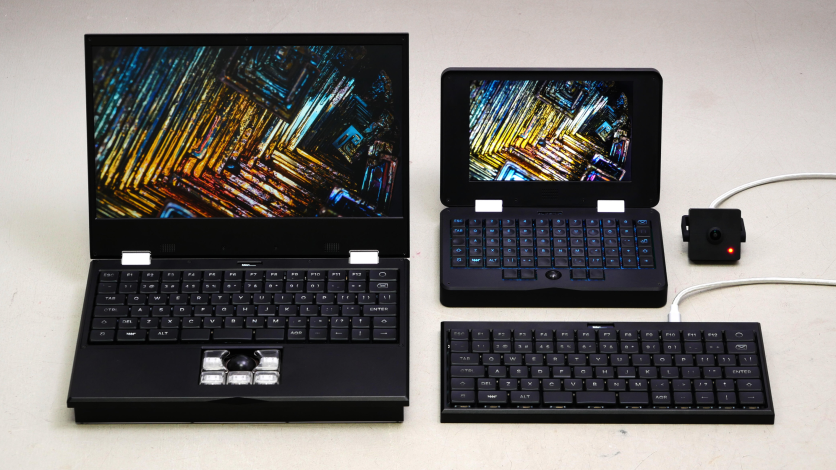
The laptop has a 12.5-inch 1080p display, a fanless chassis, Wi-Fi 5, Bluetooth 5.0 and Debian Linux, plus a mechanical keyboard with RGB backlighting. OMG! Ubuntu says it uses two removable battery packs with individually replaceable cells.
It weighs 1.6 kg (3.5 lbs), according to Notebookcheck's December 2024 launch coverage, which also described the RK3588 as "far less powerful than current-gen Intel and AMD processors." Crowd Supply's comparison table lists the Framework Laptop 13 at 1,300 g (2.9 lbs).
Backers should expect shipments to continue in batches, with MNT counting about 21% of crowdfunded units shipped so far. New buyers face a $1,249 base price, a January 29, 2027 ship date per Notebookcheck and a charger sold separately. Owners who want more storage than the factory drive offers can add their own M.2 drive, and the flash price spike that halved the SSD options is documented by TrendForce rather than unique to MNT. MNT said in March that backers could cancel.
Euro conversions use an exchange rate of 1 euro to $1.1006 as of November 17, 2026, and are approximate.
Frequently Asked Questions
Will every MNT Reform Next backer get a laptop on a published date?
MNT has not published a single date for all orders. Crowd Supply's campaign page states that backers will be informed of delays through project updates, and MNT said in October that it must fulfill all backed Crowd Supply orders before the laptop reaches its own shop.
Does open-source hardware protect a laptop from memory price increases?
No. MNT's design files are public, but MNT said keeping the original SSD sizes would have cost at least €33,500 (approximately $36,871 USD) more than budgeted, and TrendForce projected NAND contract prices up 70% to 75% in the second quarter of 2026.
Can I add my own SSD to the MNT Reform Next?
Yes. The mainboard has a full-size 2280 M.2 slot on top, under the trackpad, plus a 2230/2242 slot on the back, so owners can fit two SSDs; the internal microSD Express slot was removed to make room.
Is the MNT Reform Next fully open source hardware?
MNT publishes its circuit diagrams and electronics source files and says it uses the CERN-OHL license, but the processor is Rockchip's RK3588, and Collabora reported in December 2024 that its boot process still needed one closed DDR memory training binary.

-
 C114 Communication Network
-
 Communication Home
