
 Search


Anraga.pl
Aspen Fire Protection District in Colorado is training crews to fly Seneca's AI-assisted firefighting drones, but an FAA waiver granted in late October would let the department fly them only up to 200 feet in Pitkin County, away from populated areas, with a person watching the aircraft at all times. NPR reported on the training and those limits Nov. 10. For anyone who lives near wildland fuel, the practical takeaway is that the software is designed to calculate and aim a foam drop, while federal airspace rules currently limit how far crews can send the aircraft from where they stand.
Aspen Fire will pay about $2.5 million over five years, with private donors covering the bill. When the department officially launches the program, as early as 2027, it would be the first fire department in the world to operate the drones independently. NPR reports the drones have so far been used only on prescribed burns in California, with Seneca staff supporting the flights. NPR does not say whether the 200-foot limit refers to altitude or distance.
Seneca's AI Sensor Suite Calculates Distance, Wind Speed and Release Angle
Each Seneca aircraft measures roughly 10 by 12 feet, about the size of a small trailer, and the company designed the drones to work as a swarm. Hovering over a fire, an AI-supported sensor suite calculates distance and wind speed, then releases water or retardant at a specific angle and velocity, according to NPR. Seneca founder Stuart Landesberg compares it to a "flying Waymo".
Fox News reported in August that the aircraft combine onboard sensors, AI and computer vision to help find a fire, then can drop aerated Class A foam on a chosen spot. Landesberg says the drones have a range of 5 to 10 miles, and roughly double that when empty.
The engineering tradeoff is human supervision. Fox reported that the aircraft handle substantial parts of flight and targeting on their own, but the systems still operate under human supervision, and Seneca says a single pilot will oversee multiple aircraft in Aspen's deployment. For a reader, that means autonomy could reduce the number of pilots needed per fire, but the reports do not describe a system that dispatches and fights fires with no one involved.
Payload Figures From Seneca Drones Mix Gallons, Pounds and Foam Volume
NPR says a group of five drones can carry 500 to 1,000 gallons of finished fire foam, comparing the group to a small fire engine. Fox found that other published figures use different measures: Seneca's product page describes capacity by weight, between 500 and 1,000 pounds per trip for four to six drones, while Aspen deployment materials cite about 500 gallons of finished foam per sortie, and reports on a CAL FIRE test described both water carried by individual drones and foam volume after mixing. Fox cautioned that the figures should not be treated as interchangeable.
For scale, the U.S. Forest Service says airtankers can deliver up to 800 gallons of fire retardant in its single-engine class. Because water, retardant and finished foam are different measures, that comparison is approximate at best. Landesberg says the drones will not replace air tankers on big fires, and that they can carry tools, monitor fires and help extinguish lingering hot spots.
When a fire department or vendor cites capacity, ask which unit it is using. A gallon figure and a pound figure describe different things.
Why Do FAA Line-of-Sight Rules Limit Autonomous Firefighting Drones?
Under Aspen's waiver, firefighters cannot fly the drones over populated areas, and someone must keep eyes on them at all times. Crews cannot send a drone over a ridgeline without an observer on top of a mountain or on the other side communicating with the pilots. If the drones prove useful, Aspen Fire hopes to expand the waiver and help fight fires around the state.
A broader rule is still pending. The FAA sent its final Part 108 rule on routine beyond-visual-line-of-sight drone flights to the White House Office of Information and Regulatory Affairs on July 10, 2026. An FAA division said in September that it hopes to publish the rule before the end of the year, and Aviation International News reported Nov. 12 that the rule remains under White House review. Until it publishes, beyond-visual-line-of-sight flights still need existing FAA approvals, commonly a waiver.
That sets up the largest implication of the Aspen story, which NPR's report does not spell out. The selling point of an autonomous swarm is that one pilot can supervise several aircraft, but the waiver's spotter requirement ties each flight to terrain where observers can stand. Until Part 108 publishes or Aspen wins a broader waiver, a swarm's reach depends as much on where people can be posted as on what the aircraft can do.
Veteran Incident Commander Wants Wildfire Results, Not Prescribed-Burn Claims
Joe Stutler, a firefighter with nearly 60 years of experience who has served as an incident commander on wildfires for decades, is not affiliated with Aspen Fire or Seneca. He calls himself a big proponent of technology, says he would try the drones if he had access, and welcomes the chance to fight fires overnight when crewed aircraft are often grounded. But he says he has not seen any results and wants claims backed by data. He added that firefighters would still need to go on the ground, and that he has rarely seen even a 3,000-gallon water drop or a 5,000-gallon retardant drop put a fire out by itself. Stutler's remarks describe his own experience with crewed aircraft, not a test of Seneca's drones.
Landesberg says the drones can be the next best thing to helicopters at two orders of magnitude less cost. That is a company claim, and the reports reviewed here do not include independent cost data. Aspen's agreement covers a five-aircraft Seneca strike team and a mobile operations base.
Readers weighing Aspen's eventual results should also know about one relationship. Seneca's advisory board, as reported in October 2025, included Rick Balentine, who had recently retired as Aspen's fire chief, and Seneca's website now lists him as a firetech strategist. Aspen Fire is the department preparing to be first to operate the drones independently.
Dryad Launches Drones Automatically From Forest Gas Sensor Alerts
Seneca is not the only autonomous design. German company Dryad Networks was one of three finalists in XPRIZE's Autonomous Wildfire Response Track, tested near Nenana, Alaska, in June 2026. In September, Dryad said XPRIZE awarded it $800,000 for its finals performance and that it plans real-world pilots in 2027. Dryad's Silvanet system uses solar-powered sensors placed in forests to monitor combustion gases and particulates associated with the earliest stages of a fire. When Silvanet flags a possible fire, a Silvaguard observation drone can launch automatically and use infrared and optical imaging to find the source and confirm a real fire, and a separate suppression drone can then respond to the confirmed location. Dryad says that suppression drone carries up to 100 liters (26 gallons) of suppressant. The company also says a November 2025 demonstration detected a controlled fire and extinguished it in under 12 minutes without human involvement, a claim the reports reviewed here do not independently confirm.
The contrast with Seneca, as of Fox's August report, is where the machine gets its cue. Fox described Seneca's aircraft as designed to respond after crews identify a possible fire, while Dryad's design starts with sensors in the forest.
Rescue Drone Simulator: Second Chance Turns Wind and Payload Into Player Skills
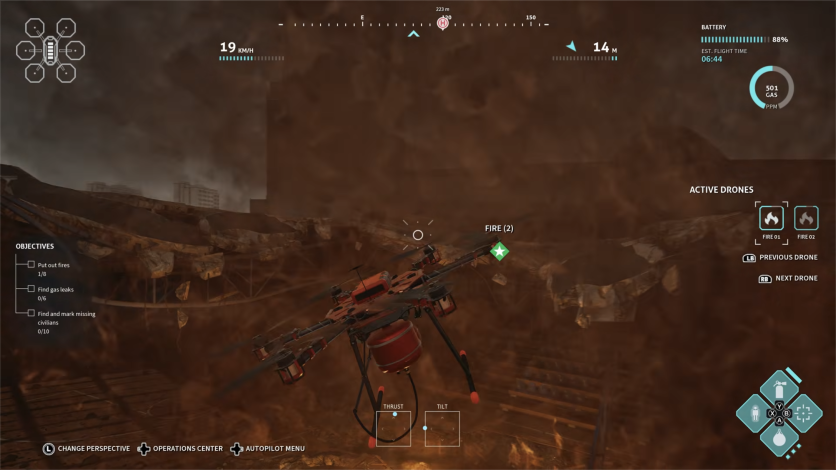
A video game is built around many of the same variables. The first gameplay trailer for Rescue Drone Simulator: Second Chance, unveiled by Anraga Studios and The Farm 51 in an Oct. 15 press release, opens with a rescue-and-firefighting operation on a burning Katowice map, shot from the drone's camera. A Firefighting Drone and a Medical Drone work side by side, and wind, smoke and payload weight affect every maneuver, according to the developers. In the game, the Firefighting Drone can put out fires with a powder extinguisher or water balloons. Players choose between a demanding Simulator mode and an assisted Arcade mode, and a workshop lets them swap components and immediately feel the difference in flight. Where Seneca's sensor suite calculates distance and wind speed, the game's Simulator mode asks the player to feel them through the controls.
The story gives that flying a human cost. Players join a newly formed crisis response unit made up of experienced specialists who, because of accidents, illness, age or traumatic experiences, no longer do their former jobs in the traditional way, and who use technology to return to rescue work. Game director Artur Fojcik, who wrote the story and whose earlier credits include Chernobylite and Get Even, says each character has lost something important and is trying to find a new role. The campaign spans 20 missions in four acts across five maps. It starts with rescue operations, but climate anomalies and infrastructure failures later add up to a larger crisis, according to the developers. The central tension is on the radio. The trailer layers in voices the team does not yet recognize, and the developers say not everyone on the frequency is on the player's side.
The tone is grounded rather than glossy. The game is set in the near future but, according to its developers, deliberately moves away from a sterile science-fiction look, drawing on analog electronics, physical control panels and industrial spaces of the 1980s and 1990s. One striking image is the Spodek, a 1971 arena in Katowice that locals call the Flying Saucer, engulfed in flames in the game's promotional art.
Rescue Drone Simulator: Second Chance is scheduled for the first quarter of 2027 on PC through Steam, PlayStation 5 and Xbox Series X|S, with Anraga Studios planning a simultaneous launch on all three platforms. The Farm 51, based in Gliwice, Poland, is the developer, and Anraga Studios of Warsaw is the publisher.
Phoenix Sends Drones to Some 911 Calls While Privacy Groups Raise Alarms
Drones are also reaching emergencies by a different route. On Nov. 10, Phoenix police and fire departments announced a joint Drone as a First Responder program that sends drones to qualifying emergency scenes before personnel arrive and streams live video to responding crews. Other Phoenix-area cities already run similar programs. TechSpot reported that such programs have spread rapidly across the country and that the Electronic Frontier Foundation has raised privacy concerns.
Aspen's drones and Phoenix's camera drones both depend on FAA permission, but they raise different questions. Aspen's is whether foam-carrying autonomous aircraft can fight real fires, and Phoenix's is how much aerial video police and fire departments collect and keep.
Three developments will show how far firefighting drones can go: whether Aspen publishes results from real incidents rather than prescribed burns, whether the FAA publishes Part 108, and whether vendors report payload in comparable units. Until then, the most useful question a resident can ask a local fire agency is simple: what has this system done on a live fire, and measured how?
Frequently Asked Questions
Can autonomous firefighting drones put out a wildfire on their own?
Not based on the reports reviewed here. Seneca's founder says the drones will not replace air tankers on big fires, the aircraft have flown prescribed burns rather than real wildfires, and Aspen's waiver requires eyes on them at all times.
How much fire foam can Seneca's drones carry?
It depends on the unit used. NPR reports 500 to 1,000 gallons of finished foam for five drones, while Seneca's product page, as described by Fox, uses pounds of suppression capacity per trip.
When will the FAA allow routine beyond-visual-line-of-sight drone flights?
No date has been announced. The FAA sent its final Part 108 rule to White House review on July 10, and an FAA division said in September it hopes to publish by year-end, but the rule was still under review Nov. 12.
When does Rescue Drone Simulator: Second Chance come out?
The developers have announced a first-quarter 2027 release on PC through Steam, PlayStation 5 and Xbox Series X|S, with no exact date yet.

-
 C114 Communication Network
-
 Communication Home
