
 Search


Silentangel.com
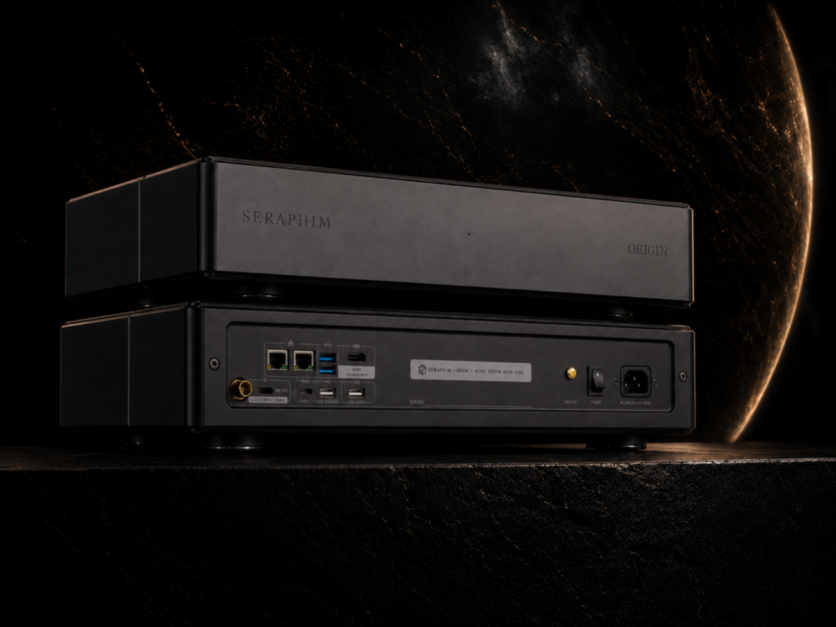
Silent Angel, the streaming-audio brand of Thunder Data Co., Ltd., a company based in Guangdong Province, China, has listed two of the six boxes in Seraphim, a playback system that splits source, endpoint, clock, network, power and grounding across six identical aluminum chassis, according to French outlet On-Mag's November 12 report.
Neither Silent Angel nor On-Mag gives a price, a ship date for the other four boxes or any measurements, and Silent Angel's page lists no dealers or prices, so the open question is which of the six jobs has a documented engineering rationale. Seraphim is also network-connected gear from a Chinese manufacturer, and no independent security audit of it was found.
Two Boxes Are Listed: Origin Music Server and Aura Roon-Only Endpoint
Silent Angel calls each box a wing. All six share one chassis measuring 436 × 255 × 70 mm (17.2 × 10.0 × 2.8 in), CNC-milled from aerospace-grade aluminum and finished in obsidian black or deep titanium gray, so the units stack into one tower.
Origin is the music server. On-Mag expects it to include a full Roon Core, but that is the outlet's inference, not a confirmed specification. On-Mag lists a USB Audio output for an external DAC, an HDMI output, a clock input, FPGA-based upsampling, a custom linear power supply and no front-panel controls. Silent Angel's page names flagship FPGA upsampling, an ultra-low-jitter architecture and a dedicated linear supply, without naming the chip or giving clock specifications.
Aura is the network endpoint. Silent Angel presents it as Roon-only, and On-Mag says it does not appear to run VitOS, Silent Angel's own software. The company's page lists I²S and AES/EBU outputs described as precision clocked; On-Mag adds coaxial, RCA and XLR outputs, a clock input and USB ports for local storage. The sales pitch for the pair is "Auditioned together. Sold together."
The listing is not new. Page metadata shows Silent Angel last updated the Seraphim page on August 12, three months before On-Mag's coverage. The page lists no dealers and directs buyers to request a private audition.
Roon Hands Timing Control to Receiver Clock, Narrowing Where Seraphim's Clock Can Matter
Roon's RAAT protocol puts the clock nearest the DAC in charge: that clock requests audio at the rate it needs, and Roon only estimates the device clock to keep its buffer filled, according to Brian Luczkiewicz in a Roon Labs community thread. The same thread says S/PDIF differs because the sender sets the clock, so RAAT's benefit ends at that link.
That points the clock debate at Aura's digital outputs rather than at Ethernet. I²S, introduced by Philips in 1986, carries clock on separate lines and was never intended for cabled links. AES3 instead encodes the clock and data together using biphase mark code. On-Mag lists a clock input on Aura, so a master clock would act at that digital-output boundary. Wikipedia's jitter entry notes that under some conditions less than a nanosecond of jitter can cut a converter with a 22 kHz Nyquist frequency to about 14 effective bits, and it gives no audibility threshold.
Switches sit upstream, where buffering can absorb timing variation. A dejitterizer stores the signal in an elastic buffer and releases it at the average incoming rate. Any benefit from a switch would more plausibly come from electrical noise reaching other components, which is the mechanism Silent Angel designer Chorus Chang points to for its Bonn switches, citing crosstalk between ports and noise passing from digital to analog circuits. Silent Angel says Nexus uses telecom-grade physical-layer isolation and a dedicated linear power supply, and publishes no specifications. Linear regulators avoid inductors and cause less electromagnetic interference than switching designs, but they waste the voltage difference as heat.
Do Audiophile Network Switches and Master Clocks Change Sound?
Public evidence is thin. Stereophile's review of Silent Angel's earlier Bonn NX switch reported no lab measurements; the reviewer wrote that an explanation can follow the listening, and he praised listeners who hear no difference without concluding such products are snake oil.
Wikipedia's audiophile entry summarizes the wider dispute: audiophile publications report differences that standard measurements and double-blind tests do not detect, while critics attribute them to placebo and confirmation bias.
Silent Angel has published no measurements for Seraphim, so Nadir's absolute black background claim and similar voicing claims remain unverified.
Silent Angel Already Sells Power Noise Reducer and Active Grounding Unit
Each of the four unreleased wings has a functional counterpart already on sale. Audio Art Cable lists the Forester FPC power noise reducer at $2,399 and the Forester FGC active grounding solution at $2,999. Best of High End covered the Forester FPC power reducer and Forester FGC active grounding on April 24, 2025. The same dealer lists the Genesis GX word clock at $3,999, the Bonn NX switch at $4,199 and the ZX Master Series Stack at $12,397.
Silent Angel's page frames Seraphim as a matched set auditioned and sold together, so what it adds is a shared enclosure and system-level pairing, while the functions already exist in separate products. Seraphim prices remain unpublished. For older products, Silent Angel's press release priced the entry-level Bonn N8 switch at $549 and the Munich M1T transporter at $1,099. The Rhein Z1 Plus server became available on March 15, 2023, with an MSRP starting at $3,199.
Four Wings Have No Dates and Aura Works Only With Roon
Pulsar (master clock), Nexus (switch), Quasar (power conditioner) and Nadir (active grounding) carry only a System completes label, with no dates or technical specifications. On-Mag adds that Quasar will use standard IEC inlets and that dedicated ground terminals are planned on the units. Silent Angel describes Nadir as using a proprietary alloy and what it calls active zero-potential simulation.
The complete system is not yet purchasable as listed. Aura's Roon-only design also narrows its use: Silent Angel's older Rhein Z1 Plus server supports Roon Bridge and HQPlayer NAA, while On-Mag describes Aura as Roon-only.
National Intelligence Law Article 7 Binds Silent Angel's Maker, and No Security Audit Was Found
Thunder Data's contact address in a High Fidelity review of the earlier Rhein Z1 lists Hengqin, Zhuhai, Guangdong Province, China, and labels the product "Made in China". 6moons likewise places Thunder Data in Zhuhai, and Stereophile calls Silent Angel a Chinese company. Silent Angel's Seraphim page does not say where Seraphim is built.
Three Chinese laws matter. China's National Intelligence Law, passed June 27, 2017, requires organizations and citizens to support and cooperate with national intelligence work under Article 7. The Data Security Law of 2021 requires cooperation when public security or national security organs need data for national security or crime investigations, after strict approval formalities, under Article 35. The Cybersecurity Law's Article 28 requires network operators to give technical support and assistance to public security and national security organs. These obligations apply to a company operating in China.
Scholars dispute the National Intelligence Law's reach. Jeremy Daum wrote in 2024 that the law leaves "intelligence" undefined and has no enforcement mechanism for the duty, yet concluded that a direct request from security agencies would be hard to resist; Gu Bin argues Article 7 does not authorize preemptive spying.
Aura is a network endpoint with USB ports for local storage, according to On-Mag. Nothing found shows what Origin or Aura transmit to Silent Angel. No independent security audit of Seraphim was found, which is a gap. On-Mag says Aura does not appear to run Silent Angel's VitOS software, so the data behavior of older products cannot be assumed to carry over.
Readers can limit exposure by placing Seraphim on a separate network segment, blocking outbound traffic the player does not need at the router and using a unique password for streaming accounts. None of these steps removes the legal obligation that applies to the manufacturer.
Read more: qdc Launches Gaming IEM With Onboard DSP Chip That Survives Locked-Down Tournament PCs
Buyers Can Verify Specs and Availability Today but Not Sound, Security or Price
What can be checked now is narrow: six identical chassis, two listed as available, four with no dates, and Roon-only Aura. What cannot be checked is Seraphim's price, the FPGA and clock specifications, whether Origin runs Roon Core, whether any box changes DAC output and what firmware sends off the home network. Standard engineering explains why a clock could matter at Aura's I²S and AES/EBU outputs, but audibility is contested and unmeasured for Seraphim. Chinese law on intelligence and data cooperation applies to the maker regardless of price or performance. A reader weighing Seraphim should wait for independent measurements, audition the system and isolate it on the network if they buy it.
Frequently Asked Questions
Does a separate master clock matter for network audio?
It depends on where the clock acts. In Roon's RAAT design the DAC-side clock sets the pace, so Ethernet timing does not drive playback. Links where the sender sets the clock, such as S/PDIF, are different, and I²S carries clock separately on its own lines. Whether any difference is audible is disputed.
Is Silent Angel a Chinese company, and does that affect my data?
Silent Angel is the brand of Thunder Data Co., Ltd., whose address in a High Fidelity review is in Zhuhai, Guangdong. China's National Intelligence Law, Data Security Law and Cybersecurity Law apply to companies operating in China, and no independent audit of Seraphim's data behavior was found.
What does FPGA upsampling in Origin actually do?
Upsampling raises a signal's sampling rate by calculating new samples from existing ones with an interpolation filter, and Wikipedia's entry does not address whether it adds information or is audible. Silent Angel's page has not named the FPGA or described its filter design.
Can Aura work with software other than Roon?
On-Mag describes Aura as a Roon-only endpoint, and Silent Angel's page calls it an isolated Roon-ready endpoint.

-
 C114 Communication Network
-
 Communication Home
