
 Search


Lucyd.co
Innovative Eyewear (LUCY Nasdaq listing) had already accomplished something notable before this morning's third-quarter results landed: the Miami company had generated more revenue in the first nine months of 2026 than it did in all of 2025. That story has not really changed with the Q3 filing — but the channel breakdown buried inside the 10-Q explains why the next two quarters may be significantly more interesting than the last thirteen.
Innovative Eyewear reported Q3 2026 net revenue of $1,009,696, a 51 percent increase over the same quarter last year and the company's highest single-quarter figure on record. For the nine months ended September 30, 2026, net revenue reached $2,793,776 — up 64 percent year-over-year and already past the company's full-year 2025 total of $2,661,669.
That thirteen-quarter streak of annual revenue growth is a credible data point. The more important number is one most investors will skim past: wholesale revenue climbed to $223,305 in Q3, up from $25,796 in Q3 2025 — a 765 percent increase. For a company that built its first four years almost entirely on direct-to-consumer sales through its own website and Amazon storefront, the third quarter of 2026 marks the first time a meaningfully different distribution architecture was running in parallel. That architecture is now live in four countries simultaneously.
Read more: Xiaomi Unveils Smart Audio Glasses with AI Camera, Live Translation, and 8-Hour Battery
How Lucyd's Smart Glasses Actually Work — and Why Camera-Free Is a Feature, Not a Limitation
Before the channel numbers make sense, the product itself needs a brief technical explanation, because Lucyd's design choices directly determine which markets it can enter and which it cannot.
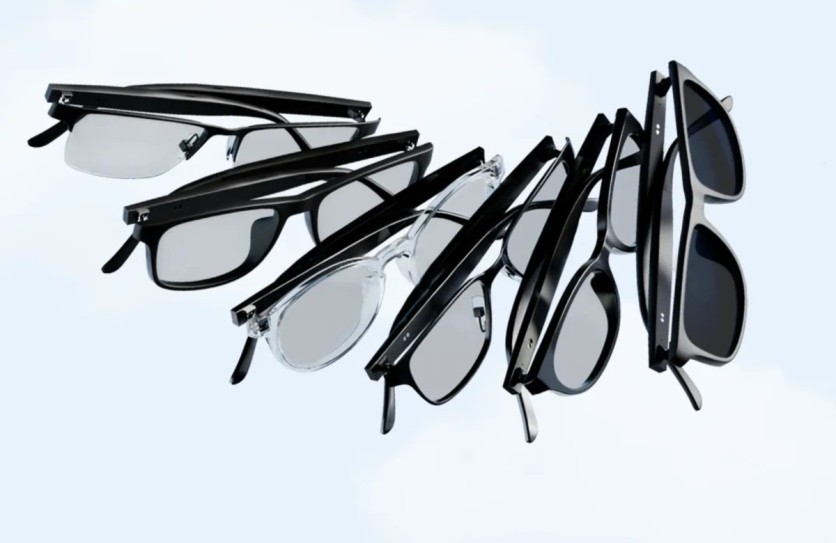
The company's Lucyd smart glasses lineup — sold under the Lucyd Lyte, Lucyd Armor, and Lucyd Aero product lines, with licensed frames under the Reebok brand — are audio-first wearables. They contain no camera. They look like ordinary prescription or non-prescription eyeglasses, with thin-film directional speakers built into the temples that project sound toward the ear canal without sealing it. That open-ear architecture keeps the wearer's environmental awareness intact — a critical requirement for the ANSI Z87.1 safety certification that makes the Lucyd Armor line viable in occupational settings where earbuds would be an OSHA violation.
The AI connectivity works through a companion smartphone app. The glasses themselves are Bluetooth audio input/output devices; the user's voice query is captured by integrated microphones, routed via Bluetooth to the Lucyd app on their paired phone, and processed by whichever large language model the user has configured — ChatGPT, Claude, or Gemini. The glasses are deliberately AI-agnostic, meaning the company does not depend on any single LLM provider's ecosystem. When one platform changes its API pricing, Lucyd's hardware is unaffected.
The absence of a camera is not a cost-cutting decision. It is the design choice that makes the ANSI certification possible, removes the smart-glasses product from the Ray-Ban privacy backlash in Germany that has followed Meta's Ray-Ban line, and simplifies the regulatory surface of the product to the point that it can be sold in optical clinics alongside standard corrective eyewear. No other major smart glasses brand has pursued this combination simultaneously.
Q3 2026 Results in Detail
The company's Q3 gross margin came in at 32 percent — below the 40-plus percent profile of a mature consumer hardware business, but up from prior quarters as the Lucyd Armor line, which carries higher margins, grew sharply. Lucyd Armor unit sales rose approximately 164 percent in Q3 to roughly 7,800 units, including approximately 2,300 units under an initial purchase order from an unnamed large U.S. big-box retailer. That retailer began in-store display installation at 150-plus locations in early November.
One financial note worth flagging for investors reading the 10-Q alongside this article: a preliminary earnings press release issued October 6 cited approximately $1.04 million in Q3 net revenue and approximately 55 percent growth. The final 10-Q figures — $1,009,696 and 51 percent — are slightly lower. This is a standard audit-process revision, not a restatement, and both sets of figures are internally consistent with the company's annual trajectory.
The company received tariff refunds of $124,854 in Q3, a one-time benefit related to Section 301 tariff exclusions on imported optical frames, which modestly improved the net loss to $2,287,141, or $(0.27) per diluted share. Innovative Eyewear is not profitable — it is still investing heavily in sales infrastructure, retail fixtures, and product development — but the operating loss has narrowed as a percentage of revenue over the past six quarters.
Four Distribution Channels, Three of Them New
The DTC-to-wholesale transition is actually three separate deals activating in the same quarter:
United States — big-box retail. An unnamed large U.S. big-box retailer received an initial Lucyd Armor purchase order in September, with store displays installed starting November 1 across 150-plus locations. The retailer has not been named in any public filing.
Canada — optical clinics. FYihealth Group, the operator of the FYidoctors, Visique, and Solis optical clinic networks, confirmed placement across 345 Canadian clinics beginning in Q3. This is an unusually direct route to prescription eyewear customers, the population most likely to pay a premium for smart frames they can have fitted with corrective lenses.
Australia and New Zealand. Directed Electronics, an Australian consumer electronics distributor operating across the AU/NZ market, placed initial orders in September. The relationship opened markets Innovative Eyewear had no prior distribution footprint in.
HTC VIVE. Under a separate strategic alliance, HTC VIVE Eagle camera glasses are now available on Lucyd.co — an unusual arrangement that pairs Lucyd's camera-free audio glasses with a camera-equipped competitor's hardware on the same storefront, covering different customer privacy preferences.
The Market the Company Is Entering
For context on the market timing: Counterpoint Research AI glasses data shows global smart glasses shipments grew 263 percent year-over-year in the first half of 2026. Display-less, audio-first models account for approximately 96 percent of all AI glasses shipments — the category Lucyd competes in directly. Meta, through its Ray-Ban collaboration with EssilorLuxottica, holds an estimated 84 to 94 percent of that display-less segment, depending on which analyst's methodology you use. EssilorLuxottica's CEO Francesco Milleri cited more than 7 million AI glasses sold in 2025.
Lucyd's position in that market is best described as a niche within a niche: ANSI-certified safety eyewear, optical-clinic-compatible frames, and AI-agnostic connectivity — the combination of which no competitor currently offers at scale. It is a small share of a fast-growing category, served through channels Meta has historically not pursued.
Products: What Is Coming
The company launched the Lucyd Aero in October 2026 at $149, introducing a new frame line to its portfolio. Upgraded Lucyd Armor models are targeted for H1 2027.
The Reebok Smart Eyewear line — Lucyd's licensed sport and lifestyle frame collection — earned TIME Best Inventions 2026 recognition in the Sports & Fitness category, announced October 20. The recognition was cited by the company as a marketing asset for the ongoing big-box retail rollout. The company also received the Lucyd Armor Red Dot Award for the Lucyd Armor smart safety glasses, an international design recognition announced earlier this year.
Investor Considerations
Innovative Eyewear is a micro-cap; LUCY shares traded in the $0.86–$0.89 range in the days preceding this filing. Maxim Group downgraded the stock to Hold in June 2026. The company has a history of equity raises to fund operations, and it remains unprofitable. For retail investors, the Q3 results represent a genuine inflection point in the company's distribution story — but Q4 2026, the first full quarter with big-box retail, optical clinic networks, and international distribution all running simultaneously, will be the first real test of whether the channel strategy translates into durable margin expansion.
The smart glasses market grew 263 percent in H1 2026 with Meta capturing the overwhelming majority of that growth. What Lucyd is testing is whether the slice of that market that cannot or will not use a camera-equipped device — industrial workers, privacy-conscious consumers, optical clinic customers — is large enough to build a viable business around. The Q4 results, expected in mid-February 2027, will begin to answer that question.
Key Numbers at a Glance
| Metric | Q3 2026 | Q3 2025 | Change |
|---|---|---|---|
Net Revenue | $1,009,696 | ~$668,000 | +51% |
Wholesale Revenue | $223,305 | $25,796 | +765% |
Gross Margin | 32% | ~28% | +~4 pts |
Net Loss | $(2,287,141) | — | — |
Loss Per Share | $(0.27) | — | — |
9-Month Revenue | $2,793,776 | — | +64% YoY |
Lucyd Armor Units | ~7,800 | ~2,955 | +164% |
All figures from Innovative Eyewear Form 10-Q for the quarter ended September 30, 2026.
Frequently Asked Questions
What are Lucyd smart glasses?
Lucyd glasses are audio-first smart eyewear made by Miami-based Innovative Eyewear (Nasdaq: LUCY). They look like ordinary eyeglasses and contain no camera — only Bluetooth speakers in the temples, microphones, and a companion app that connects to AI assistants including ChatGPT, Claude, and Gemini.
Where can I buy Lucyd glasses?
As of November 2026, Lucyd products are available on the Lucyd official website, Amazon, at 150-plus big-box retail locations (retailer not yet publicly named), 345 FYidoctors and affiliated optical clinics in Canada, and through Directed Electronics in Australia and New Zealand.
How are Lucyd glasses different from Meta Ray-Ban smart glasses?
The primary differences: Lucyd glasses have no camera; Meta's Ray-Ban does. Lucyd glasses are ANSI Z87.1 certified for occupational safety use; Meta's are not. Lucyd's AI connectivity works with multiple LLM providers; Meta's glasses are integrated specifically with Meta AI.
Is LUCY stock a buy?
TechTimes does not provide investment advice. Maxim Group holds a Hold rating as of June 2026. The company is not yet profitable and has previously raised equity to fund operations. Investors should consult their own financial advisors.

-
 C114 Communication Network
-
 Communication Home
