
 Search


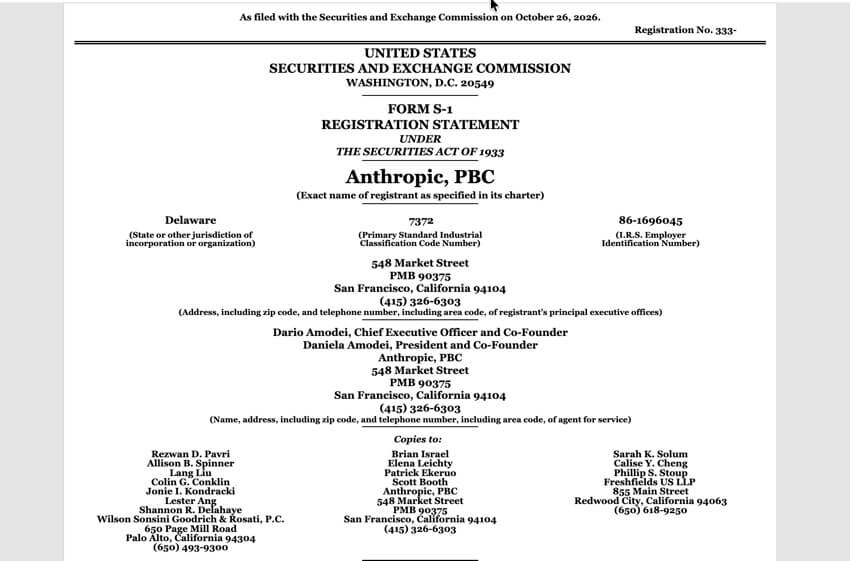
Anthropic’s newly filed Form S-1 provides a detailed view of the physical infrastructure supporting Claude. Beyond the financial disclosures, the document describes an expanding compute strategy that combines hyperscale cloud services with dedicated accelerator capacity, creating growing requirements for data centers, power systems, semiconductors and high-capacity networks.
The infrastructure story is particularly significant because Anthropic is not committing to a single chip architecture. Its operating model spans AWS Trainium, Google TPUs, NVIDIA GPUs and AMD GPUs, with capacity coordinated across providers. The S-1 also details approximately $161.2 billion in equipment lease payments associated with Broadcom-supplied TPU hardware over five years, excluding interest.
For networking and data center suppliers, the filing points to a multiyear buildout in which facility commissioning, grid connections, thermal management and inter-data-center connectivity matter alongside the availability of AI accelerators. It does not, however, provide a definitive fiber-mileage forecast, optical transceiver procurement plan or annual megawatt deployment schedule.
| Key Infrastructure Findings | |
| • Filing | Anthropic Form S-1, filed October 26, 2026. |
| • Compute strategy | A mix of cloud infrastructure and dedicated accelerator leases, managed as a shared capacity pool. |
| • Semiconductors | AWS Trainium, Google TPUs, NVIDIA GPUs and AMD GPUs; hardware diversity reduces dependence on one architecture. |
| • TPU commitments | Approximately $161.2 billion in five-year equipment lease payments tied to Broadcom-supplied TPU infrastructure, excluding interest. |
| • Facilities | Dedicated data centers alongside hyperscale cloud capacity; power, cooling and inter-facility networking are essential constraints. |
| • Primary source | Read Anthropic’s SEC Form S-1 |
Data Centers: From Cloud Capacity to Dedicated Facilities
Anthropic describes a hybrid infrastructure model that draws on cloud-provider resources and leased accelerators installed in dedicated data centers. This approach expands the range of infrastructure dependencies: securing suitable sites, energizing new capacity, installing high-density computing equipment and connecting facilities to the wider network.
The company has separately announced a $50 billion investment program for American AI infrastructure, including projects in Texas and New York with Fluidstack. Those announced plans should be distinguished from contractual commitments and accounting disclosures in the S-1.
Semiconductors: A Diversified Accelerator Roadmap
Anthropic’s multi-platform strategy spans Amazon Trainium, Google’s tensor processing units, and GPUs from NVIDIA and AMD. Supporting several accelerator families introduces software portability and orchestration requirements, but it also allows the company to procure compute across different supply chains.
A major S-1 disclosure is approximately $161.2 billion in five-year payments for leased TPU equipment supplied through Broadcom-related arrangements, excluding interest. Some capacity is expected to become operational in 2026, with additional deployments in 2027. This is a contractual payment figure, not a projection of annual semiconductor revenue or the full cost of all Anthropic infrastructure.
Power, Cooling and Networking
Accelerator installations are only useful once sufficient electricity, cooling and data-center networking are available. Anthropic identifies power availability, grid constraints, cooling and network connectivity among the dependencies affecting capacity deployment. Its geographically distributed infrastructure also creates demand for reliable, high-bandwidth connections among computing locations.
The S-1 does not quantify optical transceiver volumes, specify Ethernet or InfiniBand port counts, or identify dedicated long-haul fiber routes. Those are potential supplier opportunities inferred from the scale of the buildout, not disclosed purchase orders.
Infrastructure Outlook: 2026–2031
2026–2027: Near-term emphasis is on bringing already contracted compute into service, including initial TPU equipment deployments, Trainium expansion and dedicated data-center capacity. Anthropic and AWS have separately described a broader compute expansion of more than $100 billion over ten years and up to 5 GW of eventual infrastructure capacity. These are announced plans rather than a guaranteed annual commissioning schedule.
2028–2029: The multiyear lease and infrastructure agreements indicate continued financial exposure to accelerator and facility deployments. The precise allocation among chip platforms, sites and years is not disclosed, so any specific annual MW, GPU or fiber forecast would be speculative.
2030–2031: The infrastructure outlook depends on renewal and expansion decisions, model demand, electricity availability and hardware economics. The S-1 does not establish a company-endorsed 2031 capacity target. Investors and infrastructure suppliers will need to track subsequent filings for actual utilization, capital commitments and commissioning milestones.
Analysis
Anthropic’s filing makes clear that competition in advanced AI models also involves the ability to secure and operate physical compute capacity. For the semiconductor sector, the noteworthy feature is architectural diversity across Trainium, TPUs and GPUs. For data-center operators, the relevant bottlenecks include energy, cooling and deployment timelines. For optical and networking vendors, distributed AI capacity creates a plausible long-term demand driver, although the filing does not provide enough detail to translate that demand into specific equipment forecasts.
| Company Profile | Anthropic | |
| Company | Anthropic PBC |
| Headquarters | San Francisco, California |
| Leadership | Dario Amodei, co-founder and CEO |
| Products | Claude family of AI models and associated developer and enterprise services |
| Infrastructure | AWS Trainium, Google TPUs, NVIDIA and AMD GPUs; cloud services and leased dedicated facilities |
| Strategic focus | Scaling AI training and inference capacity while managing chip supply, electricity, cooling and network connectivity |
We’re tracking AI infrastructure, data centers, semiconductors and networking developments at Converge Digest.
Source: Anthropic, Form S-1, filed October 26, 2026. Read the full SEC filing.

-
 C114 Communication Network
-
 Communication Home
