
 Search


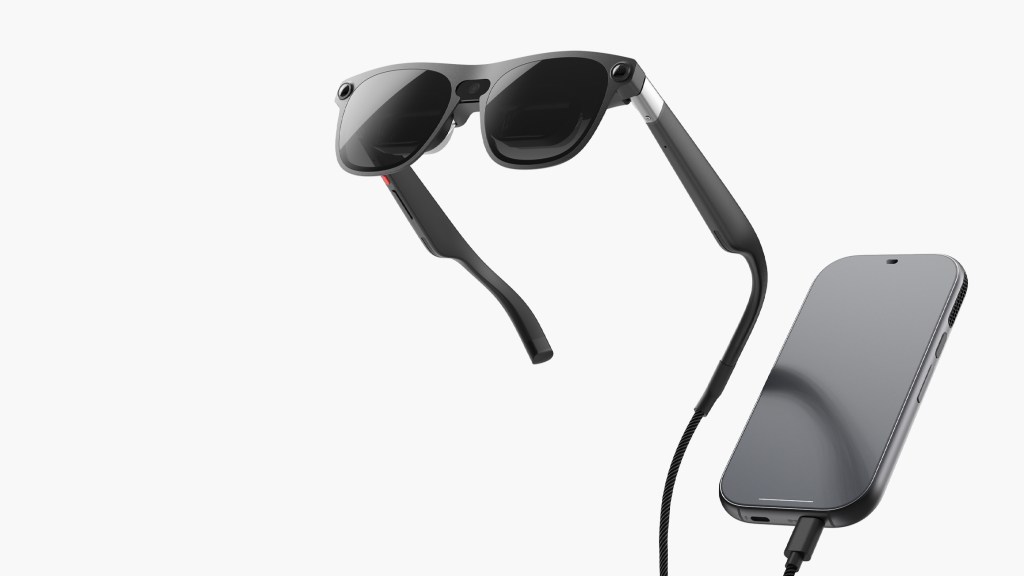
Image Credits:Xreal
At the Android Developer Summit on Wednesday, Google’s smart glasses partner Xreal launched its new Xreal Aura wired smart glasses, powered by the Android XR and Qualcomm’s Snapdragon Reality Elite platforms. The companies had teased the glasses earlier in the year at Google’s I/O developer conference.
As Meta expands its push into smart glasses, competitors like Apple and Google are keen to release their own devices. Much like it did with Android smartphones, Google is relying on an assortment of partners, including Samsung and Xreal, to bring devices powered by its Android XR platform to consumers.
The new Xreal Aura smart glasses are tethered to a smartphone-like device for processing power, rather than handling all the computing themselves. The glasses then display the content in the wearer’s field of view.
The device’s design, meanwhile, is closer to Meta’s smart glasses than Apple’s Vision Pro, which is a larger headset.
Xreal Aura uses Sony’s Micro-OLED display with 1200p resolution at 120Hz and a 95-degree field of view — screen specs that put the glasses above the Ray-Ban Meta Display on paper. However, Xreal’s smart glasses are heavier at 95 grams compared to Meta’s 69 grams, and you have to carry the puck.
At launch, the Aura supports many popular Google Play apps and games along with specific XR experiences, including NBA App for Android XR, Nevatars, Fallout: Factions, Project Hail Mary: Journey Among the Stars, NASCAR XR App, and San Francisco Ballet Company’s The Nutcracker.
Users can opt to plug a computer or handheld gaming console directly into the Xreal Aura via USB-C to make it an augmented display. The device can also allow for various entertainment and productivity use cases by spinning up a multi-monitor setup or a big virtual screen.
For audio, the Xreal Aura uses Bose’s tech to power its sound while watching videos or listening to music.
Given that the new smart glasses are powered by Android XR, Gemini is available to users as a Q&A assistant and can help users to understand on-screen context.
The Xreal Aura is available to order starting today in the United States, Canada, Japan, and
South Korea. The 12GB + 256GB version costs $1,279 with a limited launch price of $1,099 through December, and the 16GB + 512GB version is priced at $1,499 with a launch price of $1,299 through December. The company said it will start shipping by Mid-November.
In May, Xreal CEO Chi Xu told TechCrunch that building a smart glass business is hard and everyone is losing money. He also said that the Aura glasses will have a wide range of use cases, and the industry has reached an inflection point of having the right hardware, software, and design smart glasses to reach scale.
“You need all the key pieces ready — you need the hardware ready, the operating system needs to be ready, and then you need a great user interface,” Xu said at that time.

-
 C114 Communication Network
-
 Communication Home
