
 Search

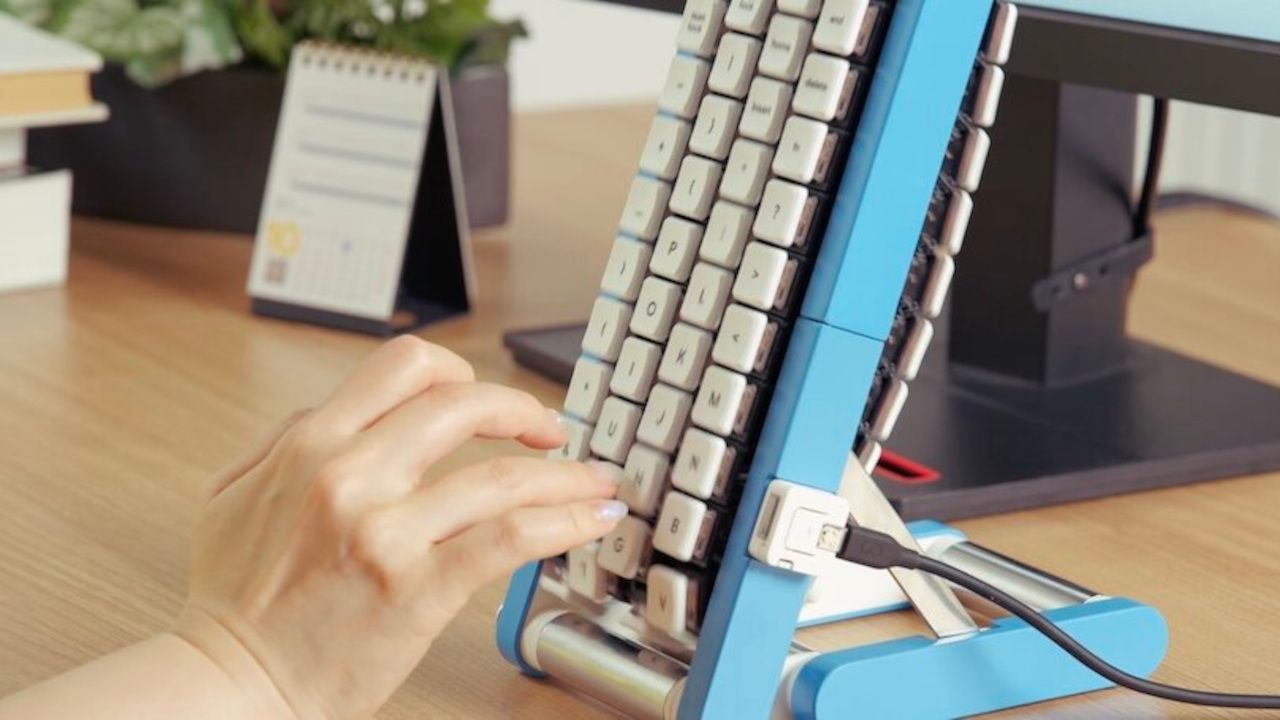
(Image credit: Google Japan)
I want one. Actually, I'm not sure I do. Google Japan has come up with a genuinely whacky keyboard where the keys move towards your fingers, rather than making you move your fingers towards the keys.
That's where the Gboard Kurukuru Version comes in. Created by Google's Gboard team in Japan, it's a physical keyboard built around four conveyor belts, with 29 keys running along each one.
So, instead of reaching across a normal keyboard to find the letter you want, you wait for it to come to you and press it as it passes underneath your finger.
The idea is to make one-handed typing easier. Google says conventional keyboards are designed around using both hands, which means typing with one hand or a single finger can involve moving your arm and hand around quite a lot. With Kurukuru, the keyboard does the moving for you.
It might actually be useful
There is, admittedly, something ridiculous about waiting for a key to trundle towards you before you can type it. But the basic idea isn't quite as daft as it first sounds.
The four belts contain 116 keys in total, and each one keeps rotating so the characters continually pass beneath your fingers. You can keep your hand in roughly the same position and simply press the key you need when it arrives.
Google says it's looking at possible future versions, too, including a high-speed mode, different colours, a longer version with more characters and a shorter version that's easier to carry around.
The problem is that this is very clearly not a product Google is planning to sell. It's part of Google Japan's long-running tradition of making deliberately strange physical keyboards, with this year's version being the 15th in the series.
The good news is that you can actually build this one yourself. Google has released the designs as an open-source project, including the files needed to 3D-print the parts and build the keyboard.
So, if you have the time, the tools and a slightly worrying amount of enthusiasm for unusual keyboards, there's nothing stopping you from making your own.
Would it actually be faster than a normal keyboard? Almost certainly not. Yet, annoyingly, I quite like the idea.

-
 C114 Communication Network
 -
 Communication Home
