
 Search

Theo Wargo/gettyimages.com
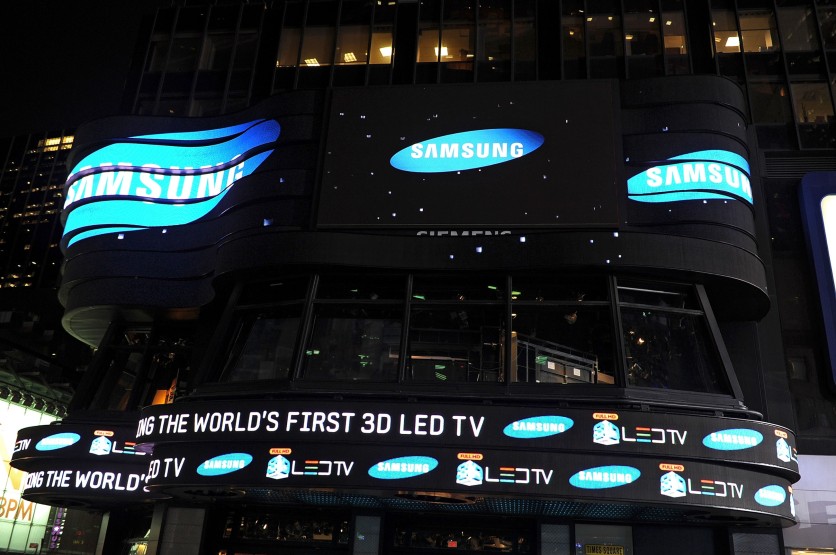
Samsung confirmed on September 8 that it has been running a coordinated global outdoor advertising campaign called "Welcome to Foldables" since September 2, featuring its Galaxy Z Fold 8 series across six landmark digital screens in four cities — including Times Square in New York, which Samsung's press materials did not specifically name but which multiple independent sources confirm as the sixth location. The campaign's announcement falls one day before Apple is scheduled to reveal its first-ever foldable smartphone at the "Surprise and Shine" event on September 9 — the first major product keynote under new Apple CEO John Ternus, who officially succeeded Tim Cook on September 1.
Samsung's Six Screens: What the Venue Map Actually Signals
The six locations are KT Square in Gwanghwamun, Seoul; COEX K-POP LIVE in Seoul; Shibuya Station in Tokyo; Piccadilly Circus in London; Outernet London; and Times Square in New York. Samsung's September 8 campaign announcement named the first five explicitly; Times Square was separately confirmed by independent coverage.
That list is not a random sampling of large screens. It maps directly onto the markets where Apple's foldable arrival poses the greatest competitive threat to Samsung's seven-year reign in the category. Piccadilly Circus and Outernet London sit in Europe's most competitive premium foldable market — the same city where Samsung staged Galaxy Unpacked on July 22 specifically to place its devices on retail shelves before Apple's September announcement. Shibuya Station reaches Tokyo, where Google's Pixel recently overtook Samsung in Japan as the top-selling smartphone brand. Times Square is the geographic and symbolic center of the American premium technology market. And Seoul's two locations — KT Square in Gwanghwamun and the K-POP LIVE screen at COEX — anchor the campaign in Samsung's home territory, where the Galaxy Z Fold 8 series broke Galaxy smartphone pre-order records.
There is a secondary logic to these choices that goes beyond foot traffic. Piccadilly Circus, Times Square, and Shibuya Station are among the most photographed and social-media-shared public advertising spaces on the planet — spaces where an ad buy generates earned media coverage worth a multiple of its direct reach. A campaign on these screens is not primarily talking to the people walking past. It is talking to the journalists and reviewers writing Apple event preview coverage over the next 24 hours, placing Samsung's brand story in their peripheral vision before Apple takes the stage.
The three rotating taglines — "Ultra Thin," "The world's lightest fold," and "Built to outlast" — are calibrated to the specific claims Apple is expected to contest at tomorrow's event. Apple's foldable device, expected to carry the name iPhone Ultra, is reportedly targeting a near-crease-free inner display through a Liquidmetal alloy hinge approximately 2.5 times harder than titanium. Samsung's taglines are pre-emptive answers to a device specification sheet that has not yet been officially published.
Read more: Samsung Needed Japanese Partner to Build Galaxy Z Fold 8 Flex Titanium, and It Nearly Didn't Work
What Samsung's Taglines Actually Mean
"The world's lightest fold" is a verified specification. The standard Galaxy Z Fold 8 weighs 201 grams (7.1 oz), confirmed as the lightest book-style foldable available at commercial launch. The Fold 8 Ultra, the premium sibling, weighs 215 grams (7.6 oz) and starts at $2,099 for the base configuration — also confirmed by Samsung's US storefront.
"Ultra Thin" references the Fold 8's unfolded thickness of 4.5 mm (0.18 in), achieved through the company's Flex Titanium display architecture, in which a precision-rolled titanium-vanadium-aluminum-chromium alloy film approximately one-third the thickness of a human hair — developed with a Japanese partner — replaces the polymer film that had caused the foldable crease to deepen in prior Galaxy Fold generations. The standard Galaxy Z Fold 8 starts at $1,899 for the 256GB configuration.
"Built to outlast" covers two engineering commitments. First, Samsung's promise of seven years of software updates — the longest in its Android foldable lineup. Second, the structural rationale of the Flex Titanium display, whose titanium foil provides approximately 20 times the mechanical stiffness of the polymer it replaced, slowing the progressive deepening of the crease that users of earlier Fold generations experienced over months of daily folding. The trade-off: the silicon-carbon batteries inside the Fold 8 series are rated at approximately 1,200 charge cycles before reaching 80 percent of their original capacity — compared to roughly 2,000 cycles for the graphite anodes in the Galaxy Z Fold 7 — meaning a daily charger can expect noticeable capacity decline in about 3.3 years rather than the prior generation's roughly 5.5 years. Tom's Guide battery testing confirmed the Fold 8 Ultra achieved 14 hours and 9 minutes of screen-on endurance, a 32 percent improvement over the Fold 7 — a real-world validation of the new chemistry's capacity gains.
Samsung in Foldables: Eight Generations of Lead Time
The "Welcome to Foldables" campaign explicitly frames Samsung's lineage as its primary competitive asset. Samsung introduced the first commercially available book-style foldable smartphone in 2019 with the original Galaxy Fold. Eight generations of iteration produced the Flex Titanium display architecture, the passport-orientation 4:3 aspect ratio inner display of the standard Fold 8, and a 106-market distribution footprint.
The Fold 8 series has already set a record for Galaxy smartphone pre-orders in South Korea. According to Counterpoint Research, Samsung's global smartphone sales had spent much of Q2 and early Q3 2026 below the prior-year baseline, but the Fold 8 and Flip 8 launches reversed Samsung's months-long sales decline in consecutive weeks after availability began on August 7.
Samsung's campaign framing — "We think it is more than welcome — because when other competitors join the market, the market will expand and awareness will increase" — was first articulated by Samsung Electronics Executive Vice President Byung-Duk Yang at a July 15, 2026 display press day and attributed in the Tokyo roundtable context to the Apple question specifically. The campaign's official language from Samsung's September 8 press release echoes that framing: Samsung's official statement reads: "'Welcome to Foldables' is both a welcome to that next chapter and a reminder of the generations of experience that helped bring the category here."
Samsung vs. Apple: A Marketing Rivalry With a Long Memory
The welcoming tone of the "Welcome to Foldables" campaign represents a calculated departure from Samsung's historical playbook when Apple launched major new products. In 2011, Samsung ran television advertisements featuring Galaxy S II owners near Apple store queues for the iPhone 4S, comparing specs and mocking the wait — a campaign that Apple's own marketing chief Phil Schiller later testified internally caused serious concern at Cupertino. In 2012, Samsung published full-page newspaper advertisements during the iPhone 5 launch weekend under the tagline "It doesn't take a genius," running a feature-by-feature comparison that cast the iPhone 5 as a modest upgrade.
The 2026 campaign is subtler — it celebrates Samsung's own journey rather than targeting Apple's shortcomings — but the underlying competitive logic is identical: own the public conversation in the 24 hours around an Apple product announcement. The difference is that Samsung now occupies a defensible position. It invented the commercial foldable category. Apple is the entrant, and Samsung is the incumbent.
What the Market Numbers Mean for the Buyer
The foldable smartphone segment is growing rapidly but remains small by absolute volume. Counterpoint Research's July 2026 forecast projected global foldable shipments would grow 21 percent year-over-year in 2026, with total lifetime shipments on track to reach a 100 million cumulative unit milestone by year-end. Counterpoint's August 2026 update revised Samsung's projected share upward to 38 percent — down from 40 percent in 2025 — as Apple enters with a projected 25 percent share in its debut year, enough to rank second globally.
IDC's December 2025 forecast, updated in 2026, projects that Apple will command approximately 34 percent of foldable market value in its first year — a disproportionately large share relative to unit volume — reflecting the iPhone Ultra's expected price point of roughly $2,000 to $2,500. Counterpoint Research Associate Director Liz Lee put Samsung's position plainly ahead of Unpacked: "Samsung still has a clear advantage in product maturity, channel reach and foldable user experience." With the iPhone Ultra's specs not yet publicly confirmed — and hands-on reviewer assessments still 24 hours away — Samsung's campaign today is making the case that product maturity and proven durability should matter to consumers who are about to see Apple's first attempt at a form factor Samsung has been iterating since 2019.
John Ternus Takes the Stage Tomorrow
Tomorrow's keynote will be the first major Apple product event under CEO John Ternus, who took over from Tim Cook. Ternus holds a bachelor's degree in mechanical engineering from the University of Pennsylvania and joined Apple's product design team in 2001, rising to SVP of Hardware Engineering in 2021. He has no public record on technology policy — no documented positions on AI governance, data privacy legislation, or platform regulation. Tim Cook, who now serves as executive chairman with a specific focus on global policy engagement, retains those relationships.
The Apple "Surprise and Shine" event details place the keynote at 10:00 a.m. PT (1:00 p.m. ET) at the Steve Jobs Theater inside Apple Park in Cupertino. It is expected to feature the iPhone Ultra foldable, the iPhone 18 Pro, the iPhone 18 Pro Max — all running Apple's A20 Pro chip built on TSMC's 2nm process — alongside Apple Watch Series 12, Apple Watch Ultra 4, and software release dates for iOS 27, watchOS 27, and macOS Golden Gate.
Whether Samsung's preemptive campaign shifts a meaningful number of purchase decisions — or whether it simply ensures that tomorrow's reviews carry a Samsung brand impression alongside Apple's announcement — will be clear only in the weeks following September 9. What is clear today is that Samsung chose to make its argument on Times Square and five of the world's most-watched advertising surfaces rather than wait for Apple's news cycle to pass.
Read more: Apple Confirms 'Surprise and Shine' Sept. 9: Variable Aperture Exclusive to Pro Max
Is Apple's Foldable Really Samsung's Biggest Competitive Challenge?
The campaign's framing positions Apple as the welcome new entrant rather than the existential rival — but the market data suggests the framing requires some tension to sustain. Counterpoint projects Samsung's global foldable unit share declining from 40 percent to 32–38 percent as Apple enters. IDC predicts the foldable category would have declined at double-digit rates in 2026 without Apple's arrival — meaning Apple's entry is simultaneously the market's biggest growth driver and Samsung's biggest share threat.
Samsung can credibly argue it will sell more units in 2026 than in any prior year even as its percentage declines, because Apple is expanding the total addressable category. Whether that is comfort or concern depends on which number Samsung's leadership is watching. The six screens across four continents suggest they are watching both.
Frequently Asked Questions
What is Samsung's "Welcome to Foldables" campaign, and why is it happening now?
Samsung's "Welcome to Foldables" is a global digital out-of-home (DOOH) advertising campaign running since September 2, 2026, featuring the Galaxy Z Fold 8 series on six iconic landmark screens: Times Square in New York, Piccadilly Circus and Outernet in London, Shibuya Station in Tokyo, and KT Square and the COEX K-POP LIVE screen in Seoul. Samsung officially confirmed the campaign on September 8 — one day before Apple is scheduled to reveal its first foldable smartphone at the "Surprise and Shine" event on September 9. The timing is deliberate: Samsung is placing its brand story in front of consumers and journalists before Apple dominates the news cycle with a competitor's first entry into a category Samsung has led for seven years.
Does Samsung's "built to outlast" claim hold up against what we know about the Fold 8?
Partially. The Flex Titanium display architecture provides approximately 20 times the mechanical stiffness of the prior polymer layer, genuinely slowing the progressive crease deepening that users of earlier Galaxy Fold generations experienced. Samsung also offers seven years of software updates. The counterbalancing disclosure: the Fold 8 series uses silicon-carbon batteries rated at approximately 1,200 charge cycles before reaching 80 percent of original capacity, compared to roughly 2,000 cycles for the graphite cells in the Galaxy Z Fold 7. For a daily charger, that means noticeably diminished battery life in about 3.3 years rather than 5.5. "Built to outlast" is accurate for display longevity; it is a more complex claim for battery longevity.
Why does Samsung's campaign map these six specific locations?
The six locations correspond closely to the markets where Apple's foldable arrival threatens Samsung's position most directly: Europe's largest premium smartphone market (London), the US premium tech culture center (Times Square), the Japanese market where Samsung has already lost ground to Google (Tokyo), and Samsung's home territory (Seoul). Landmark digital displays at these screens also generate significant earned media — photographs and video shared organically on social platforms — multiplying the campaign's reach well beyond the foot traffic that walks past the screens.
What is the foldable market share situation going into Apple's debut?
According to Counterpoint Research's August 2026 forecast update, Samsung is projected at 38 percent unit share (down from 40 percent in 2025) and Apple is entering at approximately 25 percent — enough to rank second globally. IDC separately projects Apple will capture approximately 34 percent of total foldable market value in its first year, reflecting the iPhone Ultra's premium price point. Samsung is expected to sell more foldable units in absolute terms in 2026 than in any prior year; Apple's arrival expands the total category while reducing Samsung's percentage slice of a larger pie.

-
 C114 Communication Network
 -
 Communication Home
