
 Search

Audi.com
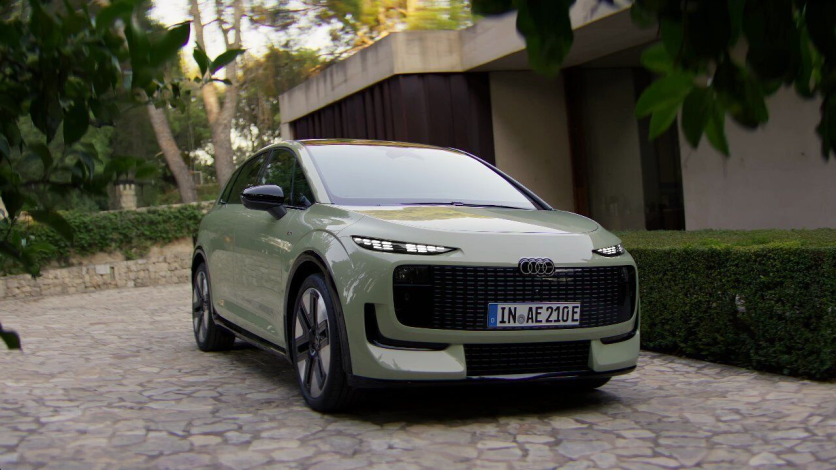
After a world premiere in Paris on September 7, 2026, the Audi A2 e-tron is now fully revealed — and the engineering inside this compact electric hatchback explains not just a headline range figure but a specific set of technology decisions that have delivered the lowest energy consumption rating of any production Audi in the brand's history.
Orders open September 10, 2026. German pricing starts at €38,200 (approximately $44,300 USD). There are currently no plans to bring the A2 e-tron to the United States.
What Is the Audi A2 e-tron
The A2 e-tron is Audi's new entry-level electric car — a five-door compact hatchback measuring 4.32 meters (170 inches) long, sitting below the Q4 e-tron in the lineup and directly replacing the discontinued A1 and Q2. The nameplate revives the original Audi A2, a car produced from 1999 to 2005 that became a benchmark for aerodynamic efficiency and aluminum construction, though the new model is a fundamentally different machine built on Volkswagen Group's updated MEB+ electric platform.
The A2 e-tron debuts with four power levels — 125 kW, 140 kW, 170 kW, and 240 kW — paired with three battery sizes: 52, 61, and 84 kWh gross capacity. All variants use rear-wheel drive exclusively, a notable departure from the quattro all-wheel-drive heritage Audi is known for, and a deliberate engineering choice made in favor of efficiency and simplicity.
How Audi Achieved 12.8 kWh per Hundred Kilometers
The A2 e-tron 140 kW with the optional efficiency package has received a preliminary WLTP energy consumption rating of 12.8 kWh per 100 km (approximately 20.6 kWh per 100 miles) — a figure Audi says is the lowest for any production model in the company's history. Three specific engineering mechanisms produce that number, and understanding them clarifies both what Audi has achieved and how it relates to the rest of the VW Group's compact EV family.
Silicon carbide power electronics. The A2 e-tron uses APP350 and APP550 permanent-magnet synchronous motors (the variant depending on power level), with power electronics built around silicon carbide (SiC) semiconductors rather than the conventional silicon IGBT transistors used in prior-generation MEB inverters. SiC is a wide-bandgap semiconductor material that operates at higher voltages and temperatures with substantially lower switching losses than silicon. In the A2 e-tron, SiC reduces switching losses by up to 33% in partial-load conditions — which is where a car spends most of its time during urban and suburban driving. Variable switching frequency alone cuts losses by approximately 20 watts in steady-state operation.
The motor itself has been refined in parallel. Lamination thickness has been reduced from 0.3 mm to 0.2 mm, which lowers what engineers call "iron losses" — the energy dissipated as heat in the magnetic core during each power cycle. The stator winding has been reconfigured from a star (Y) topology to a delta (Δ) topology, shifting the motor's most efficient operating range to better match typical highway driving speeds. A new low-friction transmission oil and a tall 10.2:1 gear ratio further reduce energy loss at speed. Audi estimates these drivetrain improvements deliver approximately 10% efficiency gains versus the previous MEB generation on the same battery.
LFP cell-to-pack battery architecture. The two smaller battery packs — 52 kWh and 61 kWh — use lithium iron phosphate (LFP) chemistry in a cell-to-pack (CTP) configuration. CTP eliminates the conventional module layer entirely: cells are bonded directly into the battery housing, increasing volumetric packing density and reducing weight and cost compared to traditional cell-module-pack hierarchies. The 84 kWh pack uses nickel-manganese-cobalt (NMC) chemistry in a modular design and is available only in the 170 kW and 240 kW variants.
LFP chemistry brings specific advantages for everyday use. Because of its inherently stable iron-phosphate chemistry, the LFP battery does not accumulate degradation during high-state-of-charge storage the way NMC cells do — meaning owners can charge to 100% regularly without shortening long-term battery life. LFP cells also require no rare earth elements, nickel, or cobalt, addressing supply-chain concerns that have accompanied NMC adoption. The adapted cooling strategy Audi applies to the LFP packs achieves 89.6% wallbox charging efficiency — meaning that for every 10 kWh pushed into the car from a home charger, 8.96 kWh reaches the battery.
One real-world caveat worth noting: LFP batteries experience more pronounced voltage sag and reduced charge acceptance in temperatures below approximately 5°C (41°F) compared to NMC. Audi addresses this with battery preconditioning through the navigation system before arriving at a charging station, but buyers in northern European markets should expect winter real-world range to fall meaningfully below the headline WLTP figures.
Aerodynamics. The drag coefficient of 0.24 Cd is the lowest in Audi's compact lineup — matching the e-tron GT sports car — and contributes up to 0.9 kWh/100 km of efficiency advantage over a conventionally proportioned vehicle. The underbody is almost entirely enclosed, active front air intakes close at highway speeds when cooling demand allows, wheel-arch gap reducers narrow airflow turbulence around tires, and flush electric door handles eliminate the drag penalty of conventional protruding handles.
What the Platform Actually Shares with the VW ID.3 Neo
Here is what the A2 e-tron's record efficiency figure does not fully communicate: the APP350 drive unit, SiC power electronics, and LFP cell-to-pack battery design are not technologies unique to the Audi. They are the same or closely related components found in the updated Volkswagen ID.3 Neo and the Cupra Born — both of which share the MEB+ platform with the A2 e-tron and are produced within the same VW Group. This is confirmed in electrive.com's platform analysis of the A2 e-tron's technical relationship to its siblings.
The Cupra Born with the same APP350 drive unit and comparable LFP battery is rated at approximately 14.3 kWh/100 km on WLTP. The A2 e-tron achieves 12.8 kWh/100 km on the same platform — a roughly 10% improvement that aerodynamics, not a fundamentally different powertrain, primarily explains.
The VW ID.3 Neo starts at €33,995 (approximately $39,400 USD), compared to the A2 e-tron's €38,200 (approximately $44,300 USD) base price. Volkswagen is also currently offering a manufacturer rebate of €3,000 on the ID.3 Neo through the end of September 2026, pushing the effective price gap to approximately €7,200 (approximately $8,400 USD).
What the Audi buyer gets for that premium: a more refined interior, the Softwrap fabric-covered dashboard extending across door panels, a standard curved 12.8-inch MMI touchscreen with the 11.9-inch Audi virtual cockpit, the proprietary Fidlock magnetic storage system, a higher standard specification level — including adaptive cruise control, wireless dual-pad 25W charging, and bidirectional charging as standard on every variant — and the Audi brand itself. The powertrain, at its core, is a platform family feature.
Range, Charging Speed, and Battery Options
The complete range and charging specifications for each powertrain variant are as follows:
The 125 kW entry-level variant with the 52 kWh LFP battery is rated at up to 423 km (263 miles) WLTP range, with a DC charging peak of 100 kW enabling a 10–80% charge in approximately 24 minutes. These specifications are drawn from Audi's official technical data released at the world premiere.
The 140 kW variant with the 61 kWh LFP battery reaches up to 515 km (320 miles) WLTP range, charges at up to 105 kW DC, and covers 10–80% in approximately 26 minutes. This is the variant with the 12.8 kWh/100 km efficiency rating when equipped with the efficiency package.
The 170 kW variant with the 84 kWh NMC battery achieves the maximum range: up to 646 km (401 miles) WLTP. DC charging peaks at 183 kW, with a 10–80% charge time of approximately 29 minutes.
The 240 kW top-of-range variant also uses the 84 kWh NMC battery and is rated at up to 630 km (391 miles) WLTP — slightly less than the 170 kW variant due to higher performance tuning. The 240 kW model accelerates from 0 to 100 km/h (62 mph) in 5.7 seconds and reaches a top speed of 200 km/h (124 mph). The three lower-powered variants are electronically limited to 160 km/h (99 mph).
The 84 kWh battery's 183 kW DC peak is worth context: this is significantly below the 270 kW peak charging capability of the Audi Q6 e-tron, which uses the 800V PPE (Premium Platform Electric) architecture rather than the MEB+'s 400V system. The 400V architecture is a cost-efficient choice for the compact segment but represents a genuine constraint for buyers planning frequent long-distance travel who prioritize charging speed over cost.
Bidirectional Charging: V2L and V2H
Bidirectional charging is standard across all A2 e-tron variants — a notable inclusion at this price point. Vehicle-to-Load (V2L) allows the car's battery to power external devices: an e-bike, power tools, outdoor equipment, or camping appliances via an adapter at the charging port (3.6 kW) or a standard outlet in the trunk (2.3 kW). The full bidirectional charging specifications are detailed in Audi's official press materials.
Vehicle-to-Home (V2H) goes further, enabling the A2 e-tron to function as a home battery backup in combination with a compatible DC wallbox — feeding stored energy from the car's 84 kWh pack (or 52/61 kWh LFP packs) back into the household electrical grid. At launch, V2H will be available in Germany, Austria, and Switzerland only. The system discharges only when the battery state of charge is between 20% and 80%; the "Instant Charge" function can override this for a full charge when range is required immediately.
V2H at this price tier, made standard rather than optional, marks a meaningful shift: previously associated with premium-tier EVs, home energy integration is now arriving in the compact hatchback segment for the first time from a major European brand.
Interior, Cargo, and Technology
Despite external dimensions roughly comparable to the Kia EV3 and VW ID.3 Neo, the A2 e-tron's MEB+ platform provides a wheelbase of 2.77 meters (109 inches) — the same as the considerably larger Q4 e-tron SUV — which translates into generous rear passenger space for a compact.
Cargo volume is 396 liters (approximately 14.0 cubic feet) with all seats in use, expanding to 1,336 liters (approximately 47.2 cubic feet) with rear seats folded. The cargo and dimensions specifications are confirmed in Audi's world premiere press release. The 170 kW and 240 kW variants also include a 13-liter frunk.
The gear selector moves to the steering column — a practical decision that frees the center console for a dual wireless charging pad compatible with Qi 2.2, charging two smartphones simultaneously at up to 25 watts each with active magnetic alignment. Active cooling prevents heat-induced charging throttling. Interior controls consolidate turn signals, high beams, and gear selection around the steering wheel and column, reducing center-console clutter.
Optional equipment includes Matrix LED headlights, augmented reality head-up display, a 1.6-square-meter panoramic glass roof, a Sonos premium sound system with 14 speakers and 660 watts of amplifier power, progressive variable-ratio steering, and the adaptive cruise assist plus system — which can brake autonomously at red lights and, in a future software update, change lanes autonomously on highways via turn-signal activation. The complete optional equipment list is available in the official press release.
The standard infotainment includes AI-integrated voice control capable of managing Microsoft Outlook, Microsoft Teams, and calendar navigation — a genuine mobile-office feature at the standard configuration level.
Driver Assistance and Safety
Standard safety equipment brings the A2 e-tron closer to the full-size Audi lineup than its price point might suggest. Every variant includes adaptive cruise control with speed-limit reading, front and rear emergency brake assist, swerve assist, lane-keeping assist, parking distance sensors (front and rear), and a reversing camera. The full driver assistance systems specification is documented in Audi's official press materials.
The trained parking feature — able to memorize up to five parking maneuvers (home garage, office, etc.) and repeat them automatically — and the reverse assist capable of backing the car out of up to approximately 50 meters (164 feet) of tight space replicate features previously found only in higher-tier Audi models.
Is the A2 e-tron Too Expensive for the Compact Segment?
The question facing the A2 e-tron is the same one that dogged its aluminum predecessor: can Audi sell a premium-priced compact in a segment where buyers are acutely price-sensitive?
The original A2's expensive aluminum space-frame construction made production costs unsustainable; the car became a symbol of engineering ambition without commercial viability. Electrive.com notes that the original A2 compact was a loss-making exercise for the German carmaker.
The new A2 e-tron has a more tractable answer. Audi brought the car to production 21 months faster than comparable predecessors and manufactures it using over 1,200 existing production assets and approximately 250 robots already deployed at the Ingolstadt plant — avoiding the bespoke capital investment that made the original unsustainable. The pearl-chain production system, introduced for the first time at Ingolstadt (previously only at Neckarsulm), fixes the customer order sequence six days before assembly begins, reducing parts storage complexity and sequencing costs. These production efficiency details are confirmed in Audi's official press release.
But the competitive landscape is more brutal than in 2005. BYD and other Chinese manufacturers are pushing models below €25,000 (approximately $29,000 USD) into the European compact EV segment, and the VW ID.3 Neo — essentially the same powertrain — carries a €4,200 to €7,200 effective price advantage after incentives. Audi is betting on brand equity, interior quality, and the complete-standard-specification approach to justify the gap. Whether that bet pays off will become clearer when first deliveries begin in December 2026.
Pricing, Availability, and What Is Not Coming to the US
German pricing for the full lineup is as follows: the A2 e-tron 125 kW with 52 kWh battery starts at €38,200 (approximately $44,300 USD); the 140 kW variant with the 61 kWh battery starts at €41,900 (approximately $48,600 USD); the 170 kW with 84 kWh NMC battery costs €48,900 (approximately $56,700 USD); the range-topping 240 kW starts at €51,200 (approximately $59,400 USD). The complete German pricing was released at the September 7 world premiere.
In the United Kingdom, the A2 e-tron is priced from £32,200 (approximately $40,900 USD).
A heat pump — useful for maintaining range in cold weather — is not included in the base specification and costs extra, a point worth flagging for buyers in colder European climates.
Orders open September 10, 2026. First customer deliveries are scheduled for December 2026. Italian showroom availability is expected from January 2027.
There are no current plans to sell the Audi A2 e-tron in the United States. The car has been engineered and manufactured specifically for the European compact market, where it competes with the VW ID.3 Neo (€33,995 / approximately $39,400 USD) and Renault Scenic E-Tech, among others. US buyers seeking an Audi EV remain directed to the Q4 e-tron and Q6 e-tron.
Exchange rates as of September 8, 2026; conversions are approximate.
Frequently Asked Questions
What is the range of the Audi A2 e-tron?
Range depends on the battery and power level. The highest WLTP range — up to 646 km (401 miles) — comes from the 170 kW variant with the 84 kWh NMC battery. The 125 kW entry model with the 52 kWh LFP battery is rated at up to 423 km (263 miles). Note that WLTP figures for LFP-equipped variants will drop more noticeably in cold weather (below 5°C / 41°F) than NMC-equipped rivals, due to LFP's sensitivity to low temperatures — a meaningful consideration for buyers in northern Europe. All battery and range specifications are confirmed in official Audi data released at the world premiere.
How does the Audi A2 e-tron compare to the Volkswagen ID.3 Neo?
They share the same MEB+ platform, the same APP350 and APP550 permanent-magnet synchronous motors, and the same silicon carbide power electronics. The A2 e-tron's efficiency advantage over the Cupra Born (same powertrain) comes primarily from its 0.24 Cd aerodynamics rather than a fundamentally different drivetrain. The Audi starts at €38,200 (approximately $44,300 USD); the VW ID.3 Neo starts at €33,995 (approximately $39,400 USD), with a €3,000 manufacturer rebate currently available through September 2026 pushing the effective gap to €7,200 (approximately $8,400 USD). The Audi's premium buys a more premium interior, higher standard specification, the Fidlock storage system, and the four-rings badge. The platform analysis is detailed in electrive.com's A2 e-tron coverage.
Is the Audi A2 e-tron coming to the United States?
No. Audi has confirmed there are currently no plans to sell the A2 e-tron in the US market. The car has been engineered for European compact-segment conditions and pricing, and Audi's North American EV lineup remains focused on the Q4 e-tron and Q6 e-tron.
What does the Vehicle-to-Home feature actually let you do?
V2H turns the A2 e-tron into a home battery backup. Using a compatible DC wallbox and an appropriate home-energy-management system, the car can discharge energy from its high-voltage battery into the home electrical grid — powering appliances, lights, and electronics during outages or feeding surplus solar energy back out. At launch this is available only in Germany, Austria, and Switzerland, where compatible wallbox ecosystems and grid regulations are in place. The car discharges only when battery state of charge is between 20% and 80% to protect long-term health, with a bypass for full-range charging when needed. Full details on V2H system specifications are available in Audi's official press release.

-
 C114 Communication Network
 -
 Communication Home
