
 Search

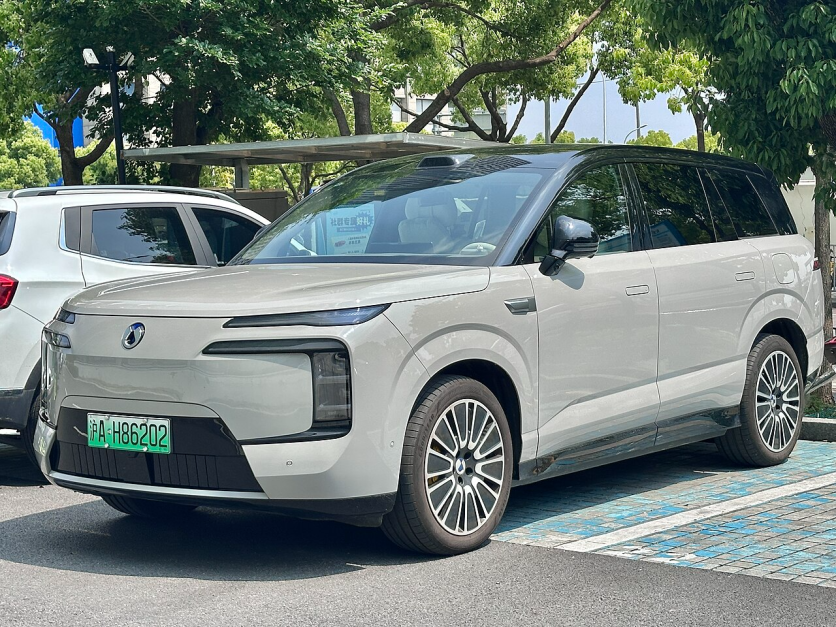
JustAnotherCarDesigner/Wikipedia.org
Denza will launch an all-electric version of its N8L large six-seat SUV in September 2026, adding a 208-liter (7.3 cu ft) powered frunk that the existing plug-in hybrid version physically cannot accommodate — and, once the vehicle's confirmed Blade Battery 2.0 pack delivers its stated CLTC range figure, family buyers face a calculation the announcement poster does not show: 960 km (597 miles) on a Chinese test cycle typically scales to roughly 480–540 km (298–336 miles) at 70 mph in mild weather for a vehicle weighing approximately 3,000 kg (6,615 lbs), according to benchmarks from independent analysts. That is still enough range for most road trips — but only if buyers understand what the CLTC number means before they buy.
Frunk Is the BEV-Exclusive Feature, Not an Upgrade
The existing N8L, first launched as a plug-in hybrid in October 2025 and relaunched with flash-charging capability on June 23, 2026, starts at ¥319,800 (approximately $47,600 USD) in its current flash-charging edition. The PHEV uses a 2.0-liter turbocharged four-cylinder engine mounted at the front — which occupies the space where the frunk will go in the BEV. Removing the internal combustion engine for an all-electric powertrain unlocks 208 liters (55 US gallons) of powered, accessible front storage, giving the N8L BEV a meaningful practical advantage over the PHEV it supplements rather than replaces.
Denza General Manager Li Hui announced the BEV launch via Weibo on August 30, describing the frunk's drain plug and rinse capability as suited to beach and camping gear, sand, and mud. The frunk is powered, not manual — a detail that matters for a large opening on a vehicle aimed at family buyers who regularly load gear with both hands occupied.
The existing PHEV N8L measures 5,200 mm (204.7 in) long, 1,999 mm (78.7 in) wide, and 1,820 mm (71.7 in) tall on a 3,075 mm (121.1 in) wheelbase, with a 2+2+2 six-seat layout. The BEV is expected to retain these dimensions. The N8L BEV's pricing, battery capacity, and specific powertrain outputs have not been disclosed as of August 31, 2026.
What 960 km CLTC Actually Means at 70 mph in a 6,600-lb SUV
A Ministry of Industry and Information Technology regulatory filing published the week of August 13, 2026 confirmed that the N8L BEV carries a 130.15 kWh Blade Battery 2.0 pack delivering a CLTC range of 960 km per MIIT filing. Its five-seat sibling, the Denza N8, achieves 1,003 km (623 miles) on the same pack; the N8L is longer and designed to carry six passengers, which explains the lower figure.
CLTC — China's Light-duty Vehicle Test Cycle — uses lower average highway speeds and more favorable ambient conditions than the WLTP standard used in Europe or the EPA standard used in the United States. Independent analysts consistently measure real-world highway range for SUV-profile BEVs at 70–78% of their CLTC rating at sustained highway speed. Applied to a 960 km CLTC figure, that produces approximately 672–749 km (418–465 miles) under mild, moderate-speed conditions — and approximately 480–540 km (298–336 miles) at sustained 110 km/h (68 mph) in a vehicle of this mass. Separate real-world testing by the Australian Automobile Association found BYD vehicles showing up to 20% range shortfalls against their advertised range figures in driving conditions — consistent with the general CLTC-to-highway scaling pattern, and a finding CarsGuide reported in detail.
The practical consequence for family buyers: a 500 km (311 mile) round trip — a realistic summer-vacation driving day — does not require a charging stop under the real-world estimate. A 600 km (373 mile) round trip likely requires one Flash Charging stop, which BYD rates at nine minutes on compatible hardware from 10% to 97%. The important caveat: BYD's nine-minute claim comes from the company's own testing. EV data analysts at CarNewsChina tested a Lynk & Co 10 at a BYD Flash Charging station and recorded peak vehicle-side input of 430 kW — far below the station's 1,500 kW hardware rating. No standardized third-party test of BYD's specific 10%-to-97% charge time has been published.
How Blade Battery 2.0 Powers the CLTC Number
The N8L BEV is expected to use BYD's Long Blade 2.0 chemistry — the variant optimized for energy density rather than charge speed. Long Blade 2.0 achieves 190–210 Wh/kg at the system level, roughly 40% above the first-generation Blade Battery's 140–150 Wh/kg, using lithium manganese iron phosphate chemistry at 3.8V nominal voltage. At 190–210 Wh/kg, a 130 kWh pack at cell level weighs approximately 619–684 kg (1,365–1,508 lbs) — a sizable fraction of the N8L's approximately 3,000 kg (6,615 lb) expected curb weight, which explains why CLTC-to-real-world range scaling matters more as vehicle mass increases.
The architecture is Cell-to-Pack (CTP): long, flat prismatic LFP cells are installed directly into the battery casing as structural load-bearing members, eliminating the intermediate module housing layer used in conventional battery packs. BYD updated this to Cell-to-Body 2.0 (CTB 2.0) in the Blade 2.0 generation, raising volumetric utilization to approximately 76%. LFP chemistry's thermal stability — it does not release oxygen during thermal decomposition, unlike nickel-manganese-cobalt — means the cells can be charged at rates that would create safety risks in competing chemistries.
The N8L BEV powertrain has not been confirmed. The five-seat N8 MIIT filing lists single-motor RWD variants at 320 kW (429 hp) or 370 kW (496 hp), and a tri-motor AWD variant producing 890 kW (1,193 hp) combined from a 270 kW (362 hp) front motor and two 310 kW (416 hp) rear units. Whether the heavier six-seat N8L BEV will offer the tri-motor configuration is not confirmed.
Flash Charging Infrastructure the N8L BEV Will Use
BYD reached its 10,000th Flash Charging station in China on August 28, 2026, at a ceremony at its Longhua flagship site in Shenzhen. The network spans 325 cities across mainland China and has registered more than 1.83 million users, approximately one-third of whom drive vehicles from brands other than BYD. BYD Executive Vice President He Zhiqi stated the company averaged 55 stations per day from the March 5, 2026 network launch through August 28.
Each station pairs its 1,500 kW charging hardware with an on-site battery energy storage system of 370 kWh — two 185 kWh cabinets that charge steadily from the grid and discharge rapidly during each vehicle session, decoupling the 1,500 kW burst from moment-of-draw grid demand. BYD says this cuts station construction costs 60% versus conventional ultra-fast chargers requiring dedicated grid reinforcement.
The network is not exclusive to BYD vehicles — any EV with a 1,000V high-voltage architecture can use it, though the full 1,500 kW throughput is accessible only to vehicles with compatible Blade Battery 2.0 architecture. BYD's target is 20,000 stations in China by December 31, 2026, requiring approximately 80 new stations per day through year-end — faster than the 55-per-day average achieved to date. A framework agreement with Sinopec allows Flash Charging hardware to co-locate at selected Sinopec sites within the state oil company's more than 30,000 integrated energy service stations across China.
Read more: BYD Great Seagull: LiDAR and 9-Minute Full Charge Under $13,000 Launch This Year
DiSus-A and God's Eye 5.0: What the Family SUV Package Includes
The N8L's current PHEV specification includes DiSus-A active body control — a hydraulic actuator system that can reposition each wheel by up to 100 mm (3.9 in) in 50 milliseconds, providing active load leveling and cornering stability in a vehicle weighing nearly 3,000 kg (6,615 lbs). This is distinct from DiSus-M (magnetorheological dampers, used in the Denza Z supercar) and DiSus-P (air suspension, used in the BAO 5 Ultimate) — each system tailored to a different performance brief.
God's Eye 5.0, a LiDAR-equipped advanced driver assistance suite, was integrated into the N8L PHEV via an OTA update in February 2026. The system, built on a reinforcement-learning end-to-end AI model, added AEB capability for stationary vehicles in tunnels at up to 135 km/h (84 mph) among more than twenty new features. The BEV version is expected to carry the same suite from launch.
Denza's Sales Context: Why September Matters
Denza sold 19,196 vehicles in July 2026, up 68.76% year-over-year from 11,375 units in July 2025, though down 5.68% from its June 2026 record of 20,352 units. For the first seven months of 2026 combined, Denza delivered 85,737 vehicles, a 6% year-over-year decline — though this marked improvement from the 16.65% decline recorded in the first half of the year alone.
The PHEV N8L generated 4,002 units after relaunch in its first full month after the June 23 flash-charging relaunch, making it Denza's second-best-selling model behind the D9 MPV. Adding a BEV variant alongside the PHEV gives Denza a pure-electric option that can address buyers who have excluded PHEVs from consideration on principle — a growing segment in China's premium market as charging infrastructure matures. The N8L BEV would also distinguish Denza's large-family offering from rivals such as Li Auto and Zeekr, which have historically led in the six-seat premium SUV segment.
Where the N8L BEV Will and Will Not Be Sold
The N8L BEV is being launched for the China domestic market. No international pricing, availability, or regulatory filing for non-China markets has been announced. Denza's current European lineup is led by the Z9GT shooting brake and D9 MPV, launched at the Palais Garnier in Paris on April 8, 2026; the brand targets over 30 European countries with more than 150 retail outlets by year-end 2026. Whether the N8L BEV will follow the Z9GT into European markets depends on regulatory homologation, EU tariff economics, and Denza's sales progress during 2026.
In the United States, BYD vehicles — including any Denza-branded products — cannot be sold: a US Department of Commerce Final Rule issued in January 2025 prohibits Chinese connected vehicle software from the 2027 model year and Chinese connected vehicle hardware from the 2030 model year, effectively barring Chinese-origin connected vehicles from American roads. The US imposes 100% import tariffs on Chinese EVs. The EU levies a 17% additional countervailing duty on BYD vehicles on top of the standard 10% auto import tariff, for a combined 27% burden.
China's Data Law Applies to Every N8L BEV Sold Anywhere
The Denza N8L BEV will be a fully connected vehicle: built-in cellular connectivity, GPS location logging, front and rear cameras, LiDAR, microphone input, and smartphone mirroring capability through Bluetooth and USB. It generates data across every aspect of family life conducted near, in, and around the vehicle.
Every Denza vehicle operates under the following fixed statutory framework, regardless of where the vehicle is driven or where its data is stored:
China's National Intelligence Law (2017), Article 7, states that any organization or citizen shall support, assist, and cooperate with state intelligence work in accordance with the law. This obligation applies to BYD as a company incorporated and headquartered in China. China's Cybersecurity Law (2017) and Data Security Law (2021) add data localization and government-access provisions. China's Automobile Data Security Regulations (2021) specifically require automakers operating in China to store vehicle-generated important data domestically. The Counter Espionage Law (2023) expanded the scope of what constitutes national security-relevant data.
These laws are not contested claims or risk assessments: they are statutory obligations that apply to BYD regardless of its stated privacy policy, its international cybersecurity certifications (BYD holds R155 and R156), or the physical location of its servers. As Carnegie Endowment research confirms, no privacy policy published in any country overrides a statute enacted in China.
Published security research provides context about what this means in practice. Researchers at PlaxidityX extracted the full GPS location history, contact list, healthcare provider details, and cellular identity (including CCID, IMSI, MAC address, and IMEI) from a 2023 BYD Atto 3 without active network intrusion; the data was stored without adequate encryption and the researchers confirmed ongoing data transmission to Chinese servers via a pre-installed GSM modem (CVE-2025-7020, subsequently patched by BYD). Researchers at Quarkslab, who dismantled a BYD Seal's telematics unit, found that GPS data had been logged continuously from the vehicle's production through its entire operational life. BYD denies unauthorized government access to vehicle data and states that it does not transmit personal data from European or international markets to China.
A Public Safety Canada memo from June 2026, prepared in response to concerns about Chinese vehicles, explicitly flagged this legal framework as a risk for Canadian owners. The UK Ministry of Defence banned Chinese-manufactured vehicles from sensitive military sites in April 2025; the UK Special Boat Service extended that ban to its Poole headquarters in July 2026. US bipartisan legislation — the Connected Vehicle Security Act of 2026, introduced by Senators Moreno and Slotkin — targets Chinese connected vehicles broadly and cites the data risks inherent in China's national intelligence legal framework as a basis for a proposed full ban.
Practical steps a buyer outside China can take: connect the vehicle only to a network-isolated WiFi router (no internet access); avoid Bluetooth and USB pairing of smartphones containing sensitive data; review the Denza app's data-sharing permissions; minimize voice interaction in the cabin. No mitigation fully addresses the structural legal obligation — it applies at the company level, not the individual vehicle level.
Read more: Denza Z Hits Goodwood: Five-Minute Charging, 1,604 PS, and China's Data Obligation
What Remains Unknown Before the September Launch
Denza has released no pricing, powertrain output, or charging-curve data for the N8L BEV. The confirmed elements as of August 31, 2026 are: the September 2026 launch window, the 208-liter (7.3 cu ft) powered frunk with a drain plug, Flash Charging compatibility expected from the platform, and a 130.15 kWh Blade Battery 2.0 pack delivering 960 km CLTC per the MIIT filing. All specifications relating to expected powertrain outputs and real-world performance are estimates until Denza publishes its own official announcement.
The September launch window, if it includes a full specification release as is standard in China's EV market, will confirm or revise every estimated figure above.
Frequently Asked Questions
Does the Denza N8L BEV's CLTC range claim mean I won't need to stop on a long road trip?
That depends on how far you're driving. The N8L BEV's MIIT filing confirms a 960 km (597-mile) CLTC range — but CLTC figures for SUV-profile vehicles typically translate to 70–78% of that number at sustained 70 mph in mild weather. For the heavy six-seat N8L BEV, expect approximately 480–540 km (298–336 miles) of realistic highway range per charge. A family road trip of up to 400 km (249 miles) each way likely requires no charging stop; a 600 km (373 mile) round trip likely requires one Flash Charging stop (rated at nine minutes from 10% to 97% if the hardware and vehicle-side architecture deliver the stated rate). Independent verification of BYD's specific nine-minute charge claim has not been published.
What Chinese laws apply to data generated in a Denza N8L BEV outside China?
Three laws establish fixed obligations: China's National Intelligence Law (2017), Article 7, requires BYD to cooperate with government intelligence requests on demand. The Cybersecurity Law (2017) and Data Security Law (2021) add data localization and government-access provisions. These apply to BYD as a Chinese company regardless of where vehicles operate, where data is stored, or what international privacy certifications the company holds. BYD holds R155 and R156 cybersecurity certifications and denies unauthorized government data access — but those certifications govern the company's internal practices, not the statutory obligations imposed by Chinese law.
Why does the N8L BEV have a frunk when the PHEV does not?
The existing N8L PHEV uses a 2.0-liter turbocharged four-cylinder engine mounted in the front of the vehicle, which occupies the space where a frunk would go. Removing the internal combustion engine in the BEV version frees that entire front cavity. BYD designed the resulting 208-liter (7.3 cu ft) powered frunk specifically for family use cases — camping gear, beach equipment, and muddy or wet items — with a drain plug to allow rinse-out cleaning. The BEV's frunk is not an upgrade that can be added to the PHEV; it is a structural consequence of replacing the ICE with a purely electric powertrain.
Is the Denza N8L BEV coming to Europe or the United States?
Not immediately. The September 2026 launch is for China. Denza's current European lineup is led by the Z9GT and D9 models, with the brand targeting over 30 European countries and more than 150 retail outlets by end-2026. Whether the N8L BEV follows will depend on regulatory filings, EU tariff economics (BYD faces a 17% additional countervailing duty plus the standard 10% import tariff for a combined 27% burden), and Denza's European sales progress. The United States remains closed to BYD vehicles: a Department of Commerce Final Rule bars Chinese connected vehicle software from the 2027 model year and hardware from 2030, alongside existing 100% tariff barriers.

-
 C114 Communication Network
 -
 Communication Home
