
 Search

Samsung.com
For the first time, a Samsung executive has officially confirmed that a Galaxy Ring 2 is in active development — and quietly suggested that iPhone users, currently locked out of the original ring, may not stay locked out much longer.
In an interview with Forbes published June 25, 2026, Dr. Hon Pak, Samsung's Senior Vice President and Head of the Digital Health Team, became the company's first public voice on a Galaxy Ring sequel. When asked directly whether the new device would support Apple's iOS, Pak smiled and declined to answer. "I'm smiling, but I can't say anything," he said. "I think you'll be very pleased with some of the releases and the upcoming news." That non-denial has rippled through the wearable tech community within days — and for good reason. For iPhone users who have watched Oura Ring dominate the ring market for years, it is the first credible signal that Samsung might be coming for them.
The timing matters. Just five days before Pak's interview went live, leaker Kosutami — a known Apple prototype source — posted to X that a health-tracking device dubbed the "iRing" is in active development at Apple. No specifications, pricing, or timeline accompanied the claim, and Apple has not responded. But Samsung's move looks less like a coincidence than a preemptive one: confirm the sequel, hint at cross-platform ambitions, and stake ground in the iPhone health data ecosystem before Apple can occupy it with its own hardware.
Samsung's Bet: Software Wins When Hardware Ties
Dr. Pak was direct about where he believes the smart ring category is heading. "If you look at the comparison of other rings, regardless of the competitor, the sensors are not that different right now," he said. "It's really about what services you create on the top layer. It's really the software differentiation that you see."
That assessment reflects how smart ring sensors actually work. Every health-tracking ring — from the Galaxy Ring to the Oura Ring 5 to the Ultrahuman Ring Pro — relies on the same basic photoplethysmography (PPG) architecture: LEDs shine light into the skin, photodetectors measure the returning signal, and algorithms translate the fluctuations into heart rate, sleep stages, blood oxygen, and heart rate variability readings. The physics of that sensing approach have largely converged. A ring's finger placement is actually advantageous — it puts sensors directly over the finger's dense capillary network, which sits close to the surface — but no brand has a PPG design so radically different that it cannot be replicated by a well-funded competitor. The form-factor constraint of a ring (limited diameter, limited width) imposes a ceiling on sensor size that applies equally to everyone in the category.
Samsung is designing the Galaxy Ring 2 as a node within a connected health ecosystem rather than a standalone device. Data from the ring would flow into Galaxy watches, Samsung smartphones, and SmartThings home appliances to build what Pak described as a holistic picture of a user's wellbeing across their day and living environment. Two new Samsung Health features illustrate the strategy. The first, called Vitals, establishes a personal biometric baseline across heart rate, respiratory rate, and blood oxygen over a seven-night period, then alerts users when readings deviate meaningfully. The second, Heart Health Score, consolidates lifestyle factors — sleep, activity, diet, stress — into a single cardiovascular risk indicator. A third feature, AI Health Coaching, is planned for 2027 and is designed to learn individual behavioral patterns and deliver personalized nudges rather than generic fitness advice.
Why Samsung Can Afford to Skip the Subscription Fee
The original Galaxy Ring launched at $399 with no monthly membership required — a deliberate contrast to Oura's model, which now charges $5.99 per month (or $69.99 per year) for full feature access. Samsung's no-subscription approach is not purely altruistic; it reflects how the ring fits into a larger business. For Samsung, the ring is an ecosystem acquisition tool: health data from the ring increases engagement with Galaxy watches, Samsung phones, and SmartThings devices. The data creates platform stickiness, and that value flows back to Samsung as ecosystem retention rather than direct subscription revenue. For Oura, health insights are the core product — recurring membership fees fund the algorithm development that is the company's competitive moat.
The Galaxy Ring 2 is expected to maintain the no-subscription structure, though pricing has not been confirmed. The original ring's $399 price point represented a calculated strike against Oura's business model, and there is no indication that Samsung is planning to abandon that positioning.
What the Hardware Is Expected to Deliver
Even as Pak downplayed sensor parity as a differentiating factor, hardware upgrades are still on the table. Leaked reports from Korean industry sources suggest the Galaxy Ring 2 is targeting nine to ten days of battery life — up from the six to seven days offered by the original model. The improvement is expected to come from silicon-carbon (Si-C) battery technology, which replaces conventional graphite anodes with a silicon-carbon composite. Silicon can theoretically store roughly ten times more lithium per gram than graphite; commercial implementations typically achieve a 20 to 50 percent capacity increase in the same physical size. For a form-factor-constrained device like a ring, where even a modest gain in battery volume translates directly into days of additional runtime, that chemistry shift makes the claimed battery life target plausible without increasing the ring's dimensions. Trade-offs remain: Si-C batteries degrade more quickly than graphite-based cells under repeated charge-discharge cycles, and manufacturing costs are higher.
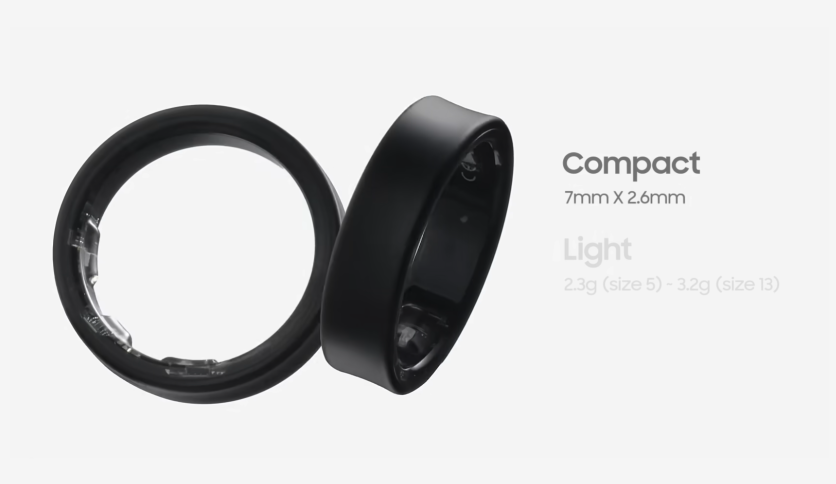
Reports from Korean sources also point to a thinner, lighter form factor and upgraded sensors targeting more accurate skin temperature readings and deeper cardiovascular monitoring. Additional sizes extending the range beyond the original nine options have been rumored. A 2026 launch is considered unlikely by South Korean industry insiders, who have described it as "virtually impossible." An early 2027 window is the current consensus — in part due to an active patent dispute with Oura at the U.S. International Trade Commission.
Read more: Samsung Eyes a Smarter, Sleeker Galaxy Ring 2, But Don't Expect It Anytime Soon
Oura's Case Against Samsung Adds Legal Uncertainty
The patent landscape surrounding the Galaxy Ring 2 is complicated. In November 2025, Oura filed an ITC complaint against Samsung (along with Reebok, Zepp Health, and Nexxbase) alleging infringement of several Oura patents related to smart ring design and technology. The investigation is active and unresolved. If Oura prevails, Samsung could face an import ban on Galaxy Ring products in the US market — the same outcome Oura secured against Ultrahuman in October 2025, which forced Ultrahuman to redesign its hardware before re-entering the American market with the Ring Pro in early 2026.
Samsung has not accepted a licensing arrangement. Instead, it counter-sued Oura in a Texas federal court in December 2025, alleging that Oura's rings infringe on four Samsung patents. Samsung has also filed multiple petitions challenging the validity of Oura's patents at the US Patent Trial and Appeal Board; six of those patent trials remain active. The litigation adds uncertainty to the Galaxy Ring 2's timeline, but analysts expect Samsung to fight rather than settle — the company has the legal resources, patent portfolio, and strategic incentive to contest Oura's IP position rather than hand its competitor a recurring royalty stream.
Samsung Moved Before Apple Could
The competitive logic behind Samsung's iOS compatibility hint becomes clearer when mapped against what Apple is reportedly doing. Kosutami's June 24 post described an "iRing" as actively in development at Apple — the first credible insider signal that Apple is building a smart ring rather than merely filing patents around the concept. The leak directly contradicts Mark Gurman's October 2024 reporting that Apple had no near-term plans for a ring device, and it coincides with Eddy Cue's reported push for more aggressive health products since taking over Apple's Health division.
Even if Kosutami's claim is accurate, a consumer-ready Apple ring is not imminent. Apple's pattern in wearables is to let the category mature before entering with a refined, deeply integrated product — it did this with the Apple Watch in 2015, years after fitness bands had proved the market. A 2027 launch would be optimistic. But the trajectory is visible.
The original Galaxy Ring is locked to Android. That exclusivity was defensible in 2024 because it kept the product tightly integrated with Samsung's Galaxy ecosystem. But the absence of iOS support means the ring cannot reach the hundreds of millions of iPhone users who might otherwise buy it — a constraint that matters far less if Samsung remains the only serious player, and far more once Apple ships its own competing hardware. If Samsung can land Galaxy Ring 2 with iOS support before Apple ships anything, it can sell health-tracking rings to iPhone users before Apple has a product to compete with. That window may be 12 to 18 months wide.
The no-display advantage matters here. Because the Galaxy Ring carries no screen and therefore cannot mirror phone notifications, offering iPhone users the full health-tracking feature suite requires fewer concessions than extending iOS support to a Galaxy Watch would. The technical barrier is lower than it sounds.
Market Racing Toward a Pivotal Twelve Months
The Galaxy Ring 2 announcement arrives at one of the most active moments in the smart ring category's history. The Oura Ring 5, announced May 28, 2026 as the world's smallest smart ring, represents Oura's most significant redesign to date — 40 percent smaller than its predecessor, with new blood pressure trend detection, nighttime breathing analysis, and tools for tracking GLP-1 medication journeys. It starts at $399 (plus the required monthly membership). Oura also confidentially filed for a US IPO in May 2026. Ultrahuman returned to the US market in early 2026 with its Ring Pro — a redesigned product that cleared US Customs — after the original Ring Air was banned under the Oura ITC ruling; the Ring Pro claims up to 15 days of battery life and carries no subscription fee.
Market research projections point to a category that will grow from its current level — roughly $400 million to $500 million annually — to approaching $4 billion by 2034. That projection depends on several things going right for the category collectively, including mainstream consumer adoption that has so far lagged behind industry enthusiasm. The next eighteen months, with Galaxy Ring 2, a potential iRing, and a fully competitive Oura on the market simultaneously, represent the clearest test of whether smart rings can reach that scale.
Samsung has now made its position explicit: software differentiation and cross-platform reach are the two levers it believes will determine the winner. The iOS hint is not a casual aside — it is a statement of competitive intent in a market where owning health data across both major mobile platforms may prove more durable than any sensor advantage.
Read more: Oura Ring 5 Features Revealed: Slimmer Oura Smart Ring Adds Ozempic Tracking Wearable Tools
Frequently Asked Questions
Will the Samsung Galaxy Ring 2 work with iPhone?
Samsung has not confirmed iOS support for the Galaxy Ring 2. Dr. Hon Pak, Samsung's SVP of digital health, declined to answer the question directly in a June 2026 Forbes interview but responded with "I'm smiling, but I can't say anything" — the closest Samsung has come to acknowledging iOS compatibility as a possibility. The original Galaxy Ring is Android-only. Whether the sequel extends to iPhone will likely be one of the most consequential product decisions Samsung makes in the smart ring category, especially given that Apple is reportedly developing its own competing ring. If you own an iPhone and are deciding whether to buy an Oura Ring 5 now or wait, Galaxy Ring 2's iOS status is the single most important unknown.
When will the Galaxy Ring 2 be released?
A 2026 launch is considered virtually impossible by South Korean industry sources, primarily because of an active patent dispute between Samsung and Oura at the US International Trade Commission. Early 2027 is the most commonly cited estimate. No official announcement of a launch date, price, or confirmed specifications has been made by Samsung as of July 2026.
How does Samsung's software strategy differ from Oura's?
Samsung's Galaxy Ring is a platform extension device: it funnels health data into the broader Galaxy and SmartThings ecosystem, where the data creates engagement across Samsung devices. Samsung does not charge a subscription fee because the ring's business value is ecosystem retention, not standalone revenue. Oura is a standalone health company whose subscription membership funds ongoing algorithm development — health insights are its primary product and the basis of its IPO case. Both approaches have merit; the question is whether you want your health data to live inside a single dedicated health platform (Oura) or integrated across a general-purpose device ecosystem (Samsung).
Do smart ring sensors differ significantly between brands?
According to Samsung's own SVP of digital health — and consistent with how the underlying technology actually works — they largely do not. All health-tracking smart rings use photoplethysmography (PPG), the same optical technique that shines light into the skin and measures changes in blood volume to derive heart rate, blood oxygen, and sleep data. The finger placement gives rings a signal strength advantage over wrist wearables, but the fundamental sensor architecture is similar across Oura, Samsung, Ultrahuman, and others. That hardware convergence is precisely why Samsung says software and ecosystem reach are where the real competition will play out in the next generation.

-
 C114 Communication Network
 -
 Communication Home
