
 Search

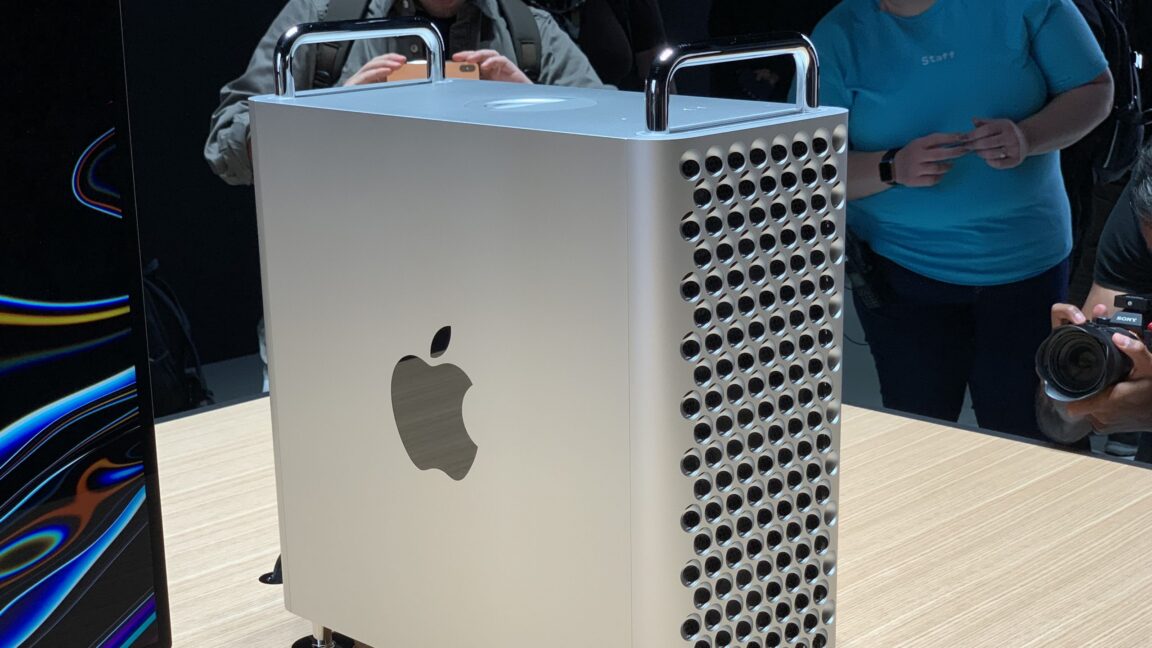
Credit: Samuel Axon
After more than a decade of flirting with the idea, Apple has finally discontinued the Mac Pro tower. The company confirmed to 9to5Mac that the latest Mac Pro iteration—an M2 Ultra model first released in mid-2023—would be its last, at least for the time being. There are no plans to make another Mac Pro.
The discontinuation of the Mac Pro should come as no surprise to anyone who has been paying attention. Reporting from late last year suggested that the Mac Pro had been put “on the back burner,” but the desktop has clearly been in danger of falling off the stove since at least the mid-2010s, during the six-year period where the controversial cylindrical “trash can” Mac Pro design languished without updates.
Apple briefly rededicated itself to its pro desktop in 2019 with a new design that hearkened back to more versatile, upgradeable, be-handled versions of the Power Mac and Mac Pro. But by the time it was updated again with M2 Ultra four years later, it was already clear that the idea of a huge and expandable Mac desktop was out of step with the Apple Silicon era. The desktop’s demise confirms that, at least in Apple’s estimation, the Mac Pro was trying to fill a niche that no longer exists.
The Mac Pro is survived by the M4 Max and M3 Ultra versions of the Mac Studio desktop, as well as by the M4 Pro Mac mini. It was preceded in death by the 27-inch iMac (2009–2020) and the iMac Pro (2017–2017).
The fourth quadrant
When Steve Jobs returned to lead Apple in 1997, one of his early initiatives was to streamline and refocus the Mac product family, which at that point had grown into a sprawling and poorly differentiated maze of Quadras, Performas, Power Macintoshes, and even third-party systems. The initial focus was a lineup of four computers to serve four market quadrants: a consumer laptop, a consumer desktop, a more powerful professional laptop, and a professional desktop.
That professional desktop was the Power Mac tower, which became the Mac Pro when Apple shifted from PowerPC to Intel processors in the mid-2000s. From the late ’90s to the early 2010s, Apple updated the Power Mac and the Mac Pro as it did its other Macs, performing periodic internal and external overhauls, punctuated with milder internal refreshes that kept their specs current.
The rate of improvement slowed in the early 2010s; the Mac Pro’s 2012 refresh barely deserved the designation, offering just a handful of new configuration options for the 2010 model. And then came the trash can.
“Can’t innovate, my ass!” Apple’s Phil Schiller introduces the tiny cylindrical Mac Pro in 2013.
Credit: Apple
At just one-eighth the volume of the old Mac Pro tower, there was no denying that the system’s 2013 refresh was dramatic or innovative. Its internal design was a unique triangle of circuit boards housing a single Intel Xeon workstation CPU (the old Pro tower had been available as a dual-socket system) and a pair of AMD Radeon GPUs.
But designing the new Mac Pro so specifically around those components arranged in that configuration left Apple with little flexibility to change the system or keep it updated. In particular, it proved impossible to move the system back to a single-GPU design while staying within its thermal constraints. By 2017, Apple was in the rare position of admitting a mistake and expressing contrition.
“I think we designed ourselves into a bit of a thermal corner, if you will,” said Apple’s Craig Federighi speaking to a small group of reporters in 2017. “We designed a system… with the kind of GPUs that at the time we thought we needed, and that we thought we could well serve with a two GPU architecture… But workloads didn’t materialize to fit that as broadly as we hoped.”
But the company was working on a true successor, and it arrived in 2019: The new Mac Pro went back to being a desktop tower, with a side that opened up for repairs and upgrades and handles you could use to cart it around. It came out years later than anyone would have wanted, but it was much more in keeping with the ethos of the original Power Mac and Mac Pro towers, at least in its design.
At the prices Apple was charging, though, it was never going to be a mass-market machine. The late-2000s-era Mac Pro tower had shipped in configurations starting in the $2,200-to-$2,500 range, and the 2012 model’s tippy-top-end configuration cost $6,199. The new Mac Pro started at $6,000 and went up from there.
There was also an issue of timing.
Schiller said in that 2017 meeting that the new Mac Pro was being designed “so that we can keep it fresh with regular improvements,” and Apple did quietly update the system a couple of times with fresh GPU options. But by the time the Mac Pro finally arrived in late 2019, Apple was just months away from introducing the first of the Apple Silicon Macs, and the writing had been on the wall for Intel Macs for a while.
Apple Silicon ended up being the final nail in the coffin for the concept of the Mac Pro. The chips’ unified memory architecture meant memory upgrades were impossible. Their integrated GPUs meant they didn’t support external graphics cards from AMD or Nvidia and couldn’t be upgraded over time. High-speed Thunderbolt ports made internal expandability less necessary. Its built-in video encoders obviated the need for Afterburner cards. It was a Mac Studio with PCI Express slots that weren’t compatible with or didn’t need the most important PCI Express accessories. And now it’s gone.

-
 C114 Communication Network
 -
 Communication Home
