
 Search

Đào Hiếu/Unsplash
Choosing between air cooling vs liquid cooling for gaming PCs is no longer a simple budget decision. Modern CPUs push well past 250W under load, while GPUs dump massive heat into compact cases. Cooling choice now affects boost clocks, noise levels, long-session stability, and even case layout. For gamers building around high-end CPUs, the right cooler directly impacts performance consistency.
Air vs liquid cooling debates usually miss context. Tower air coolers have improved dramatically, while modern AIO liquid coolers are quieter and more reliable than early generations. The real decision depends on power draw, overclocking goals, case airflow, and tolerance for noise and maintenance. This guide breaks down where each solution excels and where it doesn't.
Understanding Air Cooling vs Liquid Cooling in PC Builds
Air cooling uses large heatsinks and one or more fans to pull heat away from the CPU and dissipate it into the case airflow. The cooler sits directly on the processor, transferring heat through heat pipes into metal fins, where fans push the warmth out toward exhaust paths. This approach is simple, reliable, and widely compatible, making air cooling a popular choice for mainstream and high-performance systems alike.
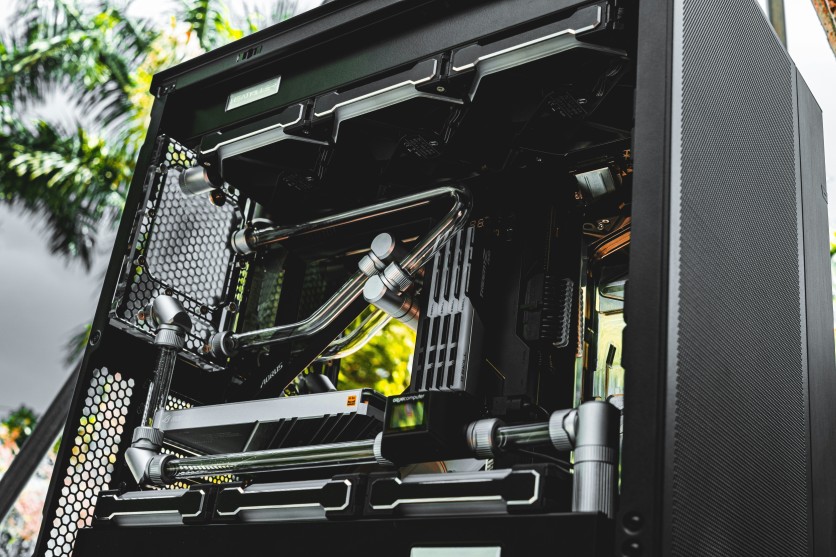
Liquid cooling relies on a closed loop filled with coolant to move heat away from the CPU more efficiently under heavy loads. A pump circulates liquid from the cold plate to a radiator, where fans disperse heat before the coolant returns to the block. This design excels at managing sustained high wattage, offering better thermal headroom and a cleaner visual layout, especially in performance-focused or showcase builds.
Air vs Liquid Cooling Thermal Benchmarks
Air vs liquid cooling thermal benchmarks show the biggest gaps only at very high power levels. In mid-range gaming builds, modern air coolers perform closer to liquid than most expect. The real differences appear once CPUs sustain extreme loads for long periods.
- High-end air coolers like the Noctua NH-D15 and Thermalright Peerless Assassin sustain 240–280W without throttling in well-ventilated cases
- Dual-tower air coolers typically land within 5–8°C of 240mm AIOs in Cinebench R23 when noise is normalized
- 360mm AIOs pull ahead above 300W, running 10–15°C cooler on CPUs like the i9-14900K during AVX workloads
- Lower liquid temperatures allow higher all-core boost clocks and reduced thermal throttling over long sessions
- Front-mounted radiators can raise GPU temps by 5–8°C due to restricted intake airflow
- Air coolers exhaust heat upward, preserving GPU cooling efficiency in airflow-focused cases
Read more: iMac Cooling System: What iMac Design Leaks Reveal About Apple Hardware Engineering in Future Models
PC Cooling Comparison: Cost and Installation
PC cooling comparison highlights how much value air cooling still offers. Performance-per-dollar heavily favors air at mainstream and enthusiast levels. Installation complexity also differs sharply between the two options.
- Quality air coolers delivering 250W+ performance now cost $40–60
- Air cooling installs quickly, usually under 10 minutes, with minimal mounting steps
- Main compatibility concerns are case height and RAM clearance
- Reliable 360mm AIOs cost $130–180, increasing total build budget significantly
- Liquid cooling requires careful radiator placement, tubing orientation, and airflow planning
- Incorrect AIO mounting can introduce air bubbles, reducing pump efficiency and increasing noise
- Air coolers can last a decade with fan swaps and fresh thermal paste
- AIOs have improved reliability, but pump wear and coolant permeation limit lifespan
Thermal Performance, Noise, and Aesthetics
Thermal performance alone doesn't define cooling quality. Noise behavior and visual presentation matter just as much in daily use. Air vs liquid cooling differences become clearer once acoustics and aesthetics are considered together.
- Large air towers typically run at 40–42dB under load with a steady, low-frequency fan tone
- At sub-250W gaming loads, air coolers remain quiet and unobtrusive
- 360mm AIOs achieve lower fan RPMs under heavy loads, maintaining 35–38dB noise levels
- Pump noise is usually masked by fans but can matter in ultra-quiet builds
- AIOs offer cleaner visuals with RGB pump blocks and unobstructed RAM visibility
- Air coolers emphasize function, though modern blacked-out designs reduce visual bulk significantly
Reliability, Maintenance, and Case Compatibility Considerations
Choosing between air and liquid cooling isn't just about temperatures. Reliability, upkeep, and case fit strongly affect long-term performance and system stability. Knowing these differences helps avoid compatibility issues and premature failures.
- Reliability differences: Air coolers use only fans, making failures rare and gradual. Dust is the main issue and is easy to clean. Liquid cooling adds pumps and coolant, which wear over time despite low leak risk.
- Maintenance needs: Air coolers need occasional dust removal and thermal paste replacement after several years. AIOs are mostly maintenance-free but cannot be repaired once pump performance drops. Their lifespan usually matches their warranty period.
- Case compatibility: Large air coolers require height and RAM clearance, limiting small cases. Liquid cooling fits compact builds better through flexible radiator placement. Regardless of type, proper airflow planning is essential for stable cooling.
Choosing the Right Cooling Setup for Your Gaming PC
Air vs liquid cooling choices should match realistic workloads, not marketing benchmarks. Gamers running stock or lightly tuned CPUs under 250W gain little from expensive AIOs. High-end air cooling delivers excellent performance with lower cost and simpler ownership.
Liquid cooling earns its place in high-power systems, sustained workloads, and silence-focused builds. Overclockers and content creators benefit most from its thermal headroom and acoustic advantages. The best cooling solution is the one aligned with your CPU power draw, case airflow, and tolerance for complexity.
Frequently Asked Questions
1. Is air cooling enough for modern high-end gaming CPUs?
Yes, for most gaming workloads, high-end air coolers handle modern CPUs effectively. Gaming rarely sustains maximum all-core loads like stress tests do. As long as power draw stays under 250W, air cooling performs reliably. Proper case airflow is the deciding factor.
2. Does liquid cooling improve gaming performance directly?
Liquid cooling doesn't increase FPS by itself. It allows CPUs to sustain higher boost clocks under prolonged load. This can improve performance consistency in CPU-heavy games or during streaming. The gains are situational rather than universal.
3. Is liquid cooling louder than air cooling over time?
Modern AIOs are often quieter under sustained heavy loads. Pump noise can become noticeable as systems age, but fan noise is usually lower than air coolers at high wattage. Maintenance-free operation lasts several years with quality units.
4. Which cooling option is better for long-term reliability?
Air cooling wins on long-term reliability. There's no pump to fail and fewer components to wear out. Liquid cooling is reliable today, but it has a defined lifespan. For set-and-forget systems, air remains the safest choice.
Read more: Mesh Wi-Fi vs Traditional Routers in 2026: Coverage, Speed, and Home Network Performance

-
 C114 Communication Network
 -
 Communication Home
