
 Search


(Source: Jeff Baumgartner/Light Reading)
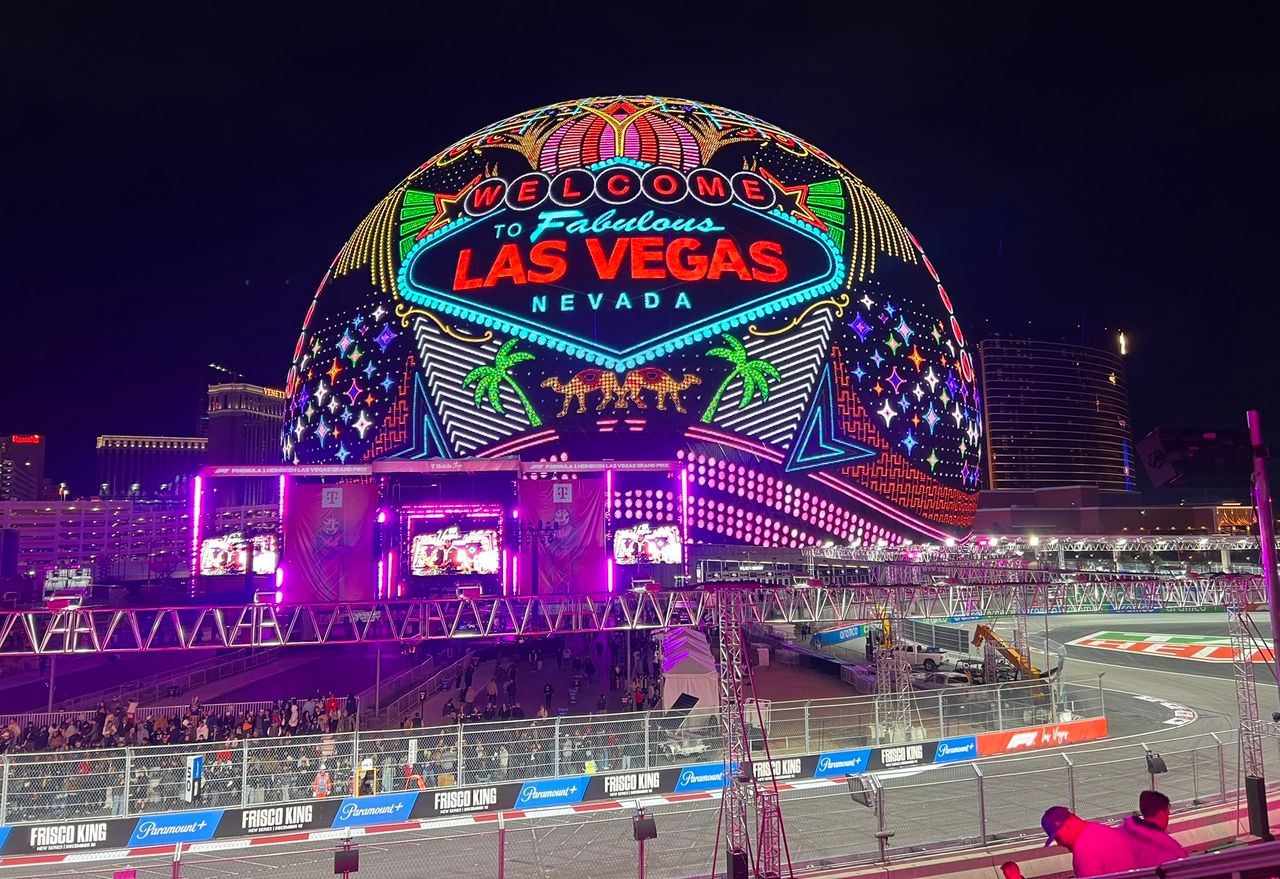
When Formula 1 returned to Las Vegas in 2023 to host one of its marquee annual races amid the glow of the city's neon lights, T-Mobile was one of the event's key brand partners. The operator placed bigger and bigger bets in the years that followed, to the point that its 5G network now serves as the event's connectivity backbone.
Heading into last Saturday's race – won by Red Bull Racing's Max Verstappen following a 50-lap contest that featured an F1-record 352 overtakes – T-Mobile's 5G network underpinned nearly all the operations of the Las Vegas Grand Prix. That included providing connectivity for the primary Apple TV live broadcast along with support for ticket scanning, point-of-sale transactions, security, crowd monitoring and transportation in and around the venue.
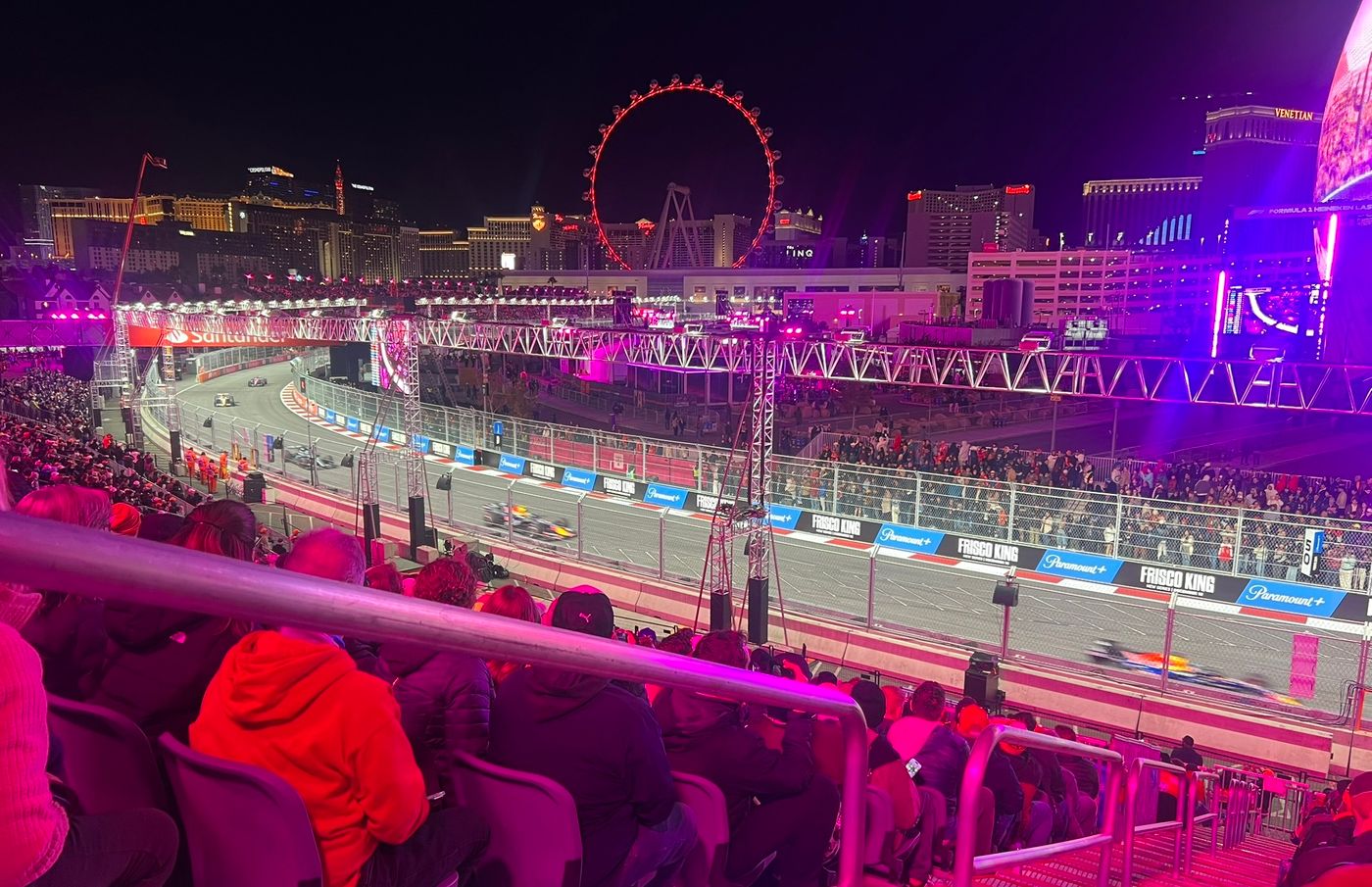
View of F1 Las Vegas Grand Prix 2026 from the grandstand. (Source: Jeff Baumgartner/Light Reading)
Rather than having to service those applications and use cases in distinct silos, T-Mobile used a mix of spectrum bands – including millimeter wave and C-band/midband – employing network slicing and a blend of both private and public connections to ensure that everything ran on the same underlying core wireless network.
T-Mobile took an evolutionary path to become the event's connectivity backbone, Grant Castle, SVP of RAN engineering and emerging technologies, told Light Reading. Early on, for example, the operator pitched in to help connect a few ticket scanners and point-of-sale terminals, but now it is the "default solution" for more than 500 ticket scanners and point-of-sales devices.
T-Mobile also carved out a network slice for those transactions. While they don't require much data, they need to be executed reliably and quickly, Castle explained.
Broadcast has to be 'sparkly perfect'
F1 has been "very willing" and "open" to giving T-Mobile the opportunity to do more each year, Castle said. (T-Mobile is the exclusive 5G partner for the Las Vegas race and provides similar support for the F1 US Grand Prix in Austin.) But he acknowledged that it took some time to sell F1 on the idea that T-Mobile's 5G network could handle the load for the primary live TV feed and provide the necessary connectivity for dozens of cameras placed around the track.
"The biggest, most difficult thing is broadcast TV," Castle said. "The quality has to be sparkly perfect. It has to be 100% reliable."
The use of network slicing played a big role in overcoming concerns about whether 5G could deliver broadcast-class performance, while also ensuring that T-Mobile could handle the full range of tasks without having to build two separate networks, according to Castle.
He said it's also become clear to everyone that running everything on a wireless network has some advantages over more traditional wireline connections, as it allows F1 to expand coverage to include drone shots from atop hotels in and around the Vegas Strip. It even allowed for iPhones equipped with broadcast-quality encoding software to provide creative, fan-level views that could be stitched into the primary live TV feed.
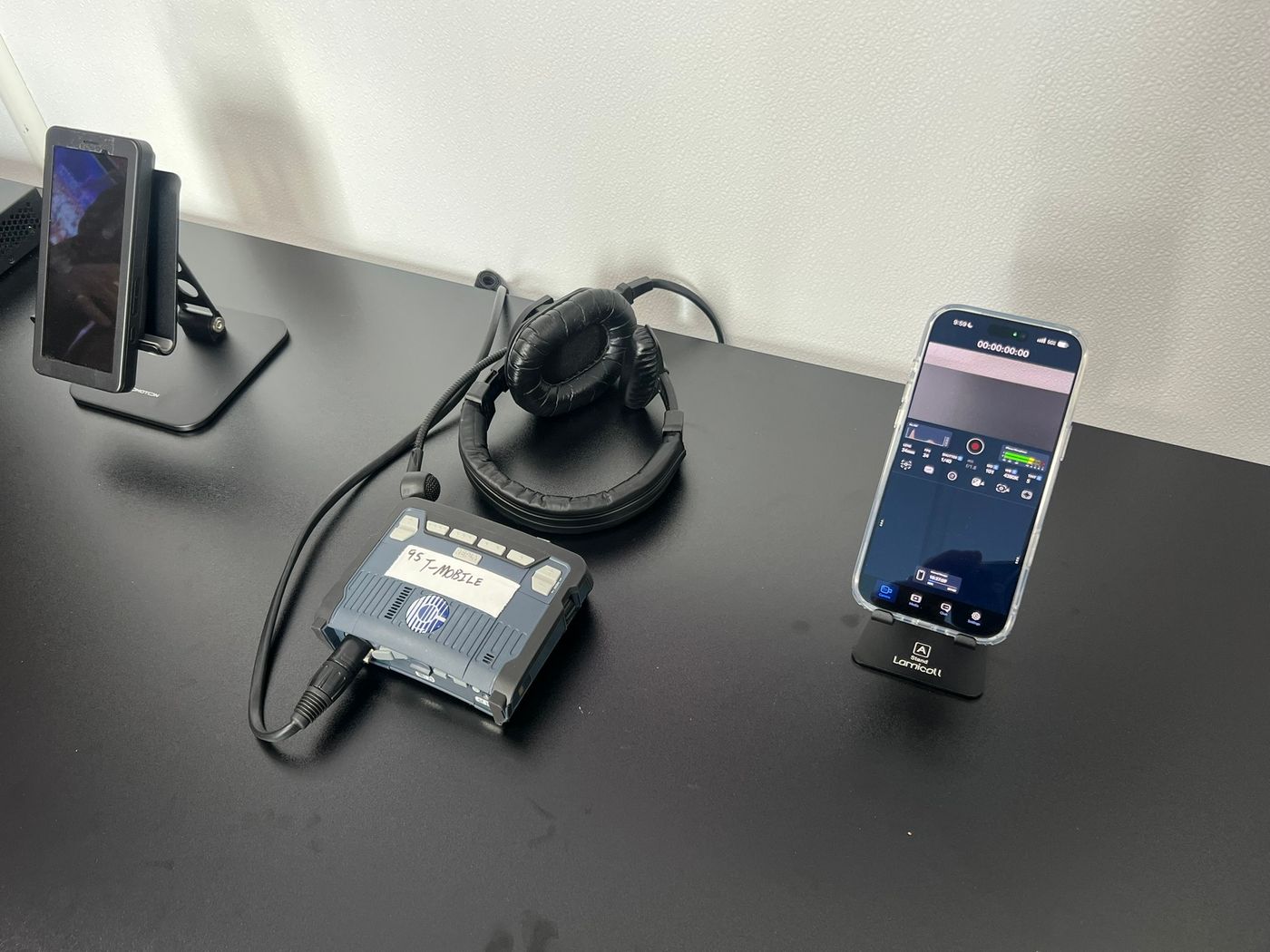
Example of an iPhone capable of delivering live feeds at the Las Vegas Grand Prix 2026 that was put into the hands of special F1 fans. (Source: Jeff Baumgartner/Light Reading)
"The quality of cameras and smartphones has gotten dramatically better," Castle said, noting that the 5G network supported the "big transfer" of data required to get that video into the production of the main TV feed. "They [the F1 fans] become the camera operator. You have this flexibility that they've never had before," he added.
Dean Locke, executive director of broadcast, media and race operations at Formula 1, noted during a pre-race panel discussion that the event itself has changed over the past five years. "I think it's up to us to capture that," he said. "If we just [placed] cameras at low level and it was all fence and track, then we haven't done a very good job."
Multiple bands, small cells and COWs
At the event, T-Mobile bulked up on both millimeter wave and C-band/midband connections. The operator doesn't deploy millimeter wave at every cell site on its national network but relies on the technology at large events that require high speeds delivered over relatively short distances.
"Millimeter wave's very helpful for dense, complex events like this," Castle said.
The use of multiple bands "really forms the basis of the networks that we build out here to power a lot of these experiences from a private network perspective," said Scott Jacka, distinguished member of the technical staff and senior director at T-Mobile, during a tech tour.
Alongside the deployment of small cells around the venue, T-Mobile also set up several temporary cell sites on wheels (COWs) to enhance public coverage.
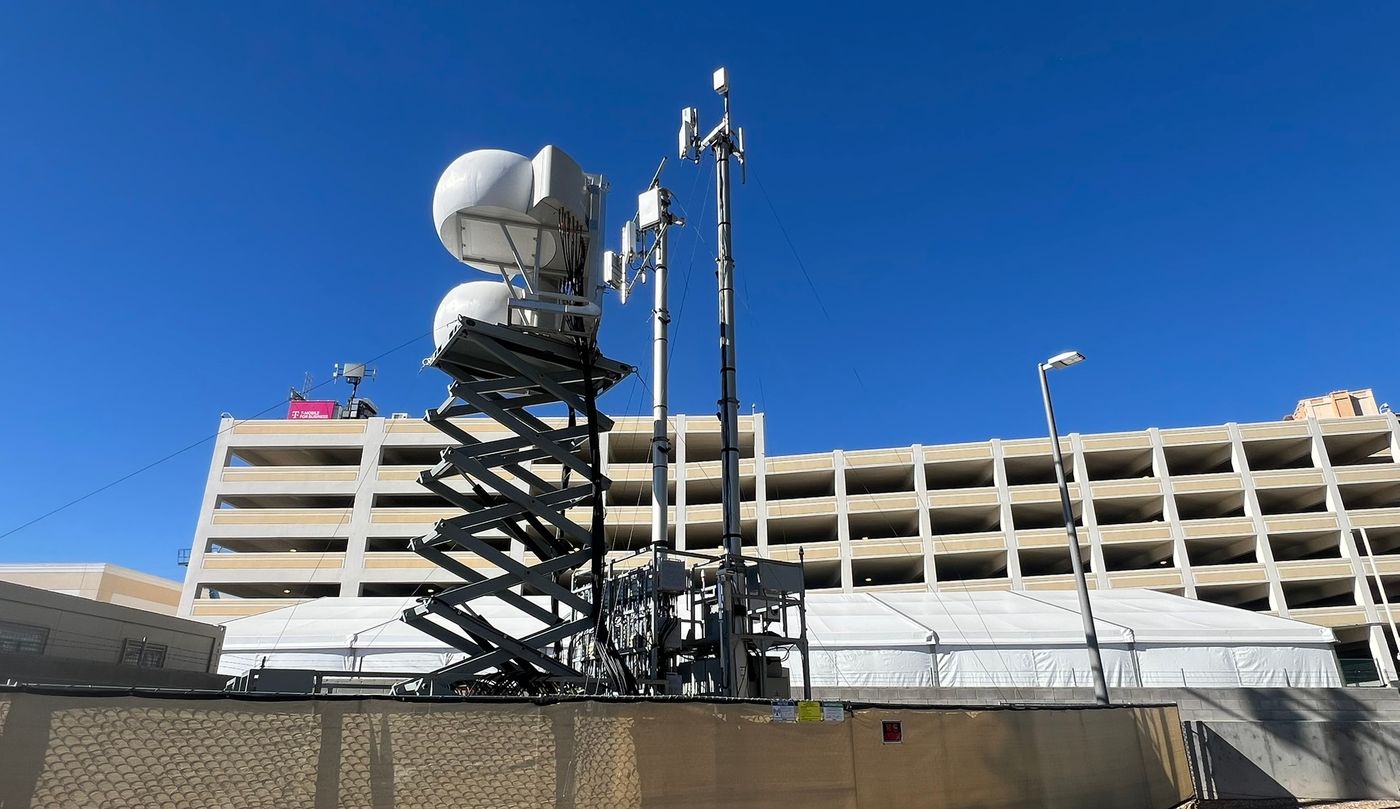
A cell on wheels T-Mobile deployed to support Las Vegas Grand Prix 2026. (Source: Jeff Baumgartner/Light Reading)
The overall production setup also included remote broadcast terminals equipped with cellular modules from companies such as LiveU and Haivision.
To assist with security, T-Mobile tapped into Wicket's facial authentication platform to track and determine who had access to certain facilities and who didn't. Those who registered their ID and likeness had the option and ability to walk through the facility without scanning their tickets, said Tommy Rose, a member of T-Mobile's sports and entertainment venues tech team.
T-Mobile also used its macro network to connect to 37 AI cameras provided by Queues to generate heatmaps that monitored and illustrated where people were congregating and send alerts when crowd sizes or line queues reached a certain threshold. For example, if an average line length reached eight minutes at a gate or concession, the system sent an alert for an adjustment, such as opening up an additional line.
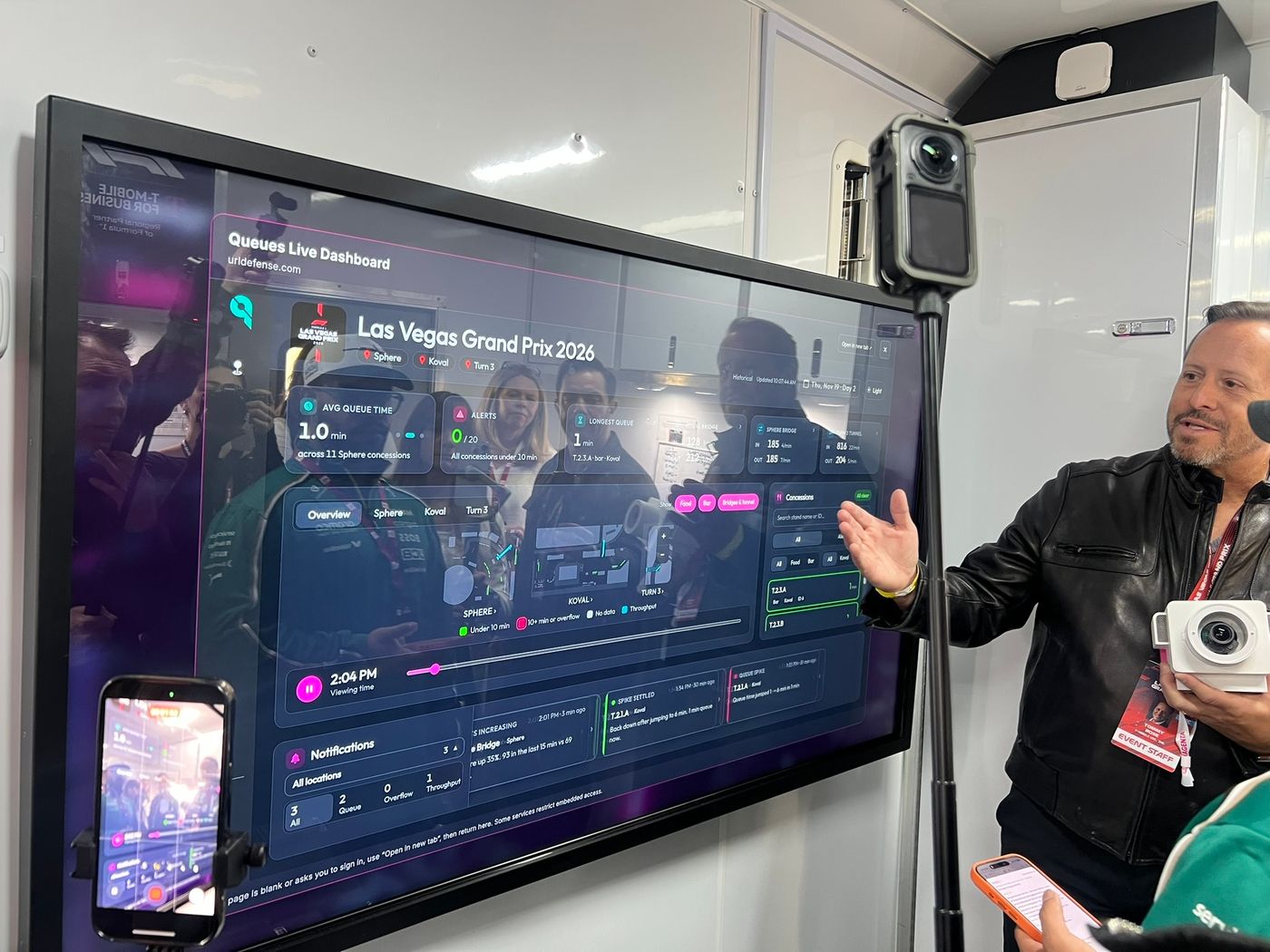
T-Mobile's Tommy Rose explains how AI cameras are being used to monitor crowds and allow for on-the-fly adjustments. (Source: Jeff Baumgartner/Light Reading)
The broader system also connected to Internet of Things (IoT) devices from WeTraQ to track and locate hundreds of shuttles (and their individual battery lives), and to make adjustments on the fly if more were needed to accommodate the crowd or if a vehicle needed a charge.
Physical AI and the road to 6G
At a recent event in Los Angeles touting T-Mobile's new "T-Mix" plans, André Almeida, T-Mobile's chief commercial officer, declared that "the robots aren't coming; they're already here."
And, in fact, a robot was present for a pre-race tech demonstration at "Club Magenta," a two-story trackside lounge with prime views of the circuit.
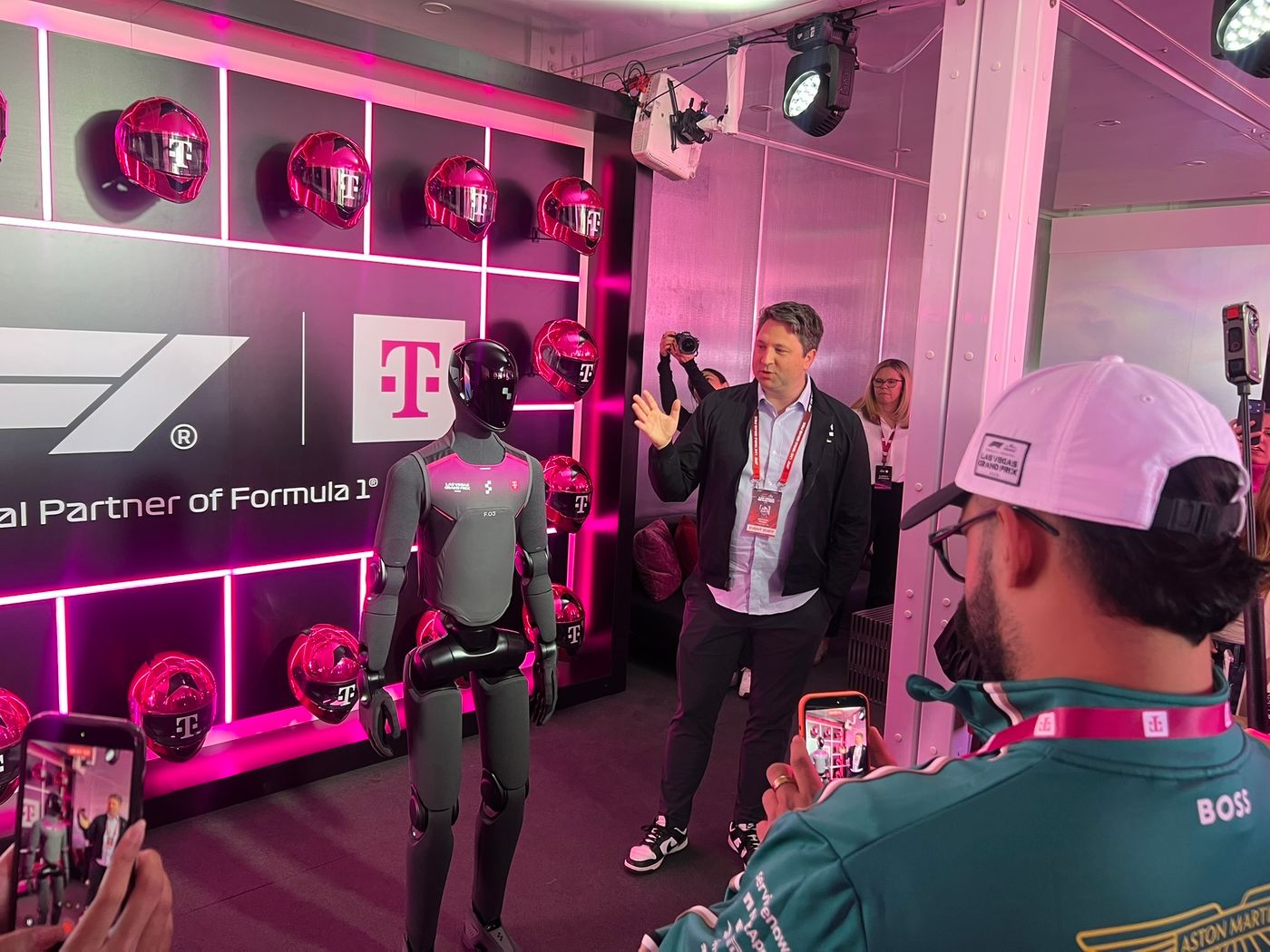
T-Mobile's Matthew Feider explains how a network slice supports the operation of Figure 03, a humanoid model from Figure AI. (Source: Jeff Baumgartner/Light Reading)
The demo centered on Figure 03, a five-foot, eight-inch general-purpose robot made by San Jose-based Figure AI, that was connected via a prioritized T-Mobile network slice to provide guaranteed levels of latency and reliability. The Figure 03 robot shown in the photo has a run-time battery life of about five hours.
While low latency is important, reliability is even more so because it's critical that packets not drop in physical AI use cases such as connected drones and autonomous vehicles, explained Matthew Feider, senior manager, physical and edge AI at T-Mobile.
Network slicing was used to connect the robots and other physical AI devices requiring a consistent, low-latency connection. Offloading some of that intelligence to the network is required to scale physical AI because the connected robots, cars and other devices can't be overwhelmed with massive batteries and on-board processing, said Castle. The system can "offload a chunk of intelligence to a [network] provider that can process these tokens, these AI decisions," he explained.
5G Advanced provides many of the tools needed to support physical AI use cases, Castle said, adding that 6G's AI-native capabilities and its ability to bulk up on upstream workloads will eventually pave the way forward.
"We think we can get pretty far with 5G Advanced. But it's clear to us that there are some key architectural changes that are going to be even better for physical AI," he said. "As we look forward and we see physical AI growing, we think 6G is going to be the ideal, long-term answer."
Editor's note: Light Reading attended the Las Vegas Grand Prix as a guest of T-Mobile, which helped offset lodging expenses.

-
 C114 Communication Network
-
 Communication Home
