
 Search


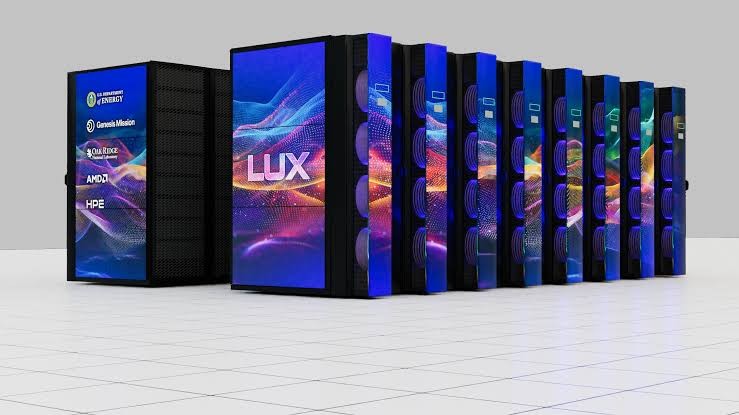
Lux Supercomputer
Oak Ridge National Laboratory (ORNL) opened its Lux supercomputer to users on Monday, Nov. 16, with half of the machine's 3.5 million node-hours a year reserved for paid access by public and private partners, with proprietary use under the Department of Energy (DOE) user-facility rate. A 175,000 node-hour minimum per six-month commitment means at most five minimum-size paying projects can share that half, by this publication's arithmetic.
AMD announced the opening on Monday, and HPE announced a No. 14 debut on the TOP500 list of the world's fastest supercomputers. That rank comes from a 64-bit benchmark, while Lux was built mainly for low-precision AI math, so the ranking and the machine's strengths point in different directions.
Paying Users Get Half of 3.5 Million Node-Hours at DOE Full-Cost Rates
Lux has 504 nodes with eight AMD Instinct MI355X GPUs each, or 4,032 GPUs, according to OLCF's Lux user guide. The Oak Ridge Leadership Computing Facility (OLCF) operates the system for DOE. The 3.5 million node-hours a year equal about 79% of what 504 nodes could deliver running every hour of a year, by this publication's calculation, so the allocation already assumes downtime and shared service nodes.
DOE's user-facility model charges proprietary users on a full cost recovery basis, while non-proprietary work is free if the results are published. The sources read for this article did not list a dollar rate per node-hour.
Who Can Afford 175,000 Node-Hours Per Six Months?
Lux charges per GPU, not per whole node: node-hours equal 0.125 times GPUs times hours. A 175,000 node-hour minimum is therefore 1.4 million GPU-hours, or about 347 hours (14.5 days) of the entire 504-node machine, by this publication's calculation.
Paid use is limited to organizations that can fill that block with GPU work for six months, such as a company training or fine-tuning a large model, or a consortium pooling budgets. By this publication's reading, a university lab running a few GPUs at a time would more likely use DOE's no-fee route for published, non-proprietary work or a Genesis Mission allocation.
OLCF Page Leaves Open Who Holds the Non-Genesis Half
OLCF's system page describes the non-Genesis half as paid access for partners. The same page says AMD will use these cycles for development and testing, and that a portion of the reserved time will be available to new partners.
Those are different arrangements. One is a public pool priced at the DOE rate; the other is a vendor-controlled allocation. Until OLCF publishes a split, the five-project ceiling is an upper bound, and fewer outside customers may fit.
Linpack Scores 64-Bit Math While Lux Peaks at 4-Bit: 181-to-1 Gap
The TOP500 ranks machines on High-Performance Linpack (HPL), which solves a dense linear system in 64-bit floating-point arithmetic, called FP64. HPE reports 220.79 petaflops for Lux. OLCF rates Lux at 40 exaflops peak in FP4, 20 exaflops in FP8 and 317 petaflops in FP64.
By this publication's calculation, the FP4 peak is 181 times the HPL result, and the HPL result reaches about 70% of the FP64 peak. The FP64 peak matches arithmetic from AMD's per-GPU specification: 4,032 GPUs at 78.6 teraflops each is about 317 petaflops. The No. 14 rank therefore describes Lux's simulation math, which is not its design target. By the same arithmetic, Lux's result is about 16% of Frontier's 1.353 exaflops, also at Oak Ridge.
The MI355X trades FP64 for low-precision throughput. Its FP64 vector rate of 78.6 teraflops sits about 4% below the prior MI300X's 81.7 teraflops, while its FP8 rate rose from about 2.6 petaflops to 5. A simulation code that depends on FP64 sees a small step back; an AI inference job running at FP4 sees a large step up. A mixed-precision benchmark result (HPL-MxP) for Lux was not found in the sources read.
ROCm and RCCL Shape Which Codes Run Well on MI355X
Lux runs AMD's ROCm software stack. Multi-GPU AI training depends on collective operations such as all-reduce, which AMD's RCCL library provides over xGMI inside a node and InfiniBand, RoCE or TCP/IP between nodes. Traditional simulation codes usually use the Message Passing Interface (MPI), a standard first released in 1994. OLCF's Lux documentation says MPI is not yet officially verified on the system, and recommends limiting MPI workloads to 16 nodes.
For a paying customer, that gap affects which codes can start on day one. AI workloads that already target ROCm and RCCL have a clearer path than MPI-heavy simulation codes.
Network, Storage and Scheduler Rules Constrain Job Design
OLCF describes one 400-gigabit Ultra Ethernet NIC per GPU, while HPE says Lux uses Juniper QFX switches supporting 800G Ethernet. AMD lists Pensando networking in the system. This publication's inference, not stated by any source read, is that both figures can be true at different layers: 4,032 400G NICs at the edge, and 800G switch ports split into 400G links.
Each node carries eight 3.2-terabyte NVMe drives, and jobs can reach Orion, OLCF's 679-petabyte Lustre file system, which purges files after 90 days. In the batch queue, Bin A covers 1-484 nodes for up to 48 hours per job. OLCF notes that some nodes run persistent services, so full-system jobs may be limited to fewer than 4,000 GPUs.
Moderate Security Applies Today; ITAR Tier Has No Date
Lux uses DOE Moderate controls today. OLCF plans to add Moderate-Enhanced controls, which it says would enable work under the International Traffic in Arms Regulations (ITAR) and protected health information support, but no date appeared in the sources read.
Security analysts have criticized Genesis Mission's architecture more broadly. Ian Lee of ShorePoint argued in Washington Technology that the security architecture was not designed for the connectivity the mission requires. The critique targets the mission, not Lux specifically.
Genesis Order Said Seek 270 Days; Lux Opened 87 Days After That Mark
Executive Order 14363, signed Nov. 24, 2025, directs DOE to seek to demonstrate initial operating capability of its Genesis Mission platform within 270 days. That mark fell on Aug. 21, 2026, by this publication's calculation, and Lux opened to users 87 days later. The order's text is a "seek to" directive subject to available appropriations, so the timing is not a missed deadline.
OLCF says half of Lux's node-hours serve Genesis Mission projects. AMD's release names three Genesis projects: AI-assisted design of a fusion power plant, AI-driven materials and advanced manufacturing work, and Earth system prediction for the Tennessee Valley. FedScoop reported in April that DOE's chief of staff said Genesis needs "a lot more" funding to meet its goals.
Discovery Arrives in 2028; AMD Powers 202 TOP500 Systems
Lux is the first of two AMD systems for ORNL. Discovery, slated for 2028, will use EPYC "Venice" CPUs and Instinct MI430X GPUs on an HPE Cray platform. Tom's Hardware reported a $1 billion deal between DOE and AMD covering both systems in October 2025. HPE made a $37 million in-kind investment in the Genesis Mission program.
AMD says its technology powers 202 systems on the November list, or 40.4% by this publication's calculation. The Next Platform said the 27 new entries marked lowest churn in the list's history and ranked Lux second among new machines behind KISTI's Hangang. SC26 continues through Friday, Nov. 20.
For a research team or company deciding whether to apply, the numbers set the terms: half the machine's hours are reserved for paid access at DOE rates, a 175,000 node-hour floor limits paying projects to five at most, the ranking reflects FP64 rather than AI strength, and MPI codes must wait for official verification. Ask OLCF for the current split of the non-Genesis half before building a budget around the five-project ceiling.
Frequently Asked Questions
Who can buy time on Lux?
OLCF reserves half of Lux's hours for paid access by public and private partners, with proprietary use at the DOE User Facility rate. Non-proprietary work is free if results are published under DOE's user-facility model.
How much does Lux time cost?
The sources read for this article give no dollar rate. They give a minimum of 175,000 node-hours per six-month commitment, which equals 1.4 million GPU-hours. Ask OLCF for a quote.
Why does Lux rank No. 14 if it peaks at 40 exaflops?
The TOP500 uses Linpack, which measures 64-bit math, and Lux's 40-exaflop figure is a 4-bit AI peak. HPE's 220.79-petaflop result is about 70% of OLCF's 317-petaflop FP64 peak. A mixed-precision result for Lux was not found.
Does AMD or the public get the non-Genesis half?
OLCF's system page says the half is reserved for paid access by partners, and also says AMD will use those cycles for development and testing and offer a portion to new partners. OLCF has not published a split between the two.

-
 C114 Communication Network
-
 Communication Home
