
 Search


Calmip.univ-toulouse.fr
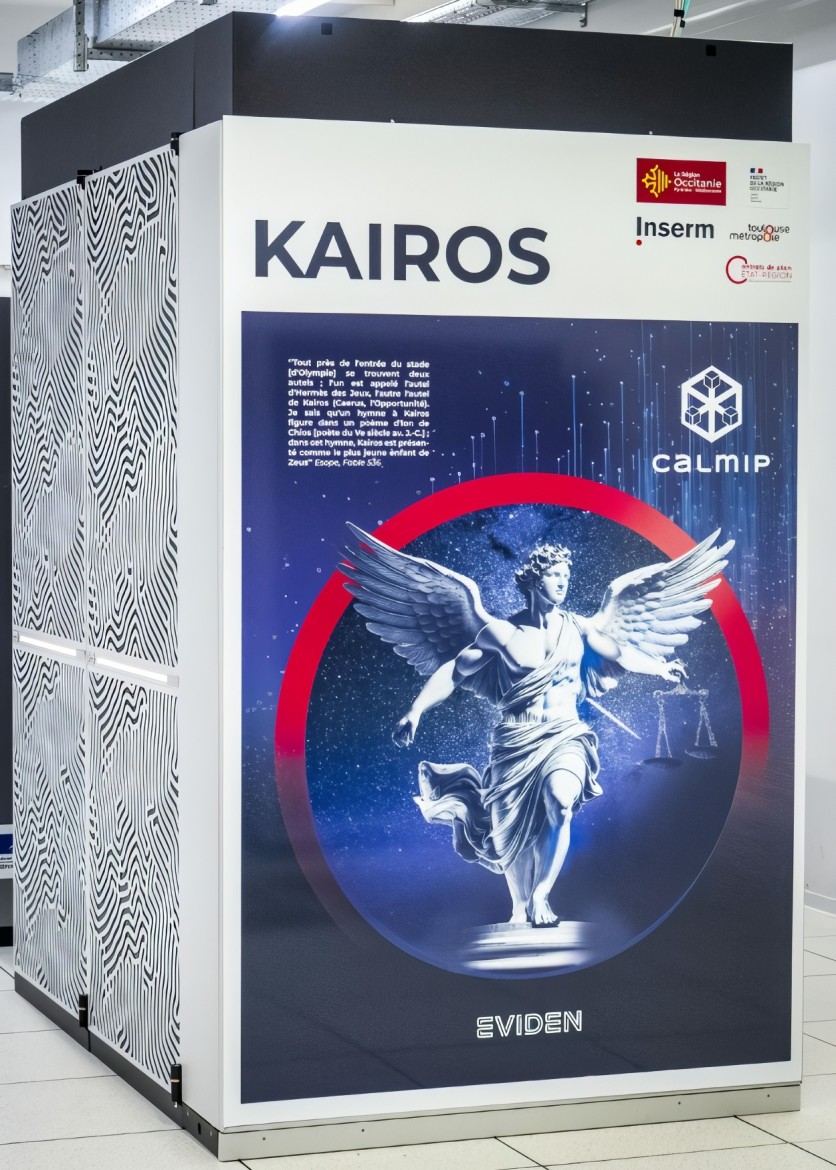
France's KAIROS supercomputer again ranks first on the Green500, scoring 73.28 gigaflops per watt on the list released Nov. 16 at the SC26 conference in Chicago, and the ten most efficient systems are the same machines in the same order as in November 2025. Eight of the ten run Nvidia GPUs from the Hopper generation, which Nvidia introduced in 2022, so the newest accelerators have not yet displaced them.
Anyone choosing hardware by efficiency rank should know what the list measures: only double-precision (FP64) Linpack, a workload on which Nvidia's newer chips have not meaningfully raised native speed. The freeze reflects a hardware generation and a benchmark definition, so it says little about efficiency gains on AI workloads, which the list does not measure.
Hopper-Generation Nvidia GPUs Fill Eight of Ten Efficiency Slots
Five of the top ten pair Nvidia's 72-core Grace CPU with a Hopper GPU in the GH200 Grace Hopper superchip, and three more use H100 GPUs with x86 CPUs. The gap from first place to tenth is 7.00 GFLOPS/W, about 10 percent.
| Rank | System | Country | GFLOPS/W | Hardware |
|---|---|---|---|---|
1 | KAIROS | France | 73.28 | Grace + GH200 |
2 | ROMEO-2025 | France | 70.91 | Grace + GH200 |
3 | Levante GPU | Germany | 69.43 | Grace + GH200 |
4 | Isambard-AI phase 1 | UK | 68.84 | Grace + GH200 |
5 | Otus (GPU only) | Germany | 68.18 | Epyc 9655 + H100 |
6 | Capella | Germany | 68.05 | Epyc 9334 + H100 |
7 | SSC-24 Energy Module | South Korea | 67.25 | Xeon 6430 + H100 |
8 | Helios GPU | Poland | 66.95 | Grace + GH200 |
9 | AMD Ouranos | France | 66.46 | Epyc + MI300A |
10 | Portage | United States | 66.28 | Epyc + MI300A |
Vendor tallies differ by counting method. AMD said its technology powers four of the ten most energy-efficient systems but did not name them. In the ComputerBase table, four systems use Epyc CPUs, and two of them, Ouranos and Portage, also use AMD's MI300A, an APU that puts 24 Zen 4 cores, 228 CDNA3 compute units and 128 GB of HBM3 memory in one package.
Why Does KAIROS Win Efficiency While Ranking 471st by Speed?
KAIROS, a 3.05-petaflop machine, ranks 471st on the Top500 released the same day, down from 420th in November 2025. Efficiency tends to decrease slightly as systems get larger, according to the Top500 organizers, and The Register attributes the pattern to interconnects that do not scale linearly. JUPITER Booster in Germany, a far larger machine, scored 63.3 GFLOPS/W in November 2025 and placed 14th. El Capitan, the largest US system, scored 60.94 in June.
Nvidia's GH200 links its Grace CPU and Hopper GPU with NVLink-C2C, which the company says provides 900 GB/s of coherent bandwidth, seven times PCIe Gen5. A single page table removes copies between CPU and GPU memory.
Poland's Helios shows efficiency and speed moving separately. It climbed from 96th to 53rd on the Top500 over the year while holding eighth place on the Green500 at 66.95 GFLOPS/W. Nine of the ten most efficient systems fell on the Top500 over the year; Helios was the only one to rise.
Green500 Scores FP64 Linpack Only, Which Nvidia's Newer Chips Did Not Meaningfully Speed Up
The Green500 divides a system's High-Performance Linpack result by the power drawn during the run. Nvidia's H100 and H200 deliver 34 teraflops of native FP64 vector math, according to a table compiled by HPCwire. Nvidia's published figures put the B200 at about 37 teraflops and the B300 at about 1.2, TechTimes has reported. Jack Dongarra said at SC25 that 64-bit performance had not improved from Hopper to Blackwell.
Nvidia's Rubin architecture sits near 33 teraflops of native FP64, slightly below Hopper. Nvidia's own tests show software emulation, the Ozaki scheme, lifting Rubin matrix multiplication to 175 teraflops, but the gain applies only to matrix math and independent accuracy testing on Rubin is missing. Glenn K. Lockwood's SC25 recap reports that Top500 rules do not allow Ozaki emulation inside Linpack's LU decomposition, so emulation would likely not raise Green500 scores.
Erich Strohmaier said in June that he believed the Green500 top ten had never before gone unchanged; Strohmaier is a Top500 co-founder. The November list extends the stall: the same top ten has now appeared on three consecutive lists, from November 2025 through November 2026.
Native FP64 Gains Wait for AMD's MI430X and Nvidia's Rubin HPC
Nvidia announced Rubin HPC at SC26 on Nov. 16, a GPU with more than 50,000 CUDA cores that it plans to make available in 2028; coverage of the announcement does not give its double-precision rate. Server makers plan to begin offering Nvidia Vera CPU racks in early 2027.
AMD is the nearer-term rival. It lists 288 teraflops of hardware FP64 for its Instinct MI430X, which it targets for first shipments in early 2027. AMD fellow Nicholas Malaya has said Ozaki emulation works best on well-conditioned problems such as Linpack and struggles on others, including materials science and combustion codes.
Europe Holds Eight of Ten Slots While Portage Is Only US Entry
Eight of the ten most efficient systems sit in Europe: three in France, three in Germany, and one each in the UK and Poland. Seven are in EU member states, and Isambard-AI is in the UK. South Korea's SSC-24 Energy Module is the lone Asian entry, and Portage is the only US system.
Turnover was low across the whole Top500. Only 27 systems, 5.4 percent of the list, were new, a record low, and the top ten by performance did not change. South Korea's Hangang supercomputer, inaugurated Nov. 2 with 8,496 GPUs that include Nvidia GH200 superchips, does not appear among the ten most efficient systems.
Readers weighing a procurement or an AI build-out should read the Green500 as a ranking of FP64 simulation efficiency. A sharp change in the list would likely need either a native-FP64 GPU such as AMD's MI430X, which is not due to ship until early 2027, or a rule change that admits emulation.
Frequently Asked Questions
What is the most energy-efficient supercomputer in the world?
France's KAIROS, which scored 73.28 GFLOPS/W on the November 2026 Green500, ahead of ROMEO-2025 at 70.91 and Levante GPU at 69.43.
Why has the Green500 top ten stopped changing?
The list scores FP64 Linpack, and Nvidia's native FP64 rate has not meaningfully risen from Hopper through Blackwell and Rubin, so newer GPUs add little on this benchmark, according to Dongarra's remark that 64-bit performance had not improved between generations. The stall reflects the benchmark and chip generations; the list does not measure AI workloads.
Does a high Green500 rank mean a system is efficient for AI?
Not necessarily. The Green500 measures FP64 Linpack, while AI training mostly uses lower-precision math that a separate benchmark, HPL-MxP, approximates.
When is the next Green500 list?
The next list is scheduled for ISC 2027 in Hamburg, set for June 7 to 11, 2027.

-
 C114 Communication Network
-
 Communication Home
