
 Search



(Source: Science Photo Library/Alamy Stock Photo)
In a bid to develop symmetrical broadband tiers that can better compete with PON, cable operators have been turning to "mid-split" and "high-split" upgrades that dedicate more spectrum to the upstream.
Those splits essentially bulk up the capacity of cable's relatively feeble legacy "low-split" upstreams, which (for North American DOCSIS) are limited to a range of 5MHz-45MHz. Mid-splits increase that range to 5MHz-85MHz and high-splits raise it to 5MHz-204MHz. If we're really getting ahead of ourselves, an ultra high-split (5MHz-684MHz, and potentially higher) might enter play.
It's well-known that Comcast is largely focused on mid-splits for its hybrid fiber/coax (HFC) network upgrades, while Spectrum/Charter is pushing ahead with a multi-phase HFC network plan focused on high-split upgrades.
So, are these splits doing what they're supposed to be doing? According to a new cable upstream-focused study from Ookla, it appears so.
Ookla found that median upload speed rose about eleven-fold, to about 223.60 Mbit/s in Spectrum's high-split markets, while upload speeds in legacy networks "barely moved." Here's how the median upload speeds moved higher on an operator-by-operator basis over the past three years:
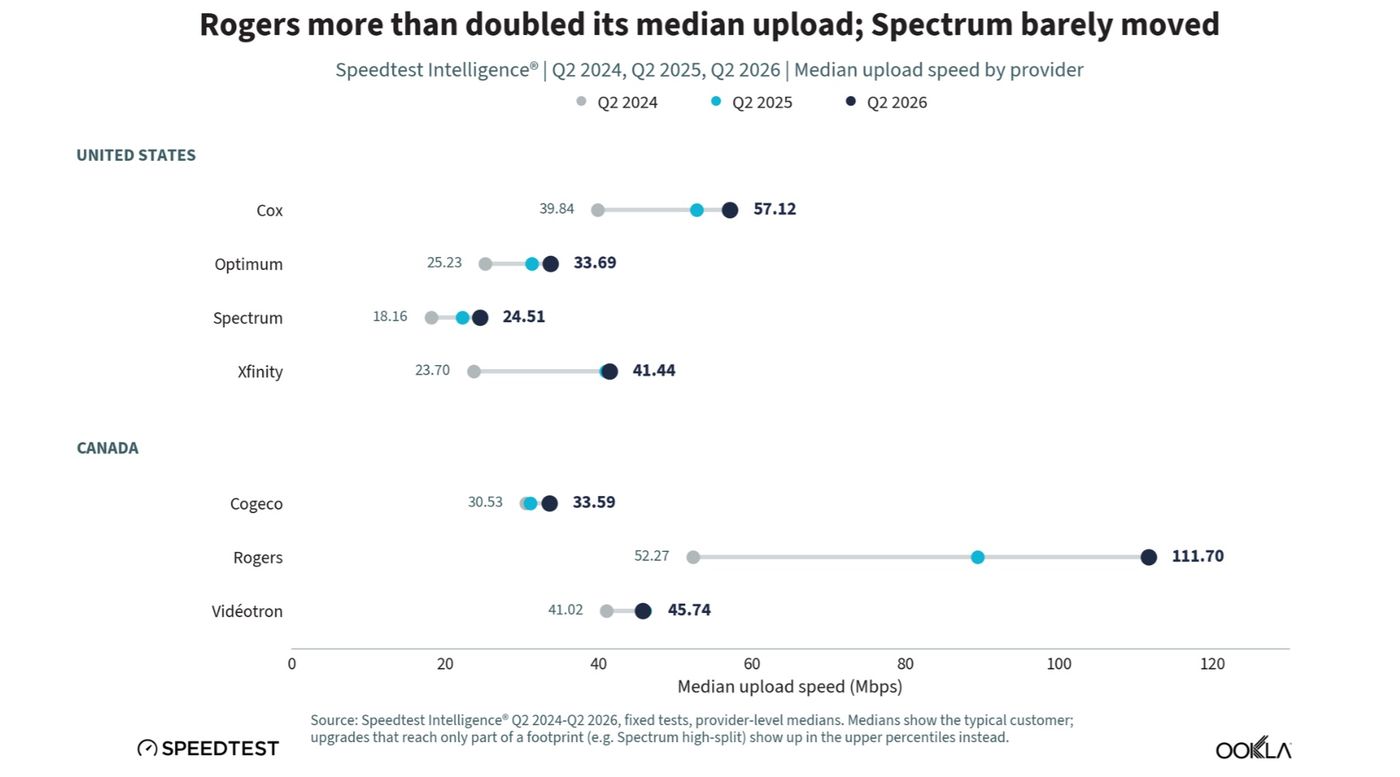
(Source: Ookla)
Ookla notes that its findings are based on Speedtest data of US and Canadian operators on a city-by-city basis taken during Q2 2024, Q2 2025 and Q2 2026. And the use of median speeds, it points out, is based on adoption of faster speed tiers rather than baseline network deployment. Depending on the speed tier in an upgraded market, customers might also require a new cable modem or gateway based on DOCSIS 3.1, DOCSIS 3.1+ or DOCSIS 4.0.
"Consumer adoption naturally follows deployment. However, until a split reaches enough of the footprint to be marketed nationally, promoting service plans and equipment that use the new capability may have to wait, resulting in slow early adoption," Ookla's Kerry Baker explained in the report.
But it fits with a broader trend that is seeing upstream speeds rise as cable operators move ahead with these split upgrades. OpenVault found in its Q2 2026 Broadband Insights report that average monthly DOCSIS upstream speeds reached 47.8%, up 33.7% year-over-year. And that's coinciding with more upstream data usage, which averaged 58.2 gigabytes per month, up 19.2% year-over-year.
Who's been doing the splits?
The report also took note of the pace of network upgrades, finding, for example, that Cox Communications (now part of Spectrum/Charter) led its peers with upgrades (via mid-splits, a few high-splits and some PON) with 77% of its cities upgraded as of Q2 2026, versus 13% for Charter (mostly high-splits). Per Ookla, Comcast upgrades (mostly mid-splits with some PON) reached 32% at the end of Q2 2026.
Rogers' east footprint acquired from Shaw Communications was 97% upgraded at the end of 2026 (via mid-splits and a smaller portion of high-splits), and 47% in its western markets (with mid-splits, PON and a sliver of high-splits).

-
 C114 Communication Network
-
 Communication Home
