
 Search


(Source: Kristoffer Tripplaar/Alamy Stock Photo)
With Verizon's fixed wireless access (FWA) subscriber growth reaching a new nadir in Q3, CEO Dan Schulman touted a fix of sorts yesterday by proclaiming that the company is unleashing a "breakthrough" that will enable Verizon to deliver 1-Gig speeds via millimeter wave spectrum to an incremental 10 million to 15 million US metro locations.
"Our 1,700MHz of millimeter wave spectrum has suddenly become a differentiated and competitive advantage" that complements Verizon's existing C-band spectrum, Schulman said on Monday's earnings call. "This is a technological breakthrough for us with significant positive implications."
He was somewhat vague on timing, noting that Verizon would be in position to implement this innovation in the "medium term," with initial rollouts getting underway in Q4 2026 and into 2027. Schulman said Verizon has conducted trials and has achieved some "operational success."
Signs point to MDUs and Starry's gigabit FWA tech
Missing from Schulman's assertion is what exactly this technical breakthrough is.
Verizon EVP and CFO Anthony Skiadas shed some light on it by pointing to the company's focus on the multiple-dwelling unit (MDU) market. "We are scaling our MDU program, which will enable us to deliver fiber-like speeds over an FWA connection," Skiadas said.
That certainly fits with Verizon's recent FWA priorities. In January 2025, Verizon began to tout a new FWA product tailored for MDUs. Months later, Verizon acquired Starry, a startup that developed a 1-Gig-capable mmWave FWA platform for MDUs and brought along coverage in parts of five markets and a batch of customers.
Industry analysts speculate that Starry's technology is some of the secret sauce that Verizon is blending into its revamped FWA strategy.
LightShed Partners analysts Walter Piecyk and Joe Galone, in a research note (registration required), said the breakthrough likely comes from a "new vendor that can consistently deliver a gigabit to every unit in a building. The prior one could not." They believe this fresh FWA-focused advantage will help to fuel Verizon's MDU initiative.
If MDU is indeed the focus of this initiative, it will take some time to get it up to speed. The LightShed analysts point out the MDU deployment process, which requires landlord approvals and a detailed installation process, runs at a slower pace than it does for FWA service to individual households.
"With its 10-15 million targeted locations predominantly in apartment buildings, securing access will be a key constraint on how quickly availability becomes revenue," they added.
New Street Research analyst David Barden also shared his thoughts on what is underpinning Verizon's purported game-changer based on recent industry conversations. He agrees that Verizon could be tapping into Starry's technology to beef up its FWA platform.
"Starry's point-to-multipoint architecture offers better propagation than a traditional wireless network," he explained in a research note (registration required). "We think most of what Dan spoke about today leverages Starry's technology developments."
Barden added that Verizon has been working on ways to improve its FWA product but "found it tough to replicate Starry's model without access to in-building wiring." He also suspects that new equipment, with possible advances in the antennas used for customer premises equipment, could be playing a role.
Verizon's FWA sub slump continues
Schulman's purported FWA breakthrough is also entering the frame as the pace of Verizon FWA subscriber growth reaches historic lows.
In Q3, Verizon added 159,000 FWA subs, down 39.1% from the 261,000 added in the year-ago period. That result also missed the 194,000 FWA sub gains expected by analysts. Verizon ended the quarter with 6.36 million FWA subs.
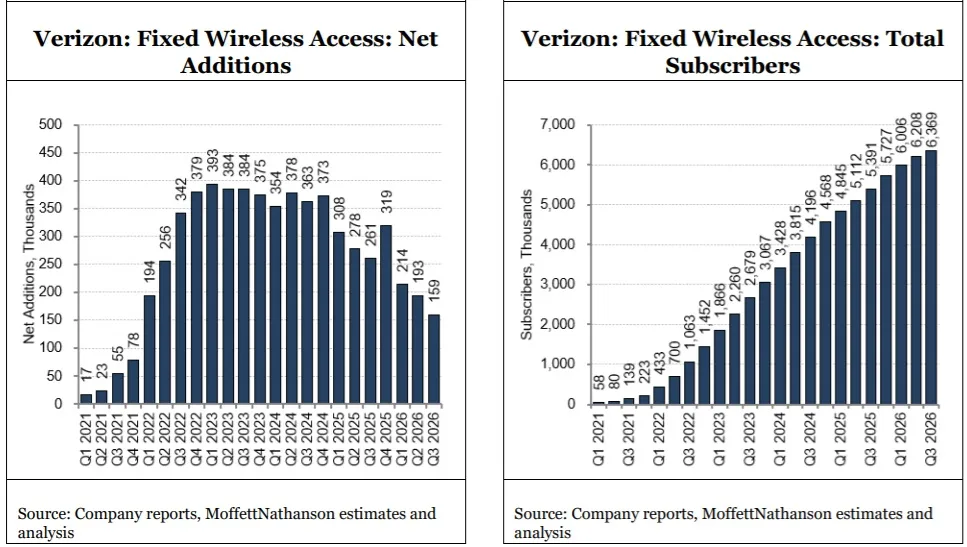
"The decline in FWA net adds was the largest on record and marks the twelfth straight quarter of lower net additions," MoffettNathanson analysts Craig Moffett and Julie Zhu said in a research note (registration required).
That slowdown appears to be partially by design as Verizon ramps up its FWA MDU initiative and looks to expand the reach of 1-Gig speeds using underutilized mmWave spectrum.
"If a customer needs a gig of speed and we can only offer them 300-Meg, we shouldn't sell the service. It's just going to be something that disappoints a customer," Schulman said. "And then the second implication was like we need a much wider footprint in which we can provide 1-Gig or more of speed."
The LightShed analysts argued the slowdown in FWA sales stems from the network "straining from the home broadband customers sharing capacity with mobile users."
Ookla: Verizon remains a mmWave champion
Based on recent network deployment, it's perhaps unsurprising that Verizon is again hanging its hat on mmWave technology.
Ookla highlighted some relatively recent mmWave 5G network deployment data in a report issued in April. Though recent 5G deployments have focused on midband spectrum, mmWave networks, which can deliver big speeds over short distances, "haven't disappeared," Mike Dano, lead industry analyst at Ookla and a former Light Reading editor, explained.
Ookla's RootMetrics testing in the second half of 2025 for urban and metro areas saw mmWave show up in 2.2% of Verizon's samples, versus 0.2% for AT&T and "almost 0%" for T-Mobile. While mmWave connections on Verizon networks appeared in 75 markets as of the first half of 2024 (out of 125 markets total), that jumped to 91 in the second half of 2025, Ookla found.
Ookla's data also found that download speeds delivered via mmWave reached speeds of 1 Gbit/s-plus in certain markets, citing Denver, Atlanta, Philadelphia and Boston as Verizon's top mmWave cities. Boston and Denver are former Starry markets, perhaps an indicator of the payoff Verizon is already seeing from the Starry acquisition.

-
 C114 Communication Network
-
 Communication Home
