
 Search


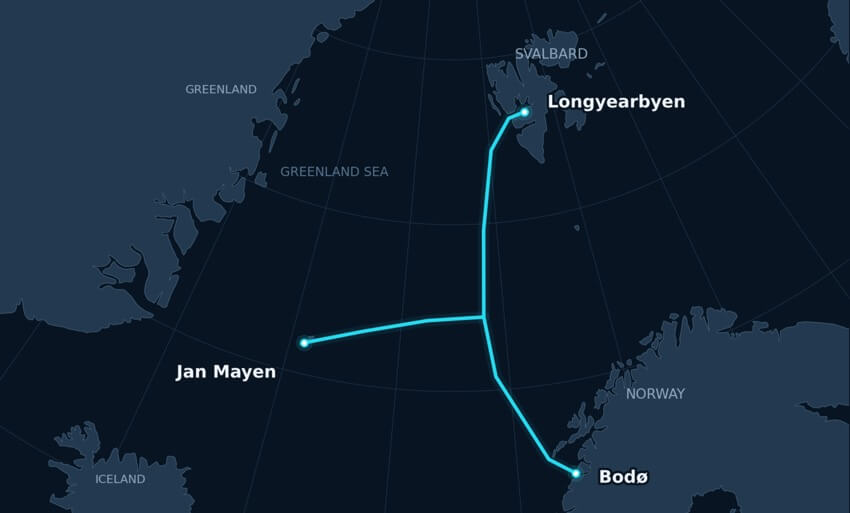
Space Norway selected Ciena to modernize its existing Svalbard subsea links and equip Arctic Way, the new cable system connecting mainland Norway, Jan Mayen and Svalbard. Announced October 13, the turnkey optical-networking contract combines upgrades to established infrastructure with preparations for Arctic Way’s planned entry into service in 2028.
The deployment includes Ciena’s 6500 Optical Platform, WaveLogic 6 Extreme coherent transponders, Spectrum Sharing and Navigator Network Control Suite. Ciena will provide network design and deployment services. The companies have not disclosed contract value, configured wavelength rates or total system capacity.
Arctic Way is a 2,350-km repeatered trunk-and-branch system with landings at Bodø, Jan Mayen and Longyearbyen, running entirely within the Arctic Circle between 67°N and 78°N. SubCom’s previously announced supply agreement covers survey, design, manufacturing and installation of the cable system. Space Norway intends to retain the two existing Svalbard cables as backup for as long as they remain functional.
| Arctic Way — Key Facts | |
| Route | • Bodø–Jan Mayen–Longyearbyen; 2,350 km. |
| Architecture | • Repeatered trunk-and-branch system, entirely within the Arctic Circle. |
| Optical systems | • Ciena 6500, WaveLogic 6 Extreme, Spectrum Sharing and Navigator NCS. |
| Service target | • Arctic Way: 2028; existing cables retained while functional. |
| Disclosures | • No contract value, route-specific line rate or total capacity announced. |
“Reliable connectivity is essential in the Arctic, where our infrastructure supports critical activities and demanding operational requirements,” said Pia Birgitte Bruhn, acting vice president of Cable Systems at Space Norway.
Analysis
The existing Svalbard connection comprises two approximately 1,400-km subsea cables linking Longyearbyen with mainland Norway via the Harstad–Andøya corridor. Operational since January 2004, the system was established primarily to transport satellite data received at SvalSat and now supports residents, businesses, public authorities and airport operations. Arctic Way will use a new mainland landing at Bodø and add a branch to Jan Mayen, extending fibre connectivity beyond the existing Svalbard arrangement.
The network has experienced confirmed physical damage. At 04:10 CET on January 7, 2022, one cable failed, leaving Svalbard dependent on the other connection. Space Norway identified an electrical shunt fault that interrupted power to some repeaters. Communications remained available, but full redundancy was lost until an alternative power-feed arrangement restored it on January 18. The operator’s subsequent annual report states that the cable was fully repaired in 2023.
The circumstances prompted a police investigation and public speculation about sabotage. Norwegian reporting identified repeated crossings by the Russian trawler Melkart 5 near the damaged section; investigators also examined seabed marks consistent with fishing gear. However, the case was closed for insufficient evidence, and intentional sabotage was not established. The defensible description is an unexplained cable-damage incident investigated as possible human interference, without proven responsibility or intent.
There is also a more recent, separate security development. On September 10, 2026, Reuters reported, citing two Western officials, that British, Norwegian and U.S. forces had disrupted a Russian GUGI subsea exercise near Svalbard earlier that spring. The officials said no cables were damaged. Norway’s Defence Ministry had publicly confirmed Russian GUGI activity and an allied monitoring operation in April, warning of capabilities to map and potentially sabotage critical undersea infrastructure. That reporting does not establish who caused the 2022 damage.
These events make continuity of service a concrete engineering requirement. Two functioning cables preserved connectivity in 2022, while a power-feed workaround restored redundancy before permanent repair. The existing system’s estimated technical lifetime ends in 2028; continued operation beyond that date is possible but not assured. Arctic Way’s planned 2028 launch therefore addresses asset renewal and additional connectivity, while usable older links can provide backup.
Ciena’s terminal equipment and network-control software address optical transmission and operations. They do not by themselves protect submerged infrastructure from physical damage or guarantee a longer wet-plant lifetime. WaveLogic 6 Extreme’s maximum 1.6 Tbps product capability should also remain separate from this deployment: no Arctic Way-specific wavelength rate or total capacity was announced. The practical significance is a transition to new infrastructure with continued use of functional legacy cables.
| Company Profiles — Space Norway and Ciena | |
| Space Norway | Norwegian state-owned operator of satellite, teleport, fibre and subsea communications infrastructure. |
| Headquarters | Oslo, Norway |
| CEO | Morten Tengs |
| Owner | Norwegian Ministry of Trade, Industry and Fisheries |
| Core coverage | Arctic connectivity • subsea cables • satellite infrastructure • government and commercial communications |
| Ciena | NYSE: CIEN; networking systems, coherent optics, automation software and services. |
| President & CEO | Gary B. Smith |
| Project role | 6500 optical platform, WaveLogic 6 Extreme, Spectrum Sharing and Navigator NCS. |

-
 C114 Communication Network
-
 Communication Home
